
Affiliate disclosure: some links on this page go to Amazon. If you buy through one we may earn a small commission, at no extra cost to you. Full disclosure.
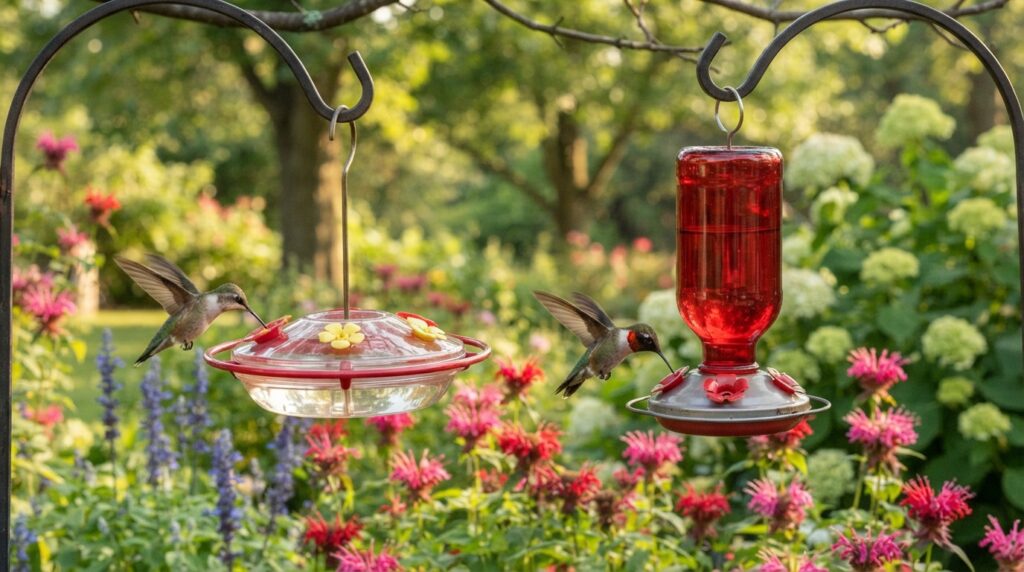
Buy a saucer-style feeder that comes apart completely, has no yellow parts, and fits in a dishwasher. Cleaning frequency is the thing that decides whether hummingbird feeding works, so buy for how easily it cleans rather than how much it holds. Two small feeders beat one large one, because of how territorial hummingbirds are.
Hummingbird feeders get bought on looks and regretted on maintenance. In hot weather this feeder needs emptying, scrubbing and refilling every two days. A design that takes ten minutes to clean does not survive that schedule — it ends up half-full of fermented nectar in August, which is worse than having no feeder at all.
So the criteria below are weighted heavily toward cleaning. That is not fussiness; it is the actual constraint.
Buying criteria, in order
- Comes apart completely — every surface reachable by a brush
- Dishwasher safe — check the manufacturer’s specification, not the marketing
- No yellow parts — yellow attracts wasps
- Built-in ant moat, or a hanger that takes one
- Perches — birds feed more comfortably perched than hovering
- Small capacity — genuinely a feature, not a compromise
Saucer vs bottle
The fundamental design choice, and it is not close.
| Saucer (dish) | Inverted bottle | |
|---|---|---|
| How it works | Nectar sits in a shallow dish; birds feed down through ports in the lid | A reservoir inverts over a base; vacuum holds nectar at the ports |
| Cleaning | Two parts, both open. Very quick | More parts, narrow neck, harder to reach inside |
| Dripping | Does not drip — nectar is below the ports | Drips as temperature changes expand the air inside |
| Wasps and bees | Better — nectar sits below insect reach but within a hummingbird’s tongue | Worse — nectar sits right at the port |
| Capacity | Smaller | Larger |
| Seeing the level | Harder | Easy |
Bottle feeders win on capacity and on being able to see the level at a glance. Both advantages evaporate once you accept that the nectar needs replacing every two to three days anyway — at which point a big reservoir just means throwing more away.
The honest drawback of saucer designs: because the nectar level is hidden, it is easier to let one run dry without noticing, and small capacity means more frequent refills in a busy yard. Some saucer feeders also have shallow ports that let rain in, diluting the nectar, so a design with some overhang is worth looking for.
Why no yellow
Wasps and bees are strongly drawn to yellow. A great many feeders are sold with bright yellow plastic flowers around the ports, which is a decision made for the shelf rather than the yard.
If you already have a feeder with yellow parts and a wasp problem, some models let you swap the flower inserts for red ones. Otherwise it is a reason to replace it.
Ant moats
A small cup of water above the feeder that ants cannot cross. Completely effective, cheap, and the single best accessory for a hummingbird feeder.
Some feeders build one in; otherwise they are sold separately and clip between the hanger and the feeder. Keep it topped up, since it evaporates in exactly the weather when ants are worst.
Never use oil, grease or sticky barriers on the hanger, the pole or around the ports to deter ants or bees. It transfers to feathers and destroys their insulating and waterproofing properties, which can be fatal. Cornell Lab is explicit about this. A water moat does the same job with no risk.
Bee guards
Small plastic cages fitted over the ports, letting a hummingbird’s tongue through but blocking insects.
They work reasonably well, with two caveats. They add fiddly parts to clean, which works against the main criterion. And a saucer feeder often solves the problem without them, because the nectar already sits out of insect reach.
Perches
Hummingbirds hover beautifully and would rather not. Given a perch they will sit and feed, which uses far less energy and gives you a considerably better view.
Some feeders omit perches deliberately, on the theory that hovering birds move on faster and reduce territorial monopolizing. In practice the better answer to territorial behavior is a second feeder out of sight of the first.
Capacity: smaller is better
This runs against instinct, so it is worth spelling out.
Nectar needs changing every two to three days in warm weather regardless of how much is left. A large feeder in a quiet yard means discarding most of a full reservoir every change — wasteful, and it makes people quietly stretch the schedule, which is where mold problems start.
An 8 to 12 ounce feeder suits most yards. If you are genuinely getting through it, that is an argument for a second feeder, not a bigger one — and a second feeder helps with territorial birds too.
Winter feeders
Relevant on the Pacific coast, where Anna’s Hummingbirds are increasingly year-round residents, and in parts of the Southeast where individual birds overwinter.
Nectar freezes at around 27°F. Options are rotating two feeders so one is always thawed indoors, wrapping the reservoir, or a purpose-built heated feeder. Check with a local Audubon chapter about whether overwintering birds are normal in your area before committing to it.
Common questions
Are saucer feeders better than bottle feeders?
For most people, yes. They come apart more easily, do not drip, and hold nectar below the reach of wasps. Bottle feeders hold more and let you see the level, which matters less than it sounds given how often nectar has to be replaced anyway.
Why does my hummingbird feeder drip?
Inverted bottle feeders drip as the air inside warms and expands, pushing nectar out. It is inherent to the design and is one of the main reasons to prefer a saucer. Moving the feeder out of direct sun reduces it.
How do I keep ants off the feeder?
An ant moat — a small water-filled cup above the feeder. Never use oil, grease or sticky substances, which get onto feathers and can be fatal.
What size feeder should I buy?
Smaller than you think. 8 to 12 ounces suits most yards. Nectar needs changing every two to three days in warm weather regardless of the level, so a large reservoir mostly means throwing more away.
Are glass or plastic feeders better?
Glass does not stain or scratch, and scratches are where mold takes hold, so it stays cleaner over time. Plastic is lighter and less breakable. Either works — the question that matters is whether it comes apart fully.
Do I need bee guards?
Often not, if you buy a saucer feeder with no yellow parts. The nectar already sits below insect reach. Bee guards add parts to clean, which works against the thing that matters most.
Related guides
- Hummingbird nectar recipe
- How to attract hummingbirds
- When to put out and take down hummingbird feeders
- Why hummingbirds aren’t coming
Sources: Cornell Lab of Ornithology, All About Birds hummingbird feeder guidance including warnings on oils and sticky substances near feeders; Project FeederWatch, Feeding Birds; National Audubon Society; manufacturer specifications from Aspects, Perky-Pet, First Nature, Droll Yankees and More Birds.
Setting up for hummingbirds?
A saucer feeder that dismantles fully is easier to keep clean than a larger bottle feeder, and cleaning matters far more than capacity. Look for no yellow parts, which draw wasps.
This link goes to Amazon. If you buy through it we may earn a small commission, at no extra cost to you.