
Affiliate disclosure: some links on this page go to Amazon. If you buy through one we may earn a small commission, at no extra cost to you. Full disclosure.
Put out a clean feeder with a 4:1 water-to-sugar mix before the first birds arrive in your region, and plant native tubular flowers so there is something to hold them there once they have found you. If you get one dominant bird chasing everything else away, add a second feeder out of sight of the first — that single change does more than anything else on this page.
Hummingbirds are the one category of American bird feeding with no British equivalent at all, and they reward the effort more than almost anything else in a yard. They are also easier to attract than people expect, provided two things are true: the food is clean, and the setup accounts for how aggressively territorial they are.
The essentials
- 4 parts water to 1 part plain white sugar. Nothing else, ever
- Put the feeder out early — before the first arrivals for your region
- Two small feeders beat one large one, placed out of sight of each other
- Native tubular flowers hold birds in a way a feeder alone does not
- Cleanliness is the whole game. Spoiled nectar is the commonest reason they stop coming
- Some shade keeps nectar fresh considerably longer
Which species you can expect
| Species | Where | Notes |
|---|---|---|
| Ruby-throated Hummingbird | East of the Great Plains | The only breeding species in most of the East |
| Anna’s Hummingbird | Pacific coast | Increasingly year-round resident, including in winter |
| Rufous Hummingbird | Northwest, migrating widely | Extremely aggressive for its size |
| Black-chinned Hummingbird | Southwest and West | Common at western feeders |
| Broad-tailed Hummingbird | Rocky Mountains | Wings make a distinctive trill |
| Allen’s Hummingbird | Coastal California | Very similar to Rufous |
| Calliope Hummingbird | Northwest mountains | Smallest bird in North America |
The eastern picture is simple: if you are east of the Plains in summer, it is almost certainly a Ruby-throated. The West is genuinely complicated, with several species overlapping and Rufous passing through on a long looping migration. eBird will show you what has actually been reported near you this week.
The feeder
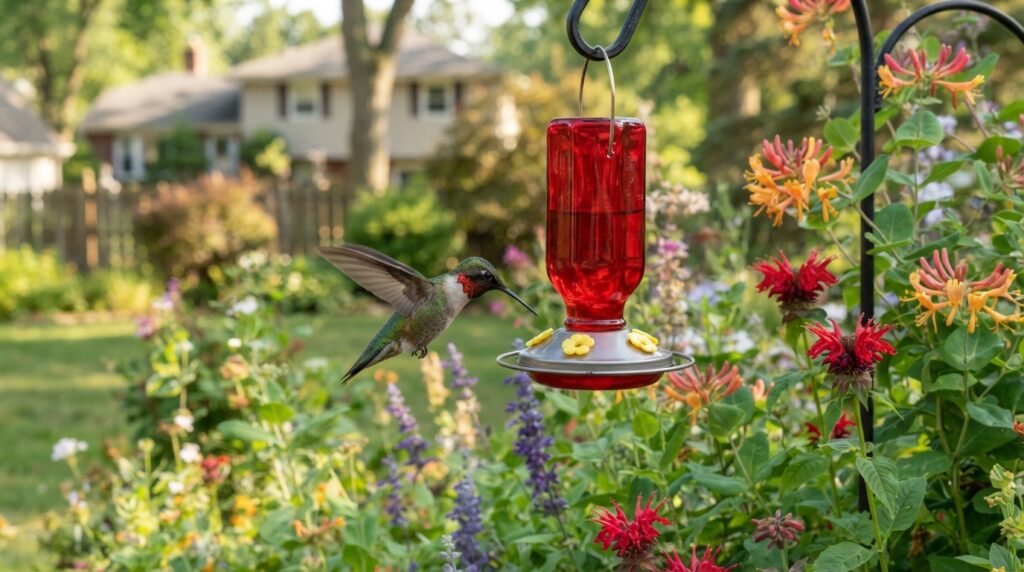
Hummingbirds find feeders by sight, and red is the color that works — which is why feeders have red parts. That is all the red you need. The nectar itself must never be dyed.
Placement. Somewhere you can see it, with partial shade if possible. Full sun spoils nectar much faster, which turns a pleasant hobby into a chore in July. A perch nearby matters more than people assume: hummingbirds spend most of the day perched, not hovering, and a feeder within sight of a thin branch gets used more.
Height is flexible. Anywhere from about four to six feet is convenient for refilling, which is the real constraint given how often you will be doing it.
Saucer-style feeders — where the nectar sits in a shallow dish below the ports rather than in an inverted bottle — are easier to take apart, easier to clean and do not drip. Given that you will be cleaning this thing every few days all summer, that matters more than capacity. The drawback: they hold less, so in a busy yard they need refilling more often. Full comparison in choosing a hummingbird feeder.
The territorial problem
Hummingbirds defend food sources aggressively. A single dominant male will often claim a feeder and spend his day chasing every other bird away from it — which means one feeder in a yard can end up serving exactly one bird.
The fix is multiple feeders placed out of sight of one another. Around a corner of the house, on opposite sides of a shrub, at different heights. A bird cannot defend what he cannot see, and the territory breaks down. Two cheap feeders in the right places beat one expensive feeder every time.
This is the single most useful thing in this article, and it is the change most people make last.
Plant for them
Feeders bring hummingbirds in. Flowers keep them there, and provide the small insects and spiders that actually make up much of their protein intake — nectar is fuel, not diet.
What they respond to is shape rather than color: long tubular flowers that a short-billed insect cannot easily rob.
| Region | Native plants worth starting with |
|---|---|
| East and Southeast | Trumpet honeysuckle, cardinal flower, bee balm, columbine, jewelweed, coral bells |
| Midwest | Bee balm, cardinal flower, wild columbine, royal catchfly |
| Southwest | Chuparosa, ocotillo, penstemon, desert willow, agave |
| West and Pacific Northwest | Red-flowering currant, western columbine, penstemon, California fuchsia |
Two practical notes. Native plants outperform ornamental hybrids, which are often bred for appearance at the expense of nectar. And avoid using pesticides anywhere near them — hummingbirds eat a great many small insects, and neonicotinoids in particular are a problem for the invertebrates they depend on.
Water
Hummingbirds rarely use a conventional bird bath — it is too deep and too still. What they do use is moving water in a very shallow film: a mister, a dripper, or a fountain with a flat rock in it. A mister aimed through foliage is a reliable way to see them bathing, which is worth setting up for its own sake.
Common questions
How long does it take hummingbirds to find a new feeder?
Anywhere from a day to a few weeks. They locate food visually while moving through, so a feeder that is easy to see from above is found faster. Planting something they already visit nearby helps considerably.
How many feeders should I put out?
At least two if you have any interest in seeing more than one bird. Place them out of sight of each other so no single bird can defend both.
Do I need to plant flowers as well?
Not to attract them, but it makes a real difference to whether they stay. Flowers also support the small insects that provide most of their protein — nectar alone is not a complete diet.
Should the feeder be in sun or shade?
Partial shade. Nectar in full sun spoils noticeably faster, which means more frequent changes and a higher risk of the birds finding it fermented before you do.
Will hummingbirds use a regular bird bath?
Rarely. They prefer very shallow moving water — a mister, dripper or fountain. A conventional bath is too deep for them.
Do hummingbirds only visit red flowers?
No. Red draws their attention, but shape matters more — long tubular flowers in any color get visited. Feeder manufacturers use red for the same reason, which is why the feeder needs red parts and the nectar does not.
Related guides
- Hummingbird nectar recipe
- Best hummingbird feeders
- When to put out and take down hummingbird feeders
- Why hummingbirds aren’t coming to your feeder
Sources: Cornell Lab of Ornithology, All About Birds hummingbird species accounts and feeding guidance; Project FeederWatch; National Audubon Society native plants database and hummingbird guidance; US Fish & Wildlife Service; eBird range and abundance data.
Setting up for hummingbirds?
A saucer feeder that dismantles fully is easier to keep clean than a larger bottle feeder, and cleaning matters far more than capacity. Look for no yellow parts, which draw wasps.
This link goes to Amazon. If you buy through it we may earn a small commission, at no extra cost to you.