
Affiliate disclosure: some links on this page go to Amazon. If you buy through one we may earn a small commission, at no extra cost to you. Full disclosure.
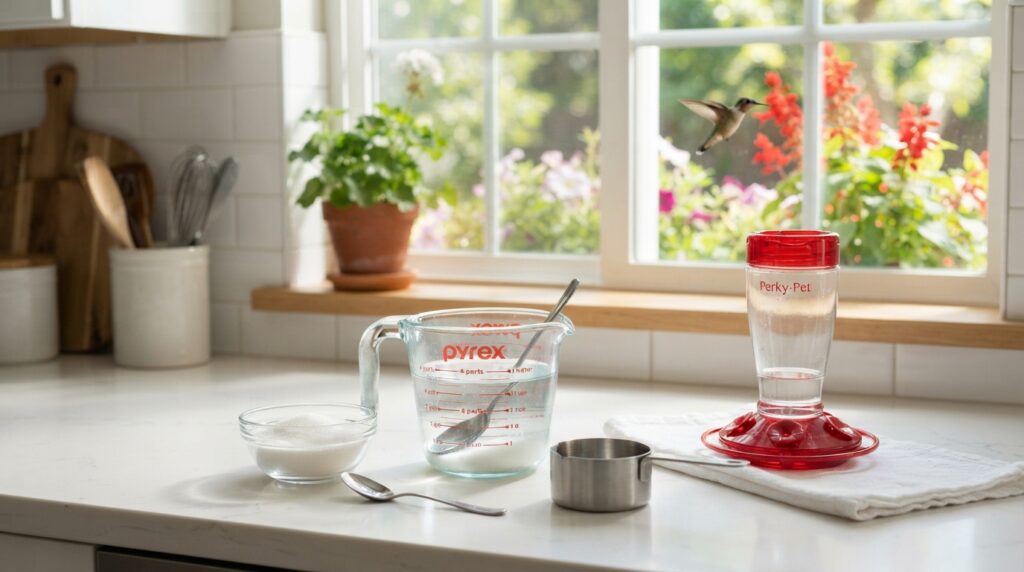
Four parts water to one part plain white granulated sugar. One cup of water to a quarter cup of sugar. Stir until dissolved — boiling is optional. No red dye, no honey, no brown sugar, no raw or organic sugar, no artificial sweetener. Change it every three to five days in mild weather, and every two days above 90°F.
This is the shortest recipe on the internet and the one people most often get wrong, usually by adding something. The whole thing is sugar and water in the right proportion, and every optional extra makes it worse.
The recipe
- 1 cup water : ¼ cup plain white sugar — a 4:1 ratio by volume
- Stir until fully dissolved. Warm water makes it quicker
- Cool to room temperature before filling the feeder
- Extra keeps in the fridge for up to about two weeks
- Nothing else goes in. No exceptions
Why 4:1
It approximates the sucrose concentration of the flower nectar hummingbirds evolved on — roughly 20 to 25 percent sugar in the plants they favor. That is the concentration their digestive systems handle efficiently.
Sweeter is not better. A heavier mix is thicker, harder to feed on, and places extra load on a very small bird’s kidneys, which have to process a large water intake relative to body size. Weaker is not better either — it provides less energy per visit, and in cold snaps or during migration that matters.
Stick to 4:1. Some sources suggest a slightly richer 3:1 mix in cold weather or during migration; it is not necessary, and 4:1 is the ratio recommended by Cornell Lab and the National Audubon Society year-round.
Do you need to boil it?
No, and this is the one point where reasonable people give different advice.
Boiling does two things: it dissolves the sugar faster, and it briefly reduces microbes in the water. It does not make the nectar last meaningfully longer in the feeder, because the moment a hummingbird’s bill goes in, bacteria and yeast go in with it.
If your tap water is safe to drink, cold or warm tap water and a good stir is fine. If you prefer to boil, cool it completely before filling — hot liquid can warp a plastic feeder.
What never to add
| Do not use | Why |
|---|---|
| Red dye | Serves no purpose — the feeder’s red parts do the attracting. There is no established safe level for hummingbirds, and given the volume a bird processes daily relative to its body weight, there is no good reason to take the risk |
| Honey | Ferments rapidly and promotes a fungal infection of the tongue and bill that is fatal. This is the most dangerous substitution of the lot |
| Brown, raw, turbinado or organic sugar | Contain iron and molasses. Hummingbirds are poor at excreting iron and it accumulates |
| Artificial sweeteners | Provide no calories at all. A hummingbird can starve while drinking them |
| Fruit juice or fruit | Ferments quickly and attracts wasps and ants |
| Molasses, corn syrup, agave | Wrong sugar composition, ferment faster |
On honey specifically. It is the most common “natural is better” substitution and the most harmful one. Honey diluted in water ferments far faster than sucrose solution and supports fungal growth linked to a fatal infection of the tongue and bill. Plain white sugar is closer to flower nectar than honey is.
How often to change it
This is where most hummingbird feeding actually goes wrong. Sugar water ferments and grows mold, and the warmer it is, the faster.
| Temperature | Change nectar |
|---|---|
| Above 90°F | Every 2 days |
| 80–90°F | Every 2–3 days |
| 70–80°F | Every 3–4 days |
| Below 70°F | Every 5–6 days |
| Feeder in full sun | Shorten all of the above |
Change it immediately, whatever the schedule says, if the nectar is cloudy, has black specks or stringy material in it, has a film inside the reservoir, or smells at all fermented.
Fill less, change more. The trick that makes this manageable: only fill the feeder with what will be drunk in two or three days. Most people fill a large feeder to the top, then throw away most of it. A quarter-full feeder changed on schedule is better for the birds and cheaper for you.
Cleaning the feeder
Changing the nectar is not the same as cleaning the feeder, and both are needed.
- Wash at least weekly with hot water and a bottle brush, more often in heat
- Do not use soap or detergent — residue taints the nectar. This is the opposite of the advice for seed feeders
- A dilute bleach solution (1 part bleach to 9 parts water) can be used to disinfect, but rinse extremely thoroughly and air dry completely
- Get into the ports. Mold grows in the small crevices around the feeding holes where a rinse never reaches
A set with a small port brush is what makes this quick — the ports are the part that matters and the part a bottle brush cannot reach. The drawback is that the tiny brushes are flimsy and tend to be the first thing to wear out, so expect to replace the set more often than you would like.
Ants and wasps
Both are nectar problems rather than feeder problems.
Ants: an ant moat — a small water-filled cup above the feeder — solves it completely and costs very little. Never use oil, grease or sticky barriers on the hanger; those get onto feathers.
Wasps and bees: choose a feeder with no yellow parts, since yellow attracts them. Saucer feeders help because the nectar sits below the port where a shorter insect tongue cannot reach it but a hummingbird’s can. Do not put oil around the ports — it contaminates the nectar and fouls feathers.
Common questions
What is the correct hummingbird nectar ratio?
Four parts water to one part plain white sugar — one cup of water to a quarter cup of sugar. This approximates natural flower nectar and is the ratio recommended by Cornell Lab and Audubon.
Do I need to add red dye?
No. The red parts of the feeder do the attracting. There is no established safe level of dye for hummingbirds and no benefit to offset the unknown, so leave it out.
Can I use honey instead of sugar?
No. Diluted honey ferments rapidly and supports fungal growth linked to a fatal infection of the tongue and bill. Plain white sugar is both safer and closer to natural nectar.
How long does nectar keep in the fridge?
Up to about two weeks in a sealed container. Making a batch and refrigerating it makes the two-day changes in hot weather far less of a chore.
Do I have to boil the water?
No. Boiling dissolves sugar faster and briefly reduces microbes, but it does not extend how long nectar stays good in the feeder. Cool it fully before filling if you do boil it.
My nectar has gone cloudy after two days. What went wrong?
Usually heat, full sun, or a feeder that was not properly cleaned last time. Move it into partial shade, scrub the ports thoroughly, and fill with less at a time.
Related guides
- Best hummingbird feeders
- How to attract hummingbirds
- Why hummingbirds aren’t coming
- How to clean bird feeders
Sources: Cornell Lab of Ornithology, All About Birds hummingbird feeding and feeder cleaning guidance; Project FeederWatch, Feeding Birds; National Audubon Society hummingbird nectar guidance; US Fish & Wildlife Service.
Making nectar this week?
Plain white sugar and water is the whole recipe, so the only thing worth buying is a feeder that comes apart completely for cleaning. Saucer designs manage that; most bottle designs do not.
This link goes to Amazon. If you buy through it we may earn a small commission, at no extra cost to you.