
Affiliate disclosure: some links on this page go to Amazon. If you buy through one we may earn a small commission, at no extra cost to you. Full disclosure.
Clean seed feeders about every two weeks. Take the feeder apart, scrub off all visible debris with hot soapy water, then soak the parts for ten minutes in a solution of one part household bleach to nine parts water. Rinse thoroughly and let everything dry completely before refilling. Clean more often in hot or wet weather, and immediately if you see a sick bird.
This is the least interesting article on this site and the most important one. Feeders concentrate birds in a way that does not happen naturally, and the things that get passed around at them — salmonellosis, mycoplasmal conjunctivitis, aspergillosis — are passed around through droppings, damp seed and contaminated surfaces.
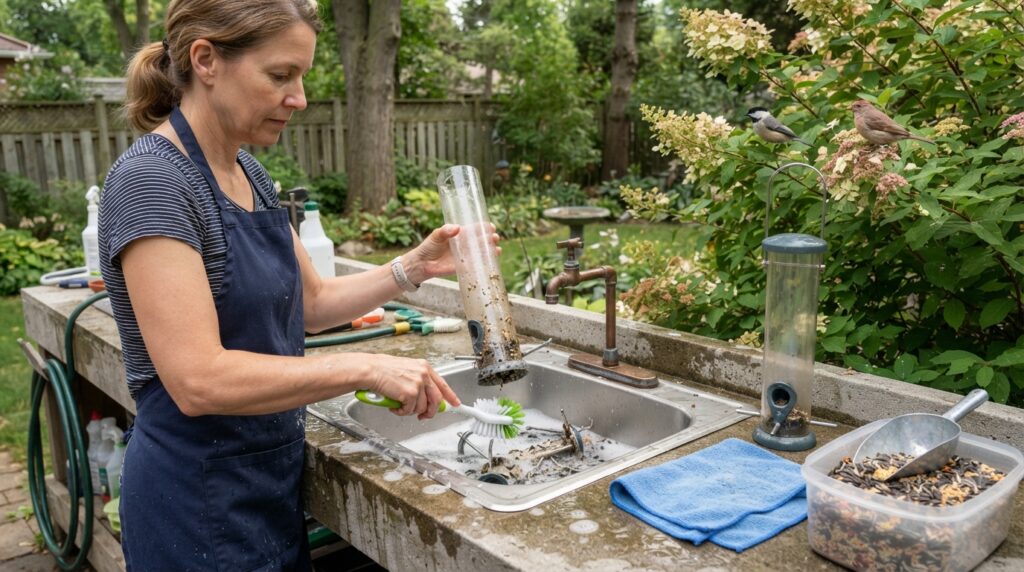
The good news is that the method is settled and takes about fifteen minutes. The order of operations matters more than most people realize, so it is worth doing properly rather than approximately.
The essentials
- Every two weeks for seed and suet feeders — the Cornell Lab and Project FeederWatch figure
- More often in heavy use, hot weather or wet weather
- Scrub first, disinfect second. Bleach does not work properly through a layer of debris
- 1 part bleach to 9 parts water, ten-minute soak
- Dry completely before refilling. Damp seed molds fast
- Rake underneath. Hulls and droppings on the ground matter as much as the feeder
- Hummingbird feeders are different — far more often, no soap
How often
| Feeder | Normal | Hot, wet or busy |
|---|---|---|
| Seed feeder (tube, hopper) | Every 2 weeks | Weekly |
| Platform or tray | Weekly | Every few days |
| Suet cage | Every 2 weeks | Weekly |
| Nyjer feeder or sock | Every 2 weeks | Weekly. Replace socks rather than cleaning |
| Hummingbird feeder | Nectar every 3–5 days, wash weekly | Nectar every 2 days above 90°F |
| Bird bath | Rinse every few days, scrub weekly | More in heat |
| Any feeder, sick bird seen | Take down for 1–2 weeks, disinfect everything | |
The method, step by step
1. Empty it
Bin the old seed rather than tipping it on the ground — if the feeder needed cleaning, the seed at the bottom is part of the reason. Wear disposable gloves.
2. Take it apart
All the way apart, not just the lid. The base of a tube feeder and the underside of a hopper tray are where residue accumulates, and those are precisely the surfaces a quick rinse never touches.
3. Scrub with hot soapy water
This step is not optional, and the order matters. Research on feeder cleaning — a Kutztown University study published in The Wilson Journal of Ornithology and cited by Project FeederWatch — compared soap and water alone, a ten-minute bleach soak alone, and scrubbing followed by a bleach soak. The methods involving dilute bleach outperformed soap alone, and Project FeederWatch’s guidance is to remove all visible debris by scrubbing before disinfecting.
Organic matter shields bacteria from disinfectant. Bleach applied over a layer of stuck-on seed and droppings is doing far less than it appears to be.
A bottle brush with a long flexible handle is the tool that matters here, because it reaches the bottom of a tube. Keep a set aside for this job rather than sharing with kitchen brushes.
The drawback with most brush sets is that the long brush is often too stiff to bend into the base of a tube feeder, which is the one place you most need it. Look for a flexible shaft rather than a rigid one, and check the brush head is narrow enough to pass the feeder ports.
4. Soak in dilute bleach for ten minutes
One part regular unscented household bleach to nine parts water — a 10% solution. Submerge the parts for about ten minutes.
Do this outdoors or in a utility sink, wear gloves, and never mix bleach with anything containing ammonia or vinegar.
5. Rinse thoroughly
Properly, until there is no bleach smell. Residual bleach on a feeding surface is not something to leave for birds.
6. Dry completely
The step people skip. Refilling a damp feeder means the new seed starts molding immediately, which undoes everything you just did. Leave the parts in the sun or somewhere airy until there is no moisture anywhere — several hours for a tube feeder.
7. Clean underneath
Rake up hulls, spilled seed and droppings from the ground below. Ground-feeding birds work through that debris, and moldy discarded seed underneath a feeder is a genuine disease route. Project FeederWatch specifically recommends removing spoiled hulls and waste from the feeding area.
8. Wash your hands
Soap and warm water afterwards, every time. Salmonella is transmissible to people, and handling feeders is a plausible route.
The dishwasher option. Many feeders are dishwasher safe and a hot cycle works well. Check the manufacturer’s specification first — heat warps some plastics and clouds others. If the feeder is dishwasher safe, this is the easiest route by a wide margin, and worth treating as a buying criterion next time.
If you would rather not use bleach
Project FeederWatch acknowledges the alternatives. Washing in boiling water works, and diluted white vinegar is a commonly suggested substitute. Both are gentler and neither is as effective a disinfectant as dilute bleach.
Vinegar is a reasonable routine choice for a feeder that is cleaned regularly and has never had a problem. It is not what to reach for during a suspected outbreak.
Hummingbird feeders
Different rules, because sugar water ferments and grows mold fast.
- Change the nectar every three to five days in mild weather, every two days above 90°F
- Wash the feeder at least weekly with hot water and a bottle brush
- Do not use soap or detergent — residue taints the nectar. This is the opposite of the seed feeder advice, and it catches people out
- A dilute bleach solution can be used, then rinsed extremely thoroughly and air dried
- Cloudy nectar, black specks, or a film inside the reservoir means change it now, whatever the schedule says
Bird baths
Often neglected and arguably higher risk than a feeder, because birds drink from and bathe in the same water they defecate in.
Dump and refill every few days. Scrub weekly with a stiff brush, and use the same 1:9 bleach solution periodically, rinsing thoroughly afterwards. Keep it shallow — under two inches at the edge, no more than three in the middle — which is both safer for birds and easier to clean.
If you see a sick bird
Stop the routine and take everything down — feeders and bird baths — for one to two weeks. Clean and disinfect all of it, rake the ground underneath, and let the birds disperse before putting anything back up. During an active outbreak, the standard advice is that removing feeders is more effective than cleaning them more often, because it breaks up the crowding that spreads the disease in the first place.
Signs, what to report and to whom: sick birds at your feeder.
Common questions
How often should I clean my bird feeder?
About every two weeks for seed feeders, according to Cornell Lab and Project FeederWatch. More often during heavy use, wet weather, hot weather, or if salmonella has been reported in your area.
What bleach ratio should I use?
One part household bleach to nine parts water, with a ten-minute soak. Scrub off visible debris first — bleach cannot work properly through a layer of stuck-on material.
Can I just rinse it with a hose?
No. Rinsing removes loose seed but leaves the film on internal surfaces that actually carries pathogens, and it leaves the feeder wet, which is worse than not cleaning it.
Is vinegar as good as bleach?
Not as a disinfectant, though it is a reasonable option for routine cleaning of a feeder that has never had a problem. Project FeederWatch lists diluted vinegar as an alternative for people uncomfortable with bleach, while recommending dilute bleach as the more effective choice.
Should I use soap on a hummingbird feeder?
No. Soap residue taints the nectar. Hot water and a bottle brush is the standard method, with a thoroughly rinsed dilute bleach soak if you want to disinfect.
Can I catch anything from my bird feeder?
Salmonella is transmissible to people, which is why gloves and handwashing are recommended. The risk is low with sensible hygiene. Do not clean feeders in a kitchen sink used for food preparation, and keep the brushes separate.
Related guides
- Sick birds at your feeder
- Types of bird feeders — including which are easiest to clean
- Hummingbird nectar recipe
- Best bird seed
Sources: Project FeederWatch, Feeding Birds and Preventing Disease: What’s the Best Way to Clean Your Bird Feeders?; Cornell Lab of Ornithology, All About Birds, How to Clean Your Bird Feeder; Feliciano, L.M., Underwood, T.J. and Aruscavage, D.F., The Wilson Journal of Ornithology, on Salmonella reduction methods; USGS National Wildlife Health Center; National Audubon Society; University of New Hampshire Extension.
Cleaning day?
A brush set with a long flexible handle reaches the base of a tube feeder, which is the part that actually matters and the part a dishcloth never touches.
This link goes to Amazon. If you buy through it we may earn a small commission, at no extra cost to you.