
Affiliate disclosure: some links on this page go to Amazon. If you buy through one we may earn a small commission, at no extra cost to you. Full disclosure.
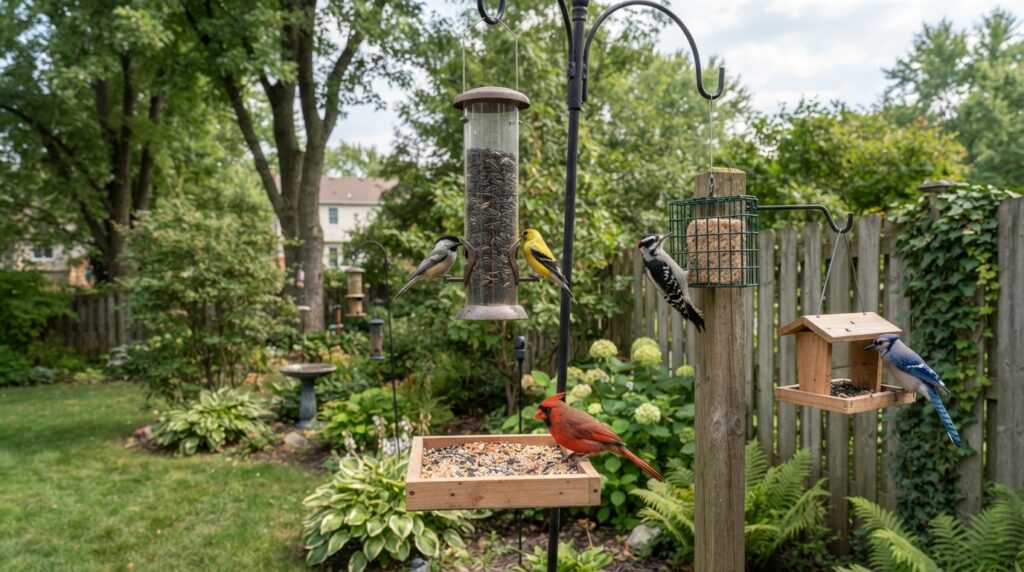
If you are buying one feeder, buy a tube feeder with metal ports and fill it with black oil sunflower — it brings in the widest range of species. If you are buying two, add a platform or hopper feeder, because cardinals, jays and doves want somewhere to stand and largely ignore small tube perches.
Feeder type determines which birds show up more than almost anything else you control. It is not that some feeders are better; it is that a bird’s feet, bill and feeding style suit some designs and not others. A cardinal on a tube feeder perch looks awkward because it is awkward.
This guide covers the seven types worth knowing, what each one actually attracts, and what to look for when buying. It is deliberately built around types rather than model numbers, because models get discontinued and the criteria do not.
Quick match
- Widest range of birds — tube feeder with black oil sunflower
- Cardinals, jays, doves, grosbeaks — hopper or platform
- Goldfinches — nyjer feeder or mesh sock
- Woodpeckers, nuthatches, chickadees — suet cage
- Juncos, sparrows, towhees — ground or low platform
- Closest view — window feeder, which is also the safest position for glass collisions
Tube feeders
A vertical clear tube with feeding ports and perches. The default feeder for good reason: seed stays dry, you can see the level, and the design suits chickadees, titmice, finches, nuthatches and goldfinches — birds that cling and perch comfortably.
What to look for. Metal-reinforced ports are the single most important feature; all-plastic ports get chewed into a wide hole by squirrels within a season or two, after which seed pours out. A removable base and a tube you can get a brush all the way down matter more than capacity. Perch length determines who can use it — short perches exclude larger birds, which some people want and some do not.
Genuine drawback. Cardinals, jays and doves struggle on them. Tubes also hold a column of seed above the lowest port, so the bottom inch or two can sit for weeks and go moldy unless you empty it at cleaning.
Hopper feeders
A house-shaped reservoir that dispenses seed onto a tray as birds feed. The best all-rounder if you want larger birds included: cardinals, grosbeaks, jays and finches all use them comfortably because there is a ledge to stand on.
What to look for. Drainage holes in the tray — without them, rain turns the tray into a bowl of spoiling seed. A roof with enough overhang to keep the tray dry. A design that opens fully for cleaning, since hoppers have more corners than tubes.
Genuine drawback. Capacity is their selling point and their problem. A large hopper holds more seed than a small yard’s birds will eat before it spoils, and the tray collects droppings from birds standing on it. Fill part way rather than to the top.
Platform and tray feeders
An open flat surface, either raised on a pole or set near the ground. These are standard and recommended in the United States, which is worth saying explicitly because guidance from some other countries advises against them.
Nothing brings in a wider mix. Cardinals, jays, doves, juncos, grosbeaks and sparrows all use them, and they take any food you put out — seed, fruit, peanuts, mealworms.
What to look for. A screened or mesh bottom rather than a solid one, so rain drains through instead of pooling. A roof if you can, which keeps seed dry and deters larger birds somewhat.
Genuine drawback. Everything is exposed — to weather, to droppings, and to squirrels, which can simply sit on it and eat. Platform feeders need cleaning more often than any other type, and only a day’s worth of seed should go out at a time.
Window feeders
Small trays or tubes that attach to glass with suction cups. Also standard practice in the US, and worth understanding properly because they solve a problem rather than creating one.
Collisions are most dangerous when a bird has room to build up speed — roughly three to thirty feet from the glass. A feeder mounted directly on the window sits inside that distance, so birds leaving it cannot accelerate enough to injure themselves. Cornell Lab’s guidance reflects this: window feeders are among the safest placements, not the most dangerous.
What to look for. Strong suction cups and a design light enough not to strain them. Something that comes off easily for cleaning, since you will be doing it often.
Genuine drawback. Small capacity, suction cups fail in cold weather, and the outside of the window gets messy. Larger birds cannot use them.
Suet feeders
Wire cages holding a suet cake. The way to bring in woodpeckers, and also used by nuthatches, chickadees, titmice and wrens.
What to look for. A tail prop — an extended back panel that woodpeckers brace against — makes a real difference to how comfortably they feed. For starling problems, an upside-down design works: woodpeckers and nuthatches hang inverted without difficulty, starlings largely will not.
Genuine drawback. Suet softens and goes rancid above roughly 90°F, and melted suet can foul feathers. Use no-melt dough cakes in summer or take suet down entirely in hot weather. Cheap wire cages also rust through in a couple of seasons.
Nyjer feeders
Tubes with very small ports, or fine mesh socks, holding nyjer seed. Goldfinches, siskins and redpolls are the audience.
What to look for. Mesh socks let birds cling anywhere and cost little; tubes last longer and are easier to clean. Either way, buy nyjer in quantities you will use within a few weeks.
Genuine drawback. Nyjer goes stale quickly and stale nyjer is refused — the most common reason a finch feeder stops working. Socks also hold moisture and need replacing regularly rather than cleaning.
Ground feeders
A low tray, or simply scattered seed. Juncos, doves, towhees, quail and most sparrows feed this way by preference.
What to look for. A raised mesh tray keeps seed off wet soil and drains after rain, which matters more than it sounds.
Genuine drawback. The highest disease risk of any method, because droppings and food occupy the same surface. Put out only what will be eaten in a day, move the location periodically, and rake underneath. Ground feeding also attracts rodents and, in bear country, bears.
Comparison
| Type | Best for | Main drawback | Cleaning |
|---|---|---|---|
| Tube | Chickadees, finches, nuthatches, titmice | Excludes cardinals and jays | Every 2 weeks |
| Hopper | Cardinals, grosbeaks, jays, finches | Holds more than gets eaten | Every 2 weeks |
| Platform | The widest mix of species | Exposed to weather and squirrels | Weekly or more |
| Window | Close viewing, collision safety | Small, suction cups fail in cold | Weekly |
| Suet cage | Woodpeckers, nuthatches | Melts above about 90°F | Every 2 weeks |
| Nyjer | Goldfinches, siskins | Seed goes stale fast | Every 2 weeks |
| Ground | Juncos, doves, sparrows | Highest disease risk | Rake often, move it around |
What matters more than type
Can you clean it? Project FeederWatch advises against using feeders that cannot be thoroughly washed — wooden feeders in particular, because porous surfaces cannot be properly disinfected. Before buying, ask whether it comes apart, whether a brush reaches every internal surface, and whether it survives a dishwasher. A feeder you dread cleaning is a feeder you will not clean.
Two other things outweigh design. Drainage decides whether seed spoils. And placement — within about ten feet of cover, and either under three feet or over thirty feet from glass — affects whether birds use it at all.
Common questions
What single feeder attracts the most birds?
A tube feeder with black oil sunflower brings in the widest range in most of the country. A platform feeder arguably attracts a broader mix but needs far more maintenance and is more exposed.
Why won’t cardinals use my tube feeder?
Cardinals are relatively large and prefer to stand while feeding rather than cling to a short perch. A hopper or platform feeder solves it immediately. More on attracting cardinals.
Are window feeders dangerous for birds?
No — correctly placed they reduce collision risk. Birds leaving a feeder attached to the glass cannot build up enough speed to be injured. The dangerous placement is a feeder roughly three to thirty feet away.
Are wooden feeders a bad idea?
For seed, largely yes. Wood is porous and cannot be reliably disinfected, which is why Project FeederWatch advises against feeders that cannot be thoroughly washed. Wooden nest boxes are a different matter — untreated wood is exactly right there.
How many feeders should I have?
Start with one and add a second only when the first is busy. Multiple feeders spread birds out, which reduces crowding and disease transmission, but they also multiply cleaning. Two well-maintained feeders beat five neglected ones.
Do squirrel-proof feeders work?
Weight-activated designs work reasonably well, but placement does more. A correctly sited baffle on a pole beats any feeder on its own. The full approach is here.
Related guides
Sources: Project FeederWatch, Feeding Birds and Types of Bird Feeders; Cornell Lab of Ornithology, All About Birds on feeder placement and window collisions; National Audubon Society; manufacturer specifications from Droll Yankees, Brome, Aspects, Woodlink and Perky-Pet.
Starting out?
One tube feeder with black oil sunflower brings in more species than any other single setup. Metal ports last; all-plastic ports get chewed open within a season or two.
This link goes to Amazon. If you buy through it we may earn a small commission, at no extra cost to you.