
Affiliate disclosure: some links on this page go to Amazon. If you buy through one we may earn a small commission, at no extra cost to you. Full disclosure.
Placement beats hardware. Mount the feeder on a smooth pole at least 5 feet high, at least 7 to 10 feet from anything a squirrel can launch from, with a baffle on the pole below it. That combination works. A squirrel-proof feeder hanging from a low branch does not, whatever it cost.
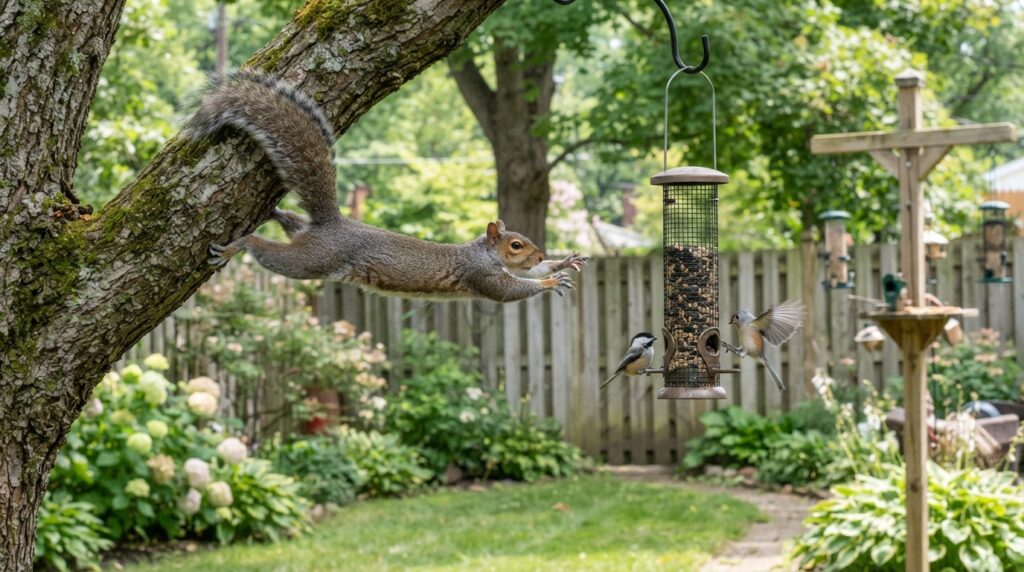
Gray squirrels can jump roughly four feet vertically from the ground and around eight to ten feet horizontally from a launch point, and they will spend a genuinely impressive amount of time working out the geometry of your yard. Any single measure gets defeated eventually. What works is making the physics unfavorable.
What actually works, in order
- Position — more effective than any product
- A pole baffle, correctly sized and correctly placed
- Weight-activated feeders — good, but not on their own
- Safflower or hot pepper seed — removes the incentive rather than the access
- Cleaning up spillage — a pile of seed underneath keeps them interested regardless
The 5-7-9 rule
The standard formulation, and worth committing to memory:
| Number | Means |
|---|---|
| 5 feet | Minimum height of the feeder above the ground |
| 7 feet | Minimum distance from anything a squirrel can jump from — and 9 to 10 feet is safer |
| 9 feet | Roughly how far a squirrel can jump horizontally from a height |
“Anything a squirrel can jump from” is broader than people allow for. Tree trunks and branches, obviously. Also: fence tops, deck railings, the roof of a shed, a garden wall, a stack of firewood, a trash can, a parked car, the house wall itself. Stand where the feeder is and look around at squirrel head height. The launch point you missed is the one they will use.
Baffles
The most cost-effective thing you can buy, and the most commonly fitted wrong.
Pole baffles are cylinders or domes fitted below the feeder on a pole. A squirrel climbing the pole meets the baffle and cannot get around it.
Hanging baffles are domes fitted above a hanging feeder, blocking descent from a branch.
Three things decide whether a baffle works.
Height. The bottom of the baffle needs to sit at least four to five feet off the ground. A baffle at three feet is simply jumped over.
Diameter. Wide enough that a squirrel cannot reach around it. Narrow baffles get defeated by a long-armed squirrel hanging off the pole.
Pole type. A smooth metal pole only. A wooden post, or a pole with brackets, joints or a decorative twist, gives them grip below the baffle and a place to launch from.
Before ordering, measure your pole diameter and check the baffle’s stated fit — the most common failure is a baffle that does not clamp tightly to the pole and slides down under a squirrel’s weight. The other honest drawback: baffles are visually intrusive. A large gray dome under a feeder is not attractive, and there is no version of this that is both effective and discreet.
Weight-activated feeders
These close off the feeding ports when something heavier than a bird lands on the perch. The mechanism is usually a spring-loaded shroud, and the better ones are adjustable so you can set the trigger weight — excluding squirrels only, or excluding grackles and jays too.
They work reasonably well. The drawbacks are real though: the mechanism has moving parts that can seize with ice, seed dust or corrosion; they are heavier and more awkward to clean than a plain tube; and they cost several times what a basic feeder does. A squirrel can also simply sit on top and reach down on some designs.
The important point: a weight-activated feeder hanging from a branch a squirrel can reach is far less effective than a plain tube feeder correctly positioned on a baffled pole. Buy the placement first.
Change the food instead
The approach with no mechanism to fail.
Safflower. Cardinals, House Finches, chickadees, titmice and doves take it. Squirrels, grackles and starlings generally will not — it is bitter. Allow a few weeks for birds to switch over, and expect it to cost more than sunflower. Some individual squirrels do eventually learn to eat it.
Hot pepper seed. Birds do not have the receptor that responds to capsaicin, so they are unaffected. Mammals are, and squirrels avoid treated seed. It is sold pre-treated, which is the sensible way to buy it.
If you use hot pepper seed: wear gloves when filling, and avoid doing it on a windy day. Capsaicin dust is genuinely unpleasant in eyes and airways. Keep treated seed away from where children or pets might reach it, and do not use it on a platform feeder where the dust blows around.
What does not work
| Method | Why not |
|---|---|
| Greasing the pole | Do not do this. Oil, petroleum jelly and cooking spray get onto feathers and destroy their waterproofing and insulation, which can be fatal in cold weather. It is also only briefly effective |
| Sticky repellents | Same problem, worse. Anything adhesive on a pole ends up on birds and small mammals |
| Ultrasonic repellers | No credible evidence of effectiveness against squirrels. They also do not discriminate |
| Feeding squirrels separately to distract them | Usually attracts more squirrels rather than diverting the ones you have |
| Hanging the feeder on fishing line | Squirrels manage it, and it poses an entanglement risk to birds |
| Trapping and relocating | Often illegal, frequently fatal for the animal. See below |
On trapping and relocating
Many states regulate or prohibit the relocation of wildlife, and rules vary considerably — some require a permit, some prohibit release on land you do not own, some prohibit relocation entirely because of disease transmission risk. Check your state wildlife agency before considering it.
Beyond the legal position: relocated squirrels have poor survival rates. They are dropped into territory already held by other squirrels, without knowledge of food caches, water or escape routes. And the vacancy in your yard gets filled within days by another squirrel. It solves nothing.
Putting it together
The setup that works
- Smooth metal pole, feeder at 5 feet or higher
- At least 7 to 10 feet from every launch point — walk around and check at squirrel height
- Pole baffle with its base at 4 to 5 feet, wide enough not to be reached around, clamped tight
- Safflower or hot pepper seed in the feeder
- Spillage raked up regularly so the ground underneath is not a reward in itself
- Optionally, a weight-activated feeder on top of all that
One honest note to finish. Squirrels are native wildlife, they are persistent because persistence is how they survive, and total exclusion is rarely achievable in a yard with mature trees. The realistic aim is to make your feeder difficult enough that they spend their time elsewhere — not to win outright.
Common questions
How far can a squirrel jump?
Roughly four feet vertically from the ground and about eight to ten feet horizontally from a launch point. Which is why the standard guidance is a feeder at least five feet up and at least seven to ten feet from anything they can jump from.
Do squirrel-proof feeders actually work?
Weight-activated designs work reasonably well, but not alone. The same feeder hanging from a reachable branch will be raided. Position and a baffle do more than the feeder does.
Is greasing the pole safe?
No. Oil and petroleum jelly transfer to feathers and destroy their insulating and waterproofing properties, which can kill a bird in cold weather. Use a baffle instead.
Does hot pepper seed harm birds?
No. Birds lack the receptor that responds to capsaicin and are unaffected. Wear gloves when filling and avoid windy days — the dust is unpleasant for people.
Can I trap and move squirrels?
Check your state wildlife agency first, because many states restrict or prohibit it. Relocation also has poor survival outcomes for the animal and the vacancy in your yard is filled within days.
My baffle is not working. What is wrong?
Usually one of three things: it is mounted too low, it is too narrow to stop a squirrel reaching around, or it is loose and slides down. Check that the base sits at four to five feet and that it clamps firmly to a smooth pole.
Related guides
- Best bird seed, including safflower
- Types of bird feeders
- Keeping grackles and starlings off your feeders
- Bears and bird feeders
Sources: Cornell Lab of Ornithology, All About Birds and Project FeederWatch on feeder pests and placement; National Audubon Society; state wildlife agency guidance on wildlife relocation and nuisance wildlife; university extension service guidance on squirrel management and capsaicin-treated seed; manufacturer specifications for baffles and weight-activated feeders.
Dealing with squirrels?
A pole-mounted baffle placed correctly beats any squirrel-proof feeder on its own. Check the baffle diameter against your pole before ordering — the common failure is a baffle a squirrel can reach around.
This link goes to Amazon. If you buy through it we may earn a small commission, at no extra cost to you.