
Affiliate disclosure: some links on this page go to Amazon. If you buy through one we may earn a small commission, at no extra cost to you. Full disclosure.
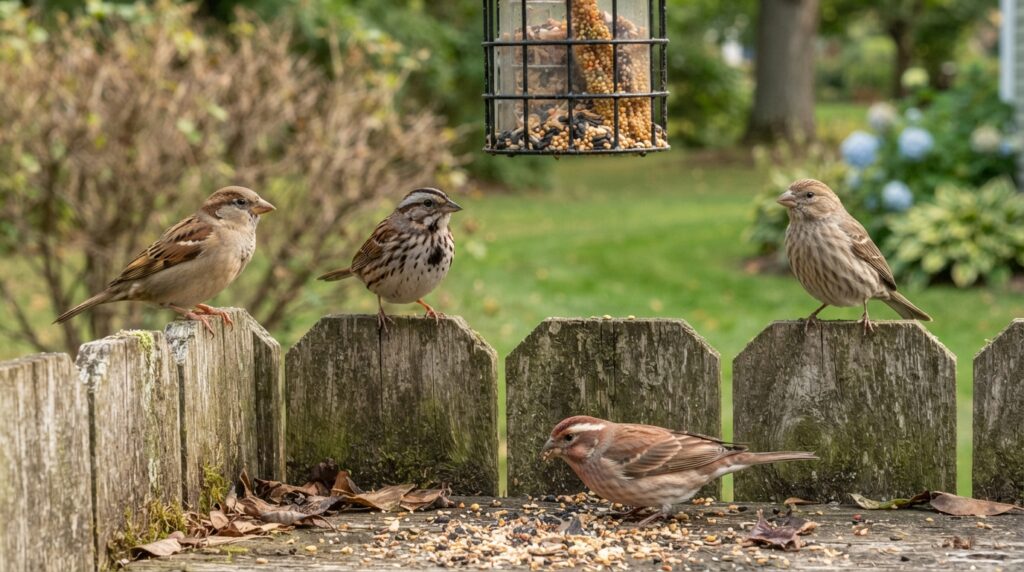
Stop looking at the brown. Check the bill first — short and conical means a seed-eater, thin and pointed means a wren. Then check the breast: cleanly streaked, blurrily streaked, or plain. Those two questions sort most small brown backyard birds in about five seconds, which is roughly as long as they give you.
“Little brown job” is real birder slang, used with mild despair, and it exists because a dozen unrelated species converge on the same solution: be small, be brown, be hard to see. Color is doing almost no work for you here. Structure and behavior are.
Below are the small brown birds most likely to be in an American yard, the two questions that separate them, and the confusing pairs worth learning properly.
The two questions
- What shape is the bill? Short, thick and conical — a seed-eater: sparrow, finch. Thin, pointed, slightly curved — an insect-eater: wren
- What does the breast look like? Crisply streaked with a central spot, blurrily streaked, or plain and unmarked
- Then: is it on the feeder or under it? In a noisy group or alone? Tail cocked upward or held level?
The likely suspects
House Sparrow
Not actually a sparrow — an Old World species, introduced, and non-native. Chunky, with a thick bill and a large head. Males have a gray crown, chestnut behind the eye and a black bib that grows larger through the breeding season. Females are plain dusty brown with a pale stripe behind the eye and an unstreaked breast.
Behavior tells you first. They arrive in noisy groups, dominate feeders, nest in building crevices and vents, and are almost always around houses. If a flock of chunky brown birds is squabbling on your feeder, this is them.
House Finch (female)
The one most often mistaken for a sparrow. Slimmer than a House Sparrow with a more rounded head, and blurry brown streaking down a whitish breast — smudged rather than crisp. Plain face with no strong pattern. The bill is conical but noticeably more curved along the top edge than a sparrow’s.
Males are the giveaway that a female is nearby: red on the head and upper chest with brown streaked flanks.
Song Sparrow
The classic native sparrow. Heavily streaked brown, and the field mark is the dark central spot where the streaks converge on the breast. Long rounded tail, often pumped in flight. Broad grayish stripe over the eye.
Usually on the ground under feeders rather than on them, alone or in twos rather than flocks.
Chipping Sparrow
Small, slim and neat. Bright rufous cap, a clean gray unstreaked breast, and a black line through the eye with a white stripe above it. In winter the cap dulls and the face pattern softens, which makes it harder.
Quiet ground feeder, often on lawns. The unstreaked breast plus the rufous cap is a reliable pair.
White-throated Sparrow
Larger and more strongly marked. Bold black-and-white or black-and-tan head stripes, a crisp white throat patch, and — the clincher — a yellow spot between the eye and the bill. Nothing else at your feeder has that.
Common in the East in winter, feeding on the ground, often scratching backwards with both feet at once.
Carolina Wren
Not a sparrow at all, and the bill says so immediately: thin, long, slightly downcurved. Warm rusty-brown above, buff below, with a bold white stripe over the eye. The tail is usually cocked upright, which no sparrow does.
Loud out of all proportion to its size. Takes suet and peanut pieces rather than seed.
House Wren
Smaller, plainer and grayer-brown than a Carolina Wren, with a much fainter eyebrow stripe and fine barring on the wings and tail. Same thin bill, same cocked tail, same restless energy. Mostly summer, mostly in brush rather than at feeders.
Female Red-winged Blackbird
Regularly misidentified as a giant sparrow. Considerably larger than anything else here, heavily streaked dark brown, with a pale eyebrow and a long, sharply pointed bill quite unlike a seed-cracker’s cone. Usually in groups, often with males whose red shoulder patches leave no doubt.
Female House Finch vs female Purple Finch
The genuinely hard pair, and worth learning because both turn up at the same feeders.
| House Finch (female) | Purple Finch (female) | |
|---|---|---|
| Face | Plain, no strong pattern | Bold white stripe above and behind the eye, dark cheek patch, strongly marked |
| Streaking | Blurry, smudged, grayish-brown | Crisp, dark, well-defined |
| Bill | Curved along the top edge | Straighter, heavier, more triangular |
| Overall | Slimmer, longer-tailed | Chunkier, shorter-tailed, more “solid” |
The face pattern is the one to rely on. A female finch with a distinct pale eyebrow and dark cheek is a Purple Finch; a plain-faced one is a House Finch.
Sorting them by behavior
| What it is doing | Likely |
|---|---|
| Noisy group dominating the feeder | House Sparrows |
| On the feeder, cracking seed, alone or in twos | House Finch |
| On the ground under the feeder, scratching | Song, Chipping or White-throated Sparrow, junco |
| Tail cocked upright, poking into crevices | Carolina or House Wren |
| On the suet feeder | Carolina Wren — sparrows and finches rarely take suet |
| Larger, streaked, in a flock, long pointed bill | Female Red-winged Blackbird |
Getting a longer look
Most of these identifications fail because the bird was fifteen feet away and gone in four seconds. Bill shape and breast pattern need a few seconds of clear view, which usually means optics.
For backyard use the specification that matters is close focus, not magnification. Many binoculars will not focus nearer than fifteen or twenty feet, which is useless if the feeder is on the deck rail. Look for close focus around six feet, in an 8×42 or 8×32 configuration.
The honest drawback: cheap binoculars often have misaligned barrels that cause eye strain and headaches within minutes, which is worse than no binoculars at all. A smaller pair from a reputable optics maker is a better buy than a large pair from an unknown brand at the same price.
Free and often better. Merlin Bird ID from the Cornell Lab identifies birds from a photo, a sound recording, or a few questions, filtered by your location and date. For small brown birds the sound feature is especially useful, since several of these species are far easier to identify by voice than by sight.
Native and non-native
Worth knowing, because the legal position differs. House Sparrows are non-native and not protected under the Migratory Bird Treaty Act, along with European Starlings and Rock Pigeons. Every other bird on this page — Song Sparrow, Chipping Sparrow, White-throated Sparrow, House Finch, both wrens, Red-winged Blackbird — is protected, including its nest and eggs.
That distinction matters before doing anything about a bird nesting somewhere inconvenient. State law adds further variation, so check with your state wildlife agency rather than generalizing.
Common questions
What is the small brown bird at my feeder?
If it is in a noisy group and dominating the feeder, House Sparrow. If it is slimmer with blurry streaking and cracking seed calmly, female House Finch. If it is under the feeder scratching on the ground, a native sparrow. Check the bill and the breast pattern.
How do I tell a sparrow from a finch?
Bill shape and streaking. Finch bills are conical but curved along the top edge; sparrow bills are straighter and more triangular. House Finch streaking is blurry and smudged, native sparrow streaking is crisper and more organized.
Are House Sparrows native to America?
No. They were introduced from Europe in the 1850s and are not protected under the Migratory Bird Treaty Act, unlike native sparrows, which are.
What small brown bird holds its tail straight up?
A wren. Carolina Wrens are warm rusty-brown with a bold white eyebrow stripe; House Wrens are smaller, plainer and grayer. Both have thin pointed bills rather than seed-cracking cones.
Why are there so many brown birds under my feeder rather than on it?
Most native sparrows and juncos prefer to feed on the ground and are working through spillage. A low tray or scattered white proso millet suits them better than a hanging feeder.
Is a female cardinal a small brown bird?
Not really — she is considerably larger, has a prominent crest, and has a thick orange-red bill that nothing on this page has. If it has a crest and a bill that color, it is a cardinal.
Related guides
- Common backyard birds of North America
- Northern Cardinal
- Best bird seed — including millet for ground feeders
- Types of bird feeders
Sources: Cornell Lab of Ornithology, All About Birds species accounts and Merlin Bird ID; Project FeederWatch common feeder birds; National Audubon Society field guide; US Fish & Wildlife Service, Migratory Bird Treaty Act protected species list and non-native species status.
Want a closer look?
A pair of 8x42 binoculars is the single thing that changes backyard birding most. Close focus matters more than magnification when the bird is fifteen feet away.
This link goes to Amazon. If you buy through it we may earn a small commission, at no extra cost to you.