
Affiliate disclosure: some links on this page go to Amazon. If you buy through one we may earn a small commission, at no extra cost to you. Full disclosure.
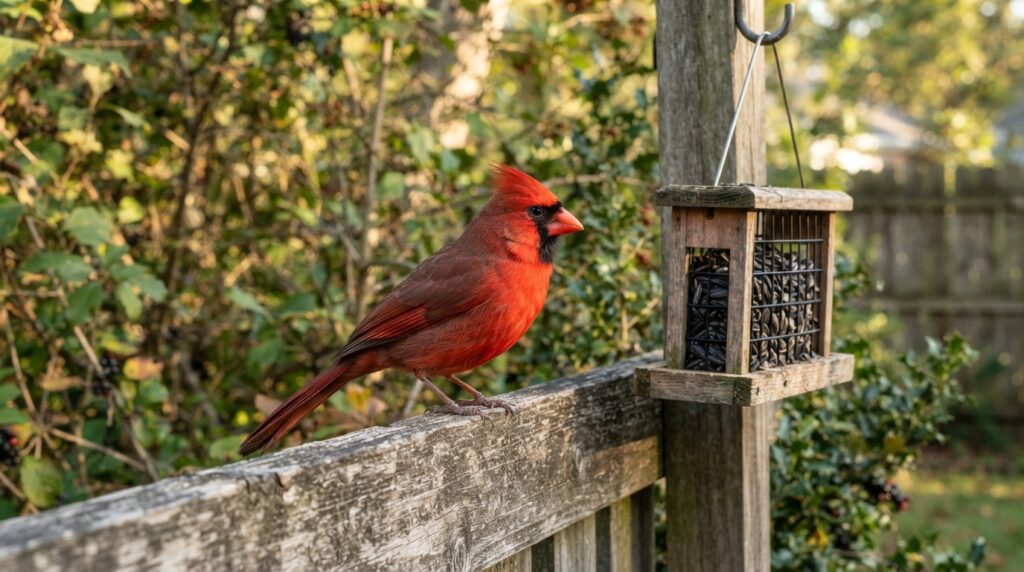
Cardinals want somewhere to stand while they eat. Offer black oil sunflower or safflower on a hopper or platform feeder rather than a tube, keep dense shrubs within reach for cover, and expect them at first light and last light — they are usually the earliest and latest birds at a feeder.
The Northern Cardinal is the most searched-for backyard bird in the United States, and it earns the attention. It does not migrate, so it is there in February when almost nothing else is. It is the state bird of seven states, more than any other species. And a male cardinal against snow is genuinely one of the better things a window can show you.
Getting them to your feeder is mostly about two things people get wrong: the feeder design, and the cover around it.
What cardinals need
- A place to stand. Hopper, platform or tray. Short tube perches do not suit them
- Black oil sunflower first, safflower second — and safflower has a useful side effect
- Dense cover nearby. Shrubs and thickets, ideally within about 10 feet
- Early and late. They feed at low light, before and after most other birds
- Water. A shallow bird bath brings them in reliably
- They do not migrate — a resident pair often stays in the same area year-round
Identifying them
| Appearance | |
|---|---|
| Male | Bright red all over, black mask around a thick orange-red bill, prominent crest |
| Female | Warm buff-brown with red edging on wings, tail and crest. Same thick orange-red bill and grayish face mask — the bill is the giveaway |
| Juvenile | Like the female but with a dark gray or black bill. This is what confuses people most; the bill turns orange as they mature |
Nothing else at an American feeder combines a prominent crest with a thick orange-red bill. If you are unsure whether a brown bird is a female cardinal, look at the bill and ignore everything else.
Their range covers the eastern two-thirds of the country and has expanded steadily north over the last century, reaching into southern Canada — a spread widely attributed in part to backyard feeding and suburban planting.
Why they ignore your tube feeder
This is the most common cardinal problem and it has a mechanical answer. Cardinals are relatively large and heavy-bodied, and they feed by perching squarely and cracking seed with a powerful bill. A short plastic perch on a tube feeder gives them nowhere to settle, so they either cling awkwardly for a moment or give up and feed on the spilled seed underneath.
Switch to a hopper or platform feeder and the problem disappears the same week. If you would rather keep the tube, a wide tray attachment fitted underneath does most of the same job.
Hopper feeders suit cardinals better than any other common design, and they take large birds without excluding smaller ones. The honest drawback: hoppers hold considerably more seed than a small yard’s birds will get through before it spoils, and the tray collects droppings from birds standing on it. Fill it part way and clean the tray more often than you would a tube.
What to feed them
| Food | How they take it |
|---|---|
| Black oil sunflower | First choice. Thin shell, high fat, easy for that bill |
| Safflower | Strongly favored. See the note below — this is the useful one |
| Striped sunflower | Taken readily. The heavier shell is no obstacle to a cardinal |
| Cracked corn | Eaten, usually from the ground |
| Peanut pieces | Taken, particularly in winter |
| Nyjer | Largely ignored — ports are too small and the seed too fine |
The safflower trick. Cardinals eat safflower happily. Squirrels, grackles and starlings generally do not — it is bitter and they usually leave it alone. A safflower-filled hopper is one of the few genuinely elegant solutions in bird feeding: it selects for the bird you want and against the animals you do not, without any mechanism to fail.
The trade-off: safflower typically costs more than sunflower, and some birds you might want — goldfinches especially — take little interest. It also takes a few weeks for birds to accept it after a switch, so do not conclude it failed after four days.
Cover matters as much as food
Cardinals are cautious feeders. They nest in dense shrubs and thickets, generally low down, and they want that kind of cover within a short flight of wherever they are eating.
A feeder in the middle of an open lawn gets ignored by cardinals long after chickadees have accepted it. Move it to roughly ten feet from a dense shrub — near cover, not buried inside it, which just gives cats an ambush point — and it changes quickly.
Planting for them works over a longer horizon: dogwood, serviceberry, viburnum, sumac and native brambles all provide both food and the thick low structure they nest in.
Why one is attacking your window
From roughly March through early summer, a cardinal repeatedly flying at a window, car mirror or hubcap is a territorial male fighting his own reflection. He is not sick, confused or injured, and he is not warning you about anything. He genuinely believes there is a rival in his territory that will not leave.
It stops on its own once nesting is underway and hormone levels drop, usually within a few weeks. If it is persistent enough to worry you, break up the reflection from the outside — that is the side he can see. Soap on the glass, a screen, or external window film all work. Anything placed inside the glass will not.
Two things worth knowing
They are often first and last at the feeder. Cardinals have relatively large eyes for their body size and forage comfortably in low light, which is why they turn up before dawn has properly arrived and after everything else has gone to roost. If you never see them, try looking earlier and later rather than concluding they are not there.
Females sing. Unusual among North American songbirds. A female cardinal sings from the nest, often in exchanges with the male, and the song appears to carry information about the nest — including, some research suggests, when to bring food.
Common questions
What is the best food to attract cardinals?
Black oil sunflower is the reliable first choice. Safflower is nearly as attractive to cardinals and has the advantage of being ignored by squirrels, grackles and starlings.
Why do cardinals come at dawn and dusk?
They forage comfortably in low light and routinely feed before and after most other species. It is normal behavior, not a sign that something is keeping them away during the day.
Do cardinals migrate?
No. They are resident year-round throughout their range, which is why they are one of the few bright birds still at a feeder in midwinter.
Is a brown bird with a red bill a female cardinal?
Almost certainly, if it also has a crest. Females are buff-brown with red on the wings, tail and crest, and the thick orange-red bill matches the male’s. Juveniles look similar but have a dark bill.
How do I stop a cardinal hitting my window?
Break up the reflection on the outside of the glass — soap, screening or external film. It is a territorial male attacking what he takes to be a rival, and it stops naturally once nesting gets underway.
Will cardinals use a bird bath?
Readily, and water often brings them in when food alone has not. Keep it shallow — under two inches at the edge, no more than three in the middle — and clean it as often as you clean the feeder.
Related guides
- Best bird seed, including safflower
- Types of bird feeders
- Common backyard birds of North America
- Keeping grackles and starlings off your feeders
Sources: Cornell Lab of Ornithology, All About Birds Northern Cardinal species account and Birds of the World; Project FeederWatch seed and feeder preference data; National Audubon Society; Cornell Lab guidance on window collisions and territorial reflection attacks.
Trying to bring cardinals in?
Cardinals want somewhere to stand. A hopper or platform feeder suits them far better than a tube, and safflower gives them something squirrels and grackles largely ignore.
This link goes to Amazon. If you buy through it we may earn a small commission, at no extra cost to you.