
Affiliate disclosure: some links on this page go to Amazon. If you buy through one we may earn a small commission, at no extra cost to you. Full disclosure.
Switch to safflower and nyjer, which grackles and starlings largely ignore, use caged or weight-activated feeders, and hang suet in an upside-down feeder — starlings will not hang inverted, woodpeckers will. Take platform feeders down temporarily. Before doing anything more direct, know that starlings are not protected but grackles and blackbirds are.
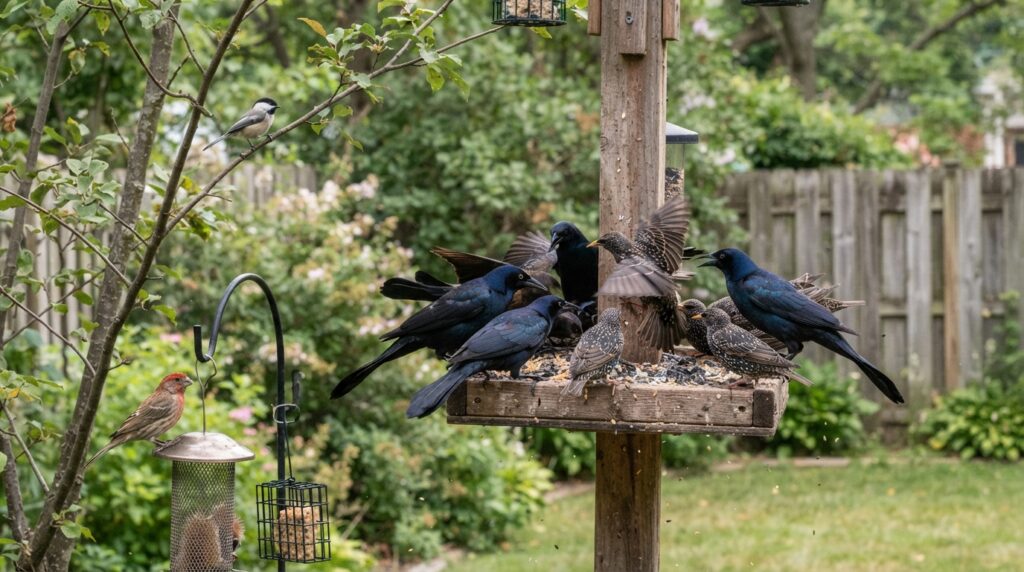
A flock of grackles can empty a feeder in an afternoon, and starlings will strip a suet cake in a day. The frustration is real. The good news is that this problem responds well to food choice and feeder design, which means you can solve it without doing anything to the birds.
What works
- Safflower — cardinals and finches eat it, grackles and starlings generally do not
- Nyjer — too small and too fiddly to interest them
- Caged feeders — small birds through, large birds out
- Upside-down suet feeders — starlings will not hang inverted
- Weight-activated feeders set to exclude heavier birds
- Removing platform feeders for a couple of weeks
The legal distinction, first
This matters before you consider anything beyond feeder management, and people routinely get it wrong because the birds look superficially similar.
Not protected under the Migratory Bird Treaty Act, because they are non-native: European Starling, House Sparrow, Rock Pigeon.
Protected under the Act, because they are native: Common Grackle, Boat-tailed Grackle, Red-winged Blackbird, Brown-headed Cowbird, Brewer’s Blackbird, and every other native blackbird.
The Act protects the birds, their nests and their eggs, and it is worded broadly. State law adds further restrictions on top. Check with your state wildlife agency before taking any action beyond changing what you offer and how.
Telling them apart: starlings are chunky and short-tailed, with a yellow bill in breeding season and heavy pale spotting in winter, and they walk rather than hop. Common Grackles are longer, with a keel-shaped tail, a glossy bronze or purple sheen, and a pale yellow eye. Red-winged Blackbirds are obvious in the male; females are heavily streaked brown and often mistaken for large sparrows.
Change the food
The simplest and most durable approach, because it has no mechanism to fail.
Safflower. Cardinals, House Finches, chickadees, titmice and doves take it. Grackles, starlings and squirrels generally will not — it is bitter. Switching a feeder entirely to safflower solves a grackle problem more reliably than most hardware.
The trade-offs are honest ones: safflower costs more than sunflower, goldfinches take little interest, and birds need two to three weeks to accept it after a switch. Do not conclude it has failed after four days.
Nyjer. Too small and too slow to be worth a grackle’s time, and it needs the small-port feeders they cannot use.
What to stop offering: cracked corn, mixed seed with corn or milo, bread, and anything on an open platform. Cheap mixes are grackle food almost by design.
Change the feeder
Caged feeders
A tube feeder inside a wire cage with gaps of roughly 1½ to 2 inches. Chickadees, titmice, finches, nuthatches and wrens pass through; grackles, starlings, jays and squirrels do not.
Genuine drawbacks: the cage excludes cardinals and grosbeaks too, which many people specifically want. They are more awkward to refill and clean than a plain tube. And a determined starling can sometimes reach through and feed from the outside if the cage sits too close to the ports — check the gap between cage and tube before buying.
Weight-activated feeders
These close the ports when something heavy lands. Better models let you adjust the trigger weight, so you can exclude grackles and starlings while still admitting cardinals.
Drawbacks: moving parts that can seize with ice, seed dust or corrosion; heavier and more awkward to clean; and several times the price of a plain feeder.
Upside-down suet feeders
The most elegant fix on this page. Suet is accessed from underneath, so a bird has to hang inverted to feed.
Woodpeckers, nuthatches and chickadees do this without difficulty. European Starlings largely will not — they are not built for it and generally give up.
Drawbacks: they hold less than a standard double cage, and some woodpeckers take a while to work them out, so expect a quiet week or two after switching.
Short perches and small ports
Tube feeders with short perches make it awkward for a large bird to balance. Not a complete solution — a determined grackle can cling briefly — but it reduces how much they take.
Change the setup
- Take platform and tray feeders down for a couple of weeks. An open flat surface is exactly what a grackle flock wants, and removing it often moves them on
- Stop ground feeding temporarily, and rake up spillage. Fallen seed sustains a flock on its own
- Fill less. Put out what will be eaten in a day so there is nothing to raid
- Wait it out. Grackle and blackbird flocks are often seasonal, moving through in spring and fall. A few weeks of reduced offerings frequently outlasts them
What not to do
| Method | Why not |
|---|---|
| Harming or removing native blackbirds | Illegal. Grackles, Red-winged Blackbirds and cowbirds are protected under the Migratory Bird Treaty Act |
| Poison or treated bait | Illegal, indiscriminate, and dangerous to pets, other birds and children |
| Sticky repellents on perches | Transfer to feathers and destroy insulation and waterproofing |
| Reflective tape, spinners, plastic owls | Birds habituate within days. Occasionally useful very briefly, never a solution |
| Removing starling nests without checking | Starlings are unprotected, but misidentification is easy and disturbing a protected species’ nest is an offense |
Keeping some perspective
Common Grackle populations have declined substantially over recent decades, enough that the species appears on conservation watch lists despite still being locally abundant. A flock in your yard is a nuisance; the species is not thriving.
None of which means you have to feed them. It is a reason to solve the problem by changing what you offer rather than by any more direct route.
Common questions
Are grackles protected?
Yes. Common Grackles, Boat-tailed Grackles, Red-winged Blackbirds and cowbirds are all native and protected under the Migratory Bird Treaty Act, along with their nests and eggs. European Starlings, House Sparrows and Rock Pigeons are not.
What seed do grackles not eat?
Safflower and nyjer. Safflower is the more useful of the two because cardinals and finches take it readily, so you keep the birds you want.
How do I stop starlings eating all the suet?
An upside-down suet feeder. Woodpeckers, nuthatches and chickadees hang inverted comfortably; starlings largely will not. Expect a short adjustment period for the woodpeckers.
Do caged feeders keep cardinals out too?
Yes, which is the main trade-off. Cages sized to admit chickadees and finches also exclude cardinals and grosbeaks. Running a separate safflower hopper alongside is the usual compromise.
Will the grackles ever leave on their own?
Often, yes. Grackle and blackbird flocks are frequently seasonal, moving through in spring and fall. Reducing what you offer for a few weeks commonly outlasts them.
Can I remove a starling nest?
European Starlings are not federally protected, so in most places yes — but identify the bird with certainty first, and check your state’s rules. Disturbing a protected species’ nest is an offense, and misidentification is common.
Related guides
- Best bird seed, including safflower
- Types of bird feeders
- How to stop squirrels
- Common backyard birds of North America
Sources: US Fish & Wildlife Service, Migratory Bird Treaty Act protected species list and non-native species status; Cornell Lab of Ornithology, All About Birds species accounts and Project FeederWatch feeder pest guidance; National Audubon Society; North American Breeding Bird Survey population trend data for Common Grackle; state wildlife agency guidance on nuisance birds.
Crowded out by bigger birds?
A caged feeder lets chickadees and finches through and keeps grackles and starlings out. The trade-off is real: cages are fiddly to refill and they exclude cardinals too.
This link goes to Amazon. If you buy through it we may earn a small commission, at no extra cost to you.