
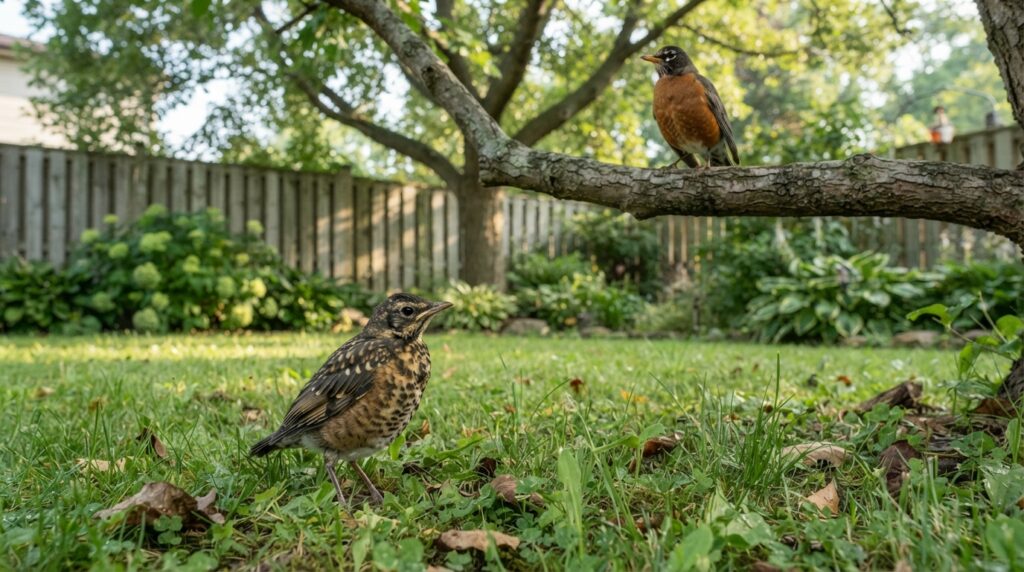
If the bird has feathers and can hop or flutter, it is a fledgling. Leave it alone — its parents are almost certainly nearby and still feeding it. If it is naked or covered in fluffy down and cannot stand, it is a nestling that has fallen. Put it back in the nest if you can find one. Do not feed it anything, and do not give it water.
Most baby birds picked up by well-meaning people did not need picking up. Wildlife rehabilitators receive large numbers of healthy fledglings every spring from people who found a young bird on the ground and assumed it was abandoned.
The distinction that decides everything takes about ten seconds to make.
If the bird is visibly injured, bleeding, has been in a cat’s mouth, or is covered in flies or ants, contact a licensed wildlife rehabilitator now. A cat’s mouth carries bacteria that will kill a bird within days even from a small puncture, so any cat contact needs professional treatment regardless of how well the bird seems. Searching for “wildlife rehabilitator” with your state and county will normally find one nearby.
Fledgling or nestling?
| Fledgling | Nestling | |
|---|---|---|
| Feathers | Mostly feathered, often with a stubby tail | Naked, or covered in wispy down |
| Movement | Hops, flutters, grips a finger or twig | Cannot stand or grip. Sprawls |
| Eyes | Open and alert | May still be closed |
| Where | On the ground, in low shrubs | Directly below a nest |
| What to do | Leave it. This is normal | Put it back in the nest |
If it is a fledgling: leave it alone
Fledging is a stage, not an accident. Young birds of many species leave the nest before they can fly properly and spend several days on the ground and in low cover while their flight feathers finish growing. The parents keep feeding them throughout, and they are usually watching from nearby — frequently watching you.
Removing a fledgling separates it from the parents that are teaching it to find food and avoid predators. Hand-rearing cannot replace that, which is why rehabilitators would rather you left it.
Two things you can reasonably do:
- Move it a short distance out of a road, a driveway, or the middle of open lawn, into cover a few feet away. The parents will find it — they are tracking it by call, not by sight alone
- Bring cats indoors for a few days. This is the single most useful intervention available to you
Then leave the area. Parent birds will not come down to feed while you are standing over the chick.
If it is a nestling: put it back
Look up. Nests are often closer and more visible than expected — in a shrub, a hanging basket, a wreath on a door, a gutter.
If you find it and can reach it safely, pick the nestling up gently in cupped hands and place it back. That is the whole procedure.
The myth worth killing. Parent birds do not abandon young because a human has touched them. Most birds have a poor sense of smell and do not detect human scent on a chick at all. This belief is widespread, and it is the reason a great many nestlings that could simply have been replaced in the nest end up in a shoebox instead.
If you cannot find the nest, or it has been destroyed, a substitute works well. Line a small container that has drainage — a berry basket, a margarine tub with holes punched in the base — with the original nest material if you can salvage it, or with dry grass. Fasten it securely in the tree or shrub as close to the original site as possible, and put the nestling in. Watch from indoors for an hour or two. Parents usually accept a substitute nest.
If no parent returns within a couple of hours, call a rehabilitator.
What not to do
| Do not | Why |
|---|---|
| Give it water | Birds are easily drowned by liquid dripped into the mouth — it enters the airway. This is one of the most common causes of death in home-rescued birds |
| Feed it bread, milk or worms | Birds are not mammals and cannot digest milk. Bread has no useful nutrition. Diets are species-specific and getting it wrong causes lasting damage |
| Keep it “just for a day or two” | Nutritional deficiencies develop fast in a growing bird, and a day of the wrong food can be irreversible |
| Raise it yourself | Illegal without a permit for most native species under the Migratory Bird Treaty Act, and rarely survivable |
| Put it in a cage in the sun | Overheating kills quickly. A dark, quiet, ventilated box at room temperature is correct while you make a phone call |
If you do need to hold it briefly
While you are contacting a rehabilitator:
- A cardboard box with air holes, lined with paper towel — not a towel with loops, which catches claws
- Somewhere dark, quiet and warm, away from pets, children and television noise
- No food, no water
- Do not handle it more than necessary. Human attention is a stressor, not a comfort
- Wash your hands afterwards
Species that need different handling
Ducklings and goslings found without a parent do need help — they are precocial and stay with the adult from hatching, so a lone one is genuinely orphaned.
Owls and hawks should not be handled at all. Call a rehabilitator and describe the situation.
House Sparrows, European Starlings and Rock Pigeons are non-native and not protected under federal law, and many rehabilitation centers will not accept them. That is a policy question, not a judgment on the individual bird.
Finding help
- Licensed wildlife rehabilitator — your state wildlife agency maintains a list, and searching that term with your state and county usually works
- Your state wildlife or natural resources agency
- A veterinarian, particularly one that accepts wildlife
- Local animal control, where nothing else is available
When you call, be ready to say roughly what the bird looks like, whether it has feathers, whether it can stand, whether there is any visible injury, whether a cat was involved, and where you found it.
Common questions
Will the parents reject a baby bird I have touched?
No. Most birds have a poor sense of smell and do not detect human scent. If you can find the nest, put the nestling back — it is the best possible outcome for the bird.
A young bird is hopping around and cannot fly. Is it hurt?
Probably not. Fledglings spend several days on the ground while their flight feathers finish growing, and the parents keep feeding them. Move it out of danger if necessary and leave it.
What should I feed a baby bird?
Nothing. Diets are species-specific and the wrong food causes rapid, often permanent harm. Never give water either — it easily enters the airway. Call a rehabilitator instead.
A cat brought me a baby bird. It seems fine.
It needs a rehabilitator regardless. Bacteria in a cat’s mouth cause infections that kill birds within days, even from punctures too small to see. This is not a wait-and-see situation.
Can I raise it myself?
No, and for most native species it is illegal without a permit under the Migratory Bird Treaty Act. Hand-rearing without training has poor survival rates, and a bird raised without its parents lacks skills it needs to survive release.
The nest was destroyed. Now what?
Make a substitute: a small container with drainage holes, lined with the old nest material or dry grass, fastened securely as near the original site as possible. Parents usually accept it. If nobody returns within a couple of hours, call a rehabilitator.
Related guides
Sources: Cornell Lab of Ornithology, All About Birds and NestWatch guidance on found young birds; National Audubon Society; US Fish & Wildlife Service, Migratory Bird Treaty Act; state wildlife agency and licensed wildlife rehabilitation guidance.
This page is general information and is not veterinary advice. For any individual bird, contact a licensed wildlife rehabilitator or your state wildlife agency.