
Affiliate disclosure: some links on this page go to Amazon. If you buy through one we may earn a small commission, at no extra cost to you. Full disclosure.
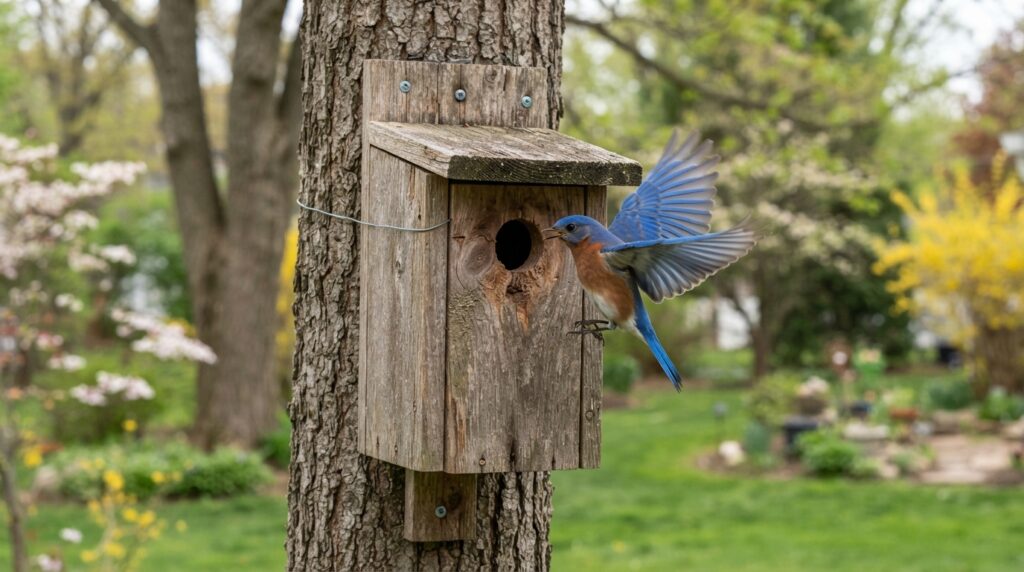
The entrance hole diameter determines which species can use your box and which cannot get in — and, critically, whether House Sparrows take it over. 1⅛ inches for chickadees, 1½ inches for bluebirds and titmice, 1¼ inches for wrens and nuthatches. Never fit a perch: it does nothing for the birds and gives predators and House Sparrows a foothold.
A birdhouse is not a general-purpose object. The hole size is a filter, and getting it wrong is the difference between a box full of chickadees and a box full of House Sparrows — which is not a neutral outcome, because House Sparrows will destroy eggs and kill nestlings of native species to take a cavity.
Most decorative birdhouses sold in garden centers have holes sized for appearance, or a perch tacked on the front, or both. This page is the specification instead.
Four things that matter more than looks
- Hole diameter — decides the species, and excludes House Sparrows and starlings
- No perch — a design fault, not a feature
- Untreated wood — the one place wood is right, unlike feeders
- A side that opens — boxes must be cleaned out annually
The chart
| Species | Hole | Floor | Hole above floor | Mount height |
|---|---|---|---|---|
| Black-capped / Carolina Chickadee | 1⅛” | 4 x 4″ | 6–8″ | 5–15 ft |
| House Wren | 1–1¼” | 4 x 4″ | 4–6″ | 5–10 ft |
| Carolina Wren | 1½” | 4 x 4″ | 4–6″ | 5–10 ft |
| White-breasted Nuthatch | 1¼” | 4 x 4″ | 6–8″ | 5–15 ft |
| Tufted Titmouse | 1¼–1½” | 4 x 4″ | 6–8″ | 5–15 ft |
| Eastern Bluebird | 1½” | 5 x 5″ | 6–10″ | 4–6 ft |
| Western / Mountain Bluebird | 1&frac9;⁄₁₆” | 5 x 5″ | 6–10″ | 4–6 ft |
| Tree Swallow | 1½” | 5 x 5″ | 5–7″ | 5–10 ft |
| Downy Woodpecker | 1¼” | 4 x 4″ | 8–10″ | 6–20 ft |
| Hairy Woodpecker | 1½” | 6 x 6″ | 9–12″ | 8–20 ft |
| Northern Flicker | 2½” | 7 x 7″ | 14–16″ | 6–20 ft |
| Purple Martin | 2⅛” | 6 x 6″ | 1–2″ | 10–15 ft |
| American Kestrel | 3″ | 8 x 8″ | 9–12″ | 10–30 ft |
| Eastern Screech-Owl | 3″ | 8 x 8″ | 9–12″ | 10–30 ft |
| Wood Duck | 4 x 3″ oval | 10 x 10″ | 16–18″ | 6–30 ft |
Cornell Lab’s NestWatch runs a tool called Right Bird, Right House that filters by your location and habitat, and it is the best free resource for confirming what will actually use a box where you live. There is no point building for Mountain Bluebirds in Georgia.
Why the hole size matters so much
House Sparrows need roughly 1¼ inches to get in. A 1⅛ inch hole excludes them, which is why that measurement is the standard for chickadees and why an eighth of an inch is worth being fussy about.
This is not fussiness for its own sake. House Sparrows are non-native cavity competitors that will destroy eggs, kill nestlings and build over the top of them to take a box. A hole sized 1½ inches for bluebirds cannot exclude them, which is why bluebird boxes need monitoring rather than being put up and forgotten.
European Starlings need about 1½ inches. Anything at or below 1½ keeps them out, which covers most small songbird boxes.
Why no perch
Every bird that uses a nest box can cling to a rough wooden surface and enter without help. Cavity nesters do not use perches in natural tree holes and do not need one on a box.
What a perch does provide is a foothold for House Sparrows and starlings to sit and harass the occupants, and a grip for a predator reaching into the hole. It exists on commercial birdhouses because it looks like what people think a birdhouse should look like.
If you have a box with a perch, remove it. It takes thirty seconds and it is a straightforward improvement.
The rest of the specification
- Untreated wood, ideally cedar or pine, three-quarters of an inch thick. Not treated lumber, not plastic, not metal — both overheat badly
- Drainage holes in the floor, four of them, or the corners cut off
- Ventilation near the top of the side walls
- A roof with overhang to keep rain out of the hole
- A side or front that opens for cleaning and monitoring
- Rough interior below the hole, or shallow saw kerfs, so nestlings can climb out
- No paint or stain inside. Outside, light colors only — dark boxes overheat
When buying rather than building, check the listed hole diameter against the chart above, and check that a side opens. The honest drawback of most commercially sold boxes: a great many are decorative, with the wrong hole size, a perch fitted, no drainage, and no way to open them. A plain unpainted cedar box with the right hole outperforms an attractive one every time, and it will look considerably less charming on the fence.
Siting and predator guards
Mount on a smooth metal pole, not a tree. A pole with a baffle underneath is dramatically safer than a tree trunk, which raccoons, snakes and cats climb without effort. This matters more than almost anything else in this article.
Face the hole away from prevailing weather — generally east or north in most of the country.
Spacing: most species will not tolerate another pair of the same species close by. Bluebird boxes want 100 yards or more between them; a common workaround is pairing two boxes 15 to 25 feet apart, which lets Tree Swallows and bluebirds each take one.
Put boxes up in late winter, February in much of the country, so they are weathered and in place before the season starts.
Cleaning and monitoring
Clean boxes out once a season, after the last brood has fledged, or in late winter before the next. Remove old nest material, brush the box out, and leave it to dry. Old nests hold mites and parasites.
Monitoring is worth doing and worth doing right. NestWatch trains volunteers to check nests without harming them and collects the data for research — brief checks every few days, not during the first or last days of the nestling period, and never near dusk. Taking part turns a box in your yard into a genuine data point.
Common questions
What size hole keeps House Sparrows out?
1⅛ inches. Sparrows need roughly 1¼ inches to enter, so an eighth of an inch is the whole margin. Bluebird boxes at 1½ inches cannot exclude them and need monitoring instead.
Why do birdhouses have perches if birds do not need them?
Because buyers expect them. Cavity nesters enter natural tree holes without perches. A perch mainly helps House Sparrows harass the occupants and gives predators a grip. Remove it.
Should I mount the box on a tree?
A smooth metal pole with a baffle is much safer. Raccoons, snakes and cats climb trees easily, and tree-mounted boxes have higher predation rates.
When should I put a nest box up?
Late winter, around February in most of the country, so it is in place and weathered before the breeding season. Boxes are also used as winter roosts.
Do I need to clean it out?
Yes, once a season after the last brood fledges, or in late winter. Old nests hold mites and parasites. This is why a box needs a side that opens.
Can I paint it?
Never inside. Outside, light colors only — dark paint makes boxes dangerously hot in summer. Untreated wood left bare is the standard and works fine.
Related guides
- Black-capped Chickadee
- Birds nesting in your house
- I found a baby bird on the ground
- Types of bird feeders
Sources: Cornell Lab of Ornithology NestWatch, including the Right Bird, Right House tool and nest box specifications; All About Birds; North American Bluebird Society nest box guidance; US Fish & Wildlife Service on non-native cavity competitors; state wildlife agency and university extension nest box plans.
Putting up a nest box?
The entrance hole diameter decides which species can use it and which cannot get in. Untreated wood, ventilation, drainage and a side that opens for cleaning are the four things to check.
This link goes to Amazon. If you buy through it we may earn a small commission, at no extra cost to you.