
Affiliate disclosure: some links on this page go to Amazon. If you buy through one we may earn a small commission, at no extra cost to you. Full disclosure.
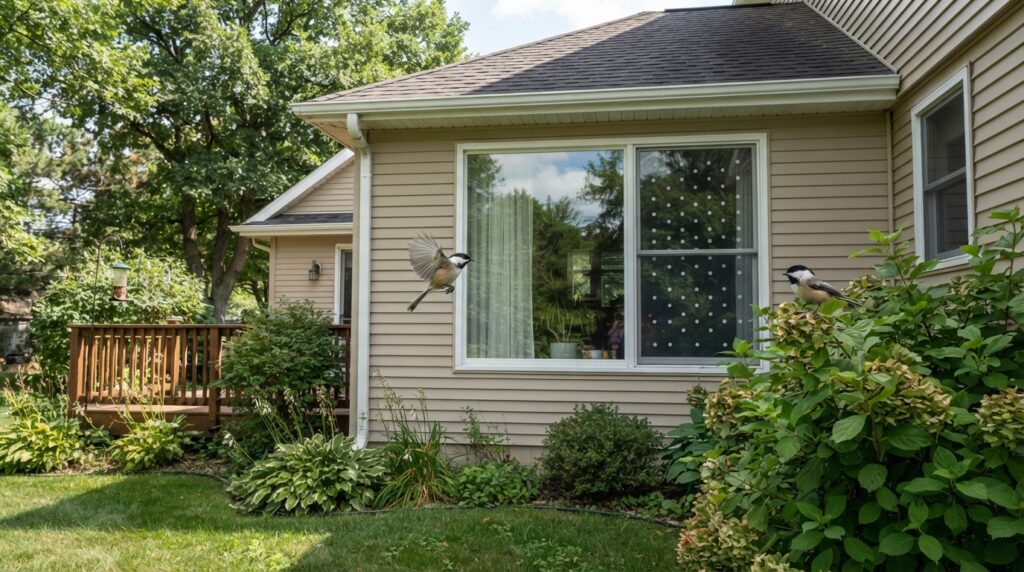
Birds do not see glass. They see the reflection of sky and trees and fly into it at full speed. The fix is to break up that reflection on the outside of the glass, with markings spaced no more than two inches apart. Two window decals in the corners do essentially nothing. Also move feeders: either closer than three feet to the glass, or further than thirty.
This is one of the few backyard bird problems where an individual homeowner can make a measurable difference, because the scale of it is not what most people assume.
A systematic review published in The Condor by Loss and colleagues estimated that between 365 million and 988 million birds are killed annually by building collisions in the United States, with a median estimate of around 599 million. The part that matters here: roughly 44 percent of that mortality occurs at residences, not at skyscrapers. Low-rise buildings account for most of the rest. Tall buildings, which get the attention, are a small share.
Your windows are the problem, and they are also the ones you can fix.
What actually works
- Markings on the outside of the glass, spaced 2 inches apart or less
- External screens or netting — the most effective single measure
- Feeders under 3 feet or over 30 feet from the window
- Closing blinds helps a little; it does not remove the reflection
- Two decals in the corners — effectively useless
Two different problems
Worth separating, because they need opposite responses.
Collisions. A bird flies into the glass at speed and is stunned or killed. It sees reflected sky, trees or your houseplants and reads it as open flight path. This happens year-round and peaks during migration.
Attacking the reflection. A bird repeatedly pecks or flies at a window, car mirror or hubcap, usually in spring, usually the same bird every morning. This is a territorial male fighting what he believes is a rival. He is not injured or confused. It stops on its own once nesting is underway.
The fixes overlap — both need the reflection broken up from outside — but the urgency is different. The first kills birds; the second is mostly an annoyance for you.
The two-inch rule
Birds will attempt to fly through gaps that look passable. Current guidance is that markings should be spaced no more than two inches apart horizontally and vertically — sometimes described as the two-by-two rule, and tightened from older four-inch advice as testing improved.
This is why a single hawk silhouette in the middle of a window does nothing. The bird simply flies past it, through the remaining unmarked glass, which is most of the window.
Everything must go on the outside of the glass. Markings behind the window are behind the reflection, and the reflection is what the bird is seeing. This is the most common mistake and it wastes the whole effort.
Options, roughly in order of effectiveness
| Method | How well it works | Drawback |
|---|---|---|
| External insect screens | Very effective — removes reflection and cushions any impact | Not available for all windows; reduces the view slightly |
| Netting stretched a few inches off the glass | Very effective — birds bounce off | Looks industrial |
| Cord or paracord curtains hung vertically 4 inches apart | Effective, and barely visible from inside | Needs installing above each window |
| Adhesive dot patterns at 2-inch spacing | Effective when spaced correctly | Visible; adhesive degrades in sun over a few years |
| Tempera paint or soap, patterned | Effective and free | Looks exactly like paint on a window |
| External window film with a dense pattern | Effective | More expensive; harder to install on large panes |
| Closing blinds or curtains | Slight help | Does not remove the exterior reflection |
| Two or three decals | Essentially none | Gives false reassurance, which is worse than nothing |
If you buy decals, buy enough to cover the whole pane at two-inch spacing — a pack of six for a picture window is not a solution. Check the product describes external application. The honest drawbacks: a fully treated window is noticeably patterned from inside, adhesive decals lift and yellow after a few years of sun, and some ultraviolet-only products marketed as invisible to humans have shown mixed results in testing. Something visible that you can see working is the safer buy.
Feeder placement
Counterintuitive but well established, and free.
| Feeder distance from glass | Risk |
|---|---|
| Under 3 feet | Low. Birds cannot build up enough speed to be injured |
| 3 to 30 feet | Highest. Enough runway to hit hard |
| Over 30 feet | Low. The window reads as part of the background |
If your feeder sits in that middle band, moving it is the single most effective change available to you and costs nothing. It is also why window-mounted feeders are a safe choice rather than a dangerous one, which surprises people.
If a bird hits your window
Do not assume a stunned bird is fine because it flew off. Many collision victims die later from internal injury or brain swelling, which is part of why the mortality estimates are so high — a bird that recovers enough to fly away is often not a survivor.
- Approach quietly and, wearing gloves, place the bird in a ventilated cardboard box lined with paper towel
- Somewhere dark, quiet and warm, away from pets and people
- No food, no water. Water dripped into the mouth easily enters the airway
- Leave it undisturbed for an hour or two, then take the box outside and open it. If it flies strongly, good
- If it cannot fly, has a drooping wing, or is still unsteady after a couple of hours, contact a licensed wildlife rehabilitator
- Any bird a cat has touched needs a rehabilitator regardless of how it looks
Other contributing factors
- Indoor plants near a window read as habitat through the glass. Move them back
- Windows on opposite walls create a see-through corridor that looks like a flight path. Break the line with a blind on one side
- Night lighting disorients nocturnal migrants. Turning off unnecessary outdoor and upper-floor lights during spring and fall migration genuinely helps, and is what the Lights Out programs run by Audubon chapters are asking for
Common questions
Do window decals actually work?
Only at density. A few decals on a large pane do very little, because birds fly through the unmarked gaps. Markings need to be no more than about two inches apart, on the outside of the glass.
Inside or outside the glass?
Outside, always. The bird is seeing a reflection on the outer surface, so anything behind that surface is not part of what it sees.
Should I move my feeder away from the house?
Only if you can get it beyond thirty feet. Otherwise move it closer — under three feet from the glass, birds cannot accelerate enough to injure themselves. The dangerous zone is the middle.
A bird hit my window and flew away. Is it all right?
Not necessarily. Internal injuries and brain swelling kill many birds that initially fly off. There is nothing you can do once it has gone, but it is a reason to treat the window rather than assume the problem resolved itself.
A bird keeps attacking my window every morning. Why?
A territorial male fighting his reflection, most common in spring. He is not ill. Break up the reflection on the outside of the glass; it stops naturally once nesting begins.
How many birds die this way?
Estimates for the United States run between 365 million and 988 million a year from building collisions, with a median around 599 million. Around 44 percent of that occurs at residences rather than tall buildings.
Related guides
- Cats and birds
- Types of bird feeders, including window feeders
- Northern Cardinal — why one is attacking your window
- I found a baby bird on the ground
Sources: Loss, S.R., Will, T., Loss, S.S. and Marra, P.P., “Bird–building collisions in the United States: Estimates of annual mortality and species vulnerability”, The Condor (2014); Cornell Lab of Ornithology, All About Birds guidance on window collisions and feeder placement; American Bird Conservancy glass collision testing and spacing guidance; National Audubon Society Lights Out program.
Want a closer look?
A pair of 8x42 binoculars is the single thing that changes backyard birding most. Close focus matters more than magnification when the bird is fifteen feet away.
This link goes to Amazon. If you buy through it we may earn a small commission, at no extra cost to you.