
Affiliate disclosure: some links on this page go to Amazon. If you buy through one we may earn a small commission, at no extra cost to you. Full disclosure.
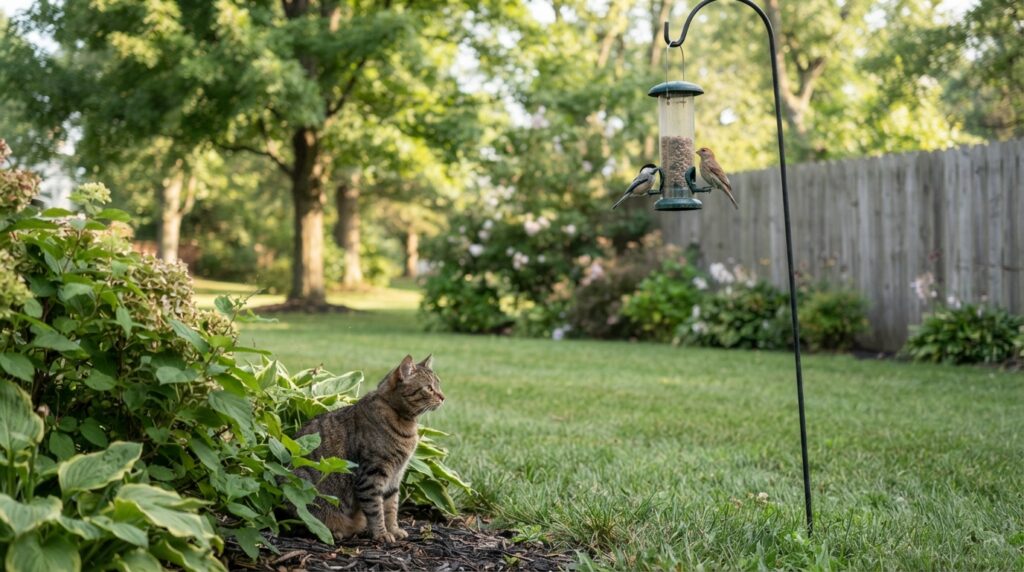
Keeping a cat indoors, or outdoors only under supervision, is the only measure that removes the risk entirely. Short of that, a brightly patterned collar cover has better evidence behind it than a bell does. For a neighbor’s cat, the practical levers are feeder placement — on a baffled pole, away from fences and low cover — rather than anything aimed at the cat.
This is a subject where people get shouted at, which is unhelpful, because most cat owners are also people who like birds. What follows is what the research actually shows and what reduces the problem in a real yard.
The numbers
The systematic estimate people cite comes from Loss, Will and Marra, published in Nature Communications in 2013. It found that free-ranging domestic cats kill an estimated 1.3 to 4.0 billion birds annually in the contiguous United States, along with 6.3 to 22.3 billion mammals. The frequently quoted single figure of around 2.4 billion is the middle of that range.
Two details matter and usually get lost:
- Un-owned cats cause the majority of it. Feral and stray cats, not pets, account for most of the mortality
- It is an estimate with wide bounds, built from a model rather than a count. The study was and remains contested. The order of magnitude is not seriously disputed; the precise figure is
For comparison, the same research group estimated building collisions at 365 to 988 million birds a year. Cats come out substantially higher.
What this does and does not mean for you. One well-fed pet cat that goes out in the afternoon is not personally responsible for a billion birds. But cats hunt regardless of hunger — predation is not driven by appetite — and a cat with access to a yard containing a bird feeder is hunting a concentrated food source. That specific combination is worth doing something about, and it is entirely within your control.
What works, in order
1. Keeping the cat in
Completely effective, and the only measure that is. Indoor cats also live substantially longer on average, avoiding vehicles, disease, fights and predators of their own.
For a cat used to going out, the transition is easier with vertical climbing space, window perches, scheduled play, and food puzzles. It generally takes a few weeks.
2. Supervised outdoor access
A catio — an enclosed outdoor run — gives a cat fresh air and stimulation with no hunting. They range from a window box to a full enclosure. Leash walking works for some cats.
3. Restricting the hours
Dawn and dusk are peak hunting periods and peak bird activity. Keeping a cat in overnight and until mid-morning removes a disproportionate share of the risk. It is a compromise rather than a solution, but it is a real reduction.
4. A brightly patterned collar cover
The one accessory with genuine published evidence behind it. Wide, brightly colored collar covers — the best-known is the BirdsBeSafe design — work on the basis that songbirds have excellent color vision and spot the cat before it strikes.
Field studies have found substantial reductions in birds caught by cats wearing them. Importantly, the effect is much weaker for mammals, which see color poorly — which is itself evidence the mechanism is doing what it claims.
Honest drawbacks: it must go over a proper breakaway safety collar, and covers get lost regularly, so buy more than one. Some cats object initially. It reduces predation, it does not eliminate it. And it does nothing for small mammals, reptiles or amphibians.
5. Bells
Evidence is mixed and generally weaker than for collar covers. Some studies find a modest reduction; cats appear to learn to move without ringing them. A bell is better than nothing and considerably worse than the alternatives above.
Feeder placement when there is a cat
The practical answer when the cat is not yours, and worth doing even when it is.
| Change | Why |
|---|---|
| Feeder on a smooth pole with a baffle | A baffle stops cats climbing as well as squirrels |
| Cover about 10 feet away, not adjacent | Close cover is an ambush point. Ten feet gives birds an escape route without giving a cat a hiding place |
| Clear low dense planting under and around the feeder | That is where a cat waits |
| Away from fences, walls and sheds | All are launch and observation points |
| Rake up spilled seed | Ground-feeding birds are the most vulnerable of all |
| Prickly planting at the base of the pole | Discourages sitting underneath |
Ground feeding and nest boxes
If cats use your yard, reconsider ground feeding entirely — juncos, doves and sparrows feeding on open ground are the easiest targets available.
Nest boxes should go on smooth poles with baffles rather than on trees or fences, which cats climb without effort.
A neighbor’s cat
Difficult, and worth handling carefully, because the relationship usually matters more than the outcome.
- Do the placement changes above first — they are within your control and they work
- Motion-activated sprinklers deter cats reasonably well and are harmless
- Cats dislike certain textures underfoot; a strip of chicken wire laid flat under the feeder area discourages sitting
- If you do speak to the neighbor, offering a collar cover as a gift lands considerably better than a complaint
- Never harm or trap someone’s pet. Beyond the obvious, it is illegal in most places
Feral colonies
A genuinely contested area, and this site is not going to pretend otherwise. Trap-neuter-return is widely practiced and widely debated: supporters point to stabilized colony sizes over time, critics point to research suggesting colonies maintained and fed by people can reach densities well above what truly feral cats would sustain, with predation continuing throughout.
If there is a colony near you, your local wildlife agency and local cat welfare organizations will have positions on it, and they will not be the same position. That is the honest state of the question.
Common questions
How many birds do cats kill in the US?
An estimated 1.3 to 4.0 billion a year in the contiguous states, from a 2013 systematic review by Loss, Will and Marra. Un-owned cats account for the majority.
Does a bell on the collar work?
Somewhat, but the evidence is mixed and cats appear to learn to move quietly. A brightly patterned collar cover has better published support.
My cat is well fed. Does it still hunt?
Yes. Hunting in cats is not driven by hunger, which is why well-fed pets still catch birds and often do not eat them.
Where should I put a feeder if there are cats around?
On a smooth pole with a baffle, roughly ten feet from cover, away from fences and sheds, with low dense planting cleared from underneath. Rake up spillage so nothing feeds on the ground.
A cat caught a bird and it seems unhurt. What now?
It needs a licensed wildlife rehabilitator regardless of appearance. Bacteria in a cat’s mouth cause infections that kill birds within days, even from punctures too small to see.
Is keeping a cat indoors cruel?
Indoor cats live substantially longer on average. Cats need stimulation rather than territory specifically — vertical space, play, puzzles, and a catio or leash walks give outdoor access without the hunting.
Related guides
- Why birds fly into windows
- I found a baby bird on the ground
- Why aren’t birds coming to my feeder?
- Nest box hole sizes by species
Sources: Loss, S.R., Will, T. and Marra, P.P., “The impact of free-ranging domestic cats on wildlife of the United States”, Nature Communications 4:1396 (2013); Loss et al., The Condor (2014) on building collisions; Cornell Lab of Ornithology, All About Birds; American Bird Conservancy Cats Indoors program; published field trials of anti-predation collar covers.
Want a closer look?
A pair of 8x42 binoculars is the single thing that changes backyard birding most. Close focus matters more than magnification when the bird is fifteen feet away.
This link goes to Amazon. If you buy through it we may earn a small commission, at no extra cost to you.