
Affiliate disclosure: some links on this page go to Amazon. If you buy through one we may earn a small commission, at no extra cost to you. Full disclosure.
If the feeder is new, the usual answer is time — two to four weeks is normal, and longer is common. If birds were coming and stopped, the three likeliest causes are stale or spoiled seed, a hawk working your yard, or late-summer molt. Work through the checklist below in order rather than changing everything at once.
There are two versions of this problem and they have different answers, so it is worth being clear which one you have.
The feeder is new and nothing has ever come. This is almost always patience. Birds find food by watching each other and by working a regular route through the neighborhood, and a new object takes time to enter that route.
Birds were coming and then stopped. Something changed. Usually it is the seed, a predator, or the season — and there is a sensible order to check them in.
Check in this order
- How long has it been up? Under a month on a new feeder means keep waiting
- Smell the seed. Musty, clumped or dusty seed gets refused outright
- Look for a hawk. A single Cooper’s Hawk empties a yard for days
- What month is it? Late summer and early fall are genuinely quiet
- Is the feeder dirty? Moldy residue puts birds off and makes them ill
- Where is it? Too exposed and nothing feels safe landing
- Is there a cat? Birds learn a yard is dangerous within days
1. The feeder is new
Two to four weeks is the normal range for a new feeder to be discovered, and six weeks is not unusual in a yard with little cover or in a neighborhood where several other people feed birds.
Birds locate food largely by watching other birds. Chickadees and titmice are typically first to investigate anything new, and everything else follows them. Until one curious chickadee works out that your feeder is food, nothing happens.
Three things speed it up: put the feeder where birds already go, near a shrub or tree rather than in open lawn; scatter a little seed on the ground or on top of the feeder so it is visible from above; and leave it alone. Moving a new feeder every few days resets the clock every time.
2. The seed is stale, wet or the wrong kind
This is the most common cause of a feeder that was busy and went quiet, and the easiest to miss because seed does not look obviously bad.
Open the feeder and smell it. Fresh seed smells faintly nutty and of nothing much. Old seed smells musty. If it has clumped, feels damp, has a dusty gray bloom on it, or has sprouted at the bottom, birds will refuse it — and eating it can make them sick.
Seed does not last indefinitely in a bag either. Nyjer in particular goes stale fast, and stale nyjer is one of the most common reasons finches abandon a feeder that worked fine last month.
The cheap-mix problem. If you switched to a bargain mix, that alone can explain it. Mixes padded with milo, red millet, wheat and oats get thrown on the ground while birds dig for the sunflower. What looks like “birds are not coming” is often “birds are coming, eating the 20% they want, and dumping the rest.” How to read a seed label.
Straight black oil sunflower is the reliable diagnostic. If birds ignore a feeder filled with fresh black oil sunflower, the problem is not the food. The trade-off is shell debris underneath, which needs raking and which will kill grass over a season.
3. There is a hawk
A feeder is a concentration of small birds, and Cooper’s Hawks and Sharp-shinned Hawks have learned this thoroughly. Both hunt suburban yards specifically because feeders are there.
The signature is abrupt: a busy feeder goes completely silent, often within a single day, and stays that way for anywhere from a few days to a couple of weeks. You may find a scatter of feathers on the lawn, or see a medium-sized long-tailed hawk sitting quietly in a tree.
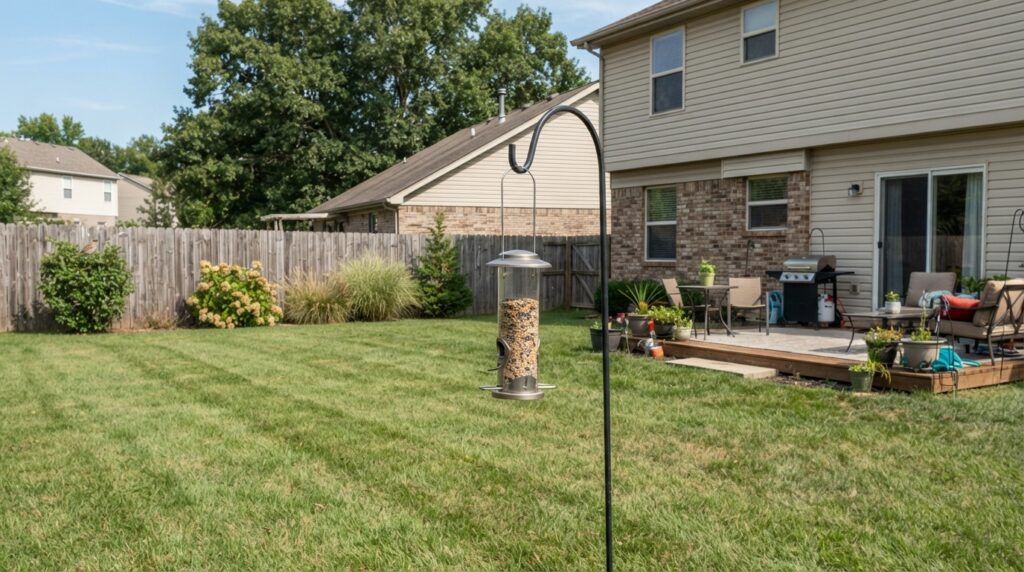
This is not a problem to solve. Hawks are native, protected under the Migratory Bird Treaty Act, and part of a functioning yard. What helps is cover: a feeder within about ten feet of a dense shrub gives small birds somewhere to dive. Ten feet is the useful distance — much closer and a cat has an ambush point, much further and there is nowhere to reach.
4. It is late summer
Every August, people conclude they have done something wrong. Almost nobody has.
Two things coincide. Birds molt after nesting, replacing their feathers, which is energetically expensive and makes them vulnerable, so they stay under cover and go quiet. At the same time natural food — insects, seeds, berries — is at its annual peak, so a feeder is the least interesting option available.
It resolves on its own, generally through September as migration begins and natural food declines. Keep the feeder clean and stocked with less at a time so nothing spoils in the heat.
5. The feeder is dirty
Birds avoid feeders with moldy residue, wet clumped seed, or a build-up of droppings on the perches. Beyond the avoidance, a dirty feeder actively spreads disease.
Cornell Lab and Project FeederWatch recommend cleaning roughly every two weeks, more often in hot or wet weather or if there is any sign of illness. Full method in how to clean bird feeders.
6. Placement
Birds will not feed somewhere that feels dangerous, and their assessment differs from ours.
| Problem | What happens | Fix |
|---|---|---|
| Middle of open lawn | Nowhere to escape to. Small birds will not commit | Move within about 10 feet of a shrub or tree |
| Buried inside dense cover | Cats and hawks have an ambush point | Near cover, not inside it |
| Right against a window | Varies by distance — see below | Either under 3 feet or over 30 feet from glass |
| Heavy foot traffic | Constant disturbance | A quieter side of the house |
| High wind or full sun | Seed spoils faster, feeding is harder | Sheltered spot with some shade |
On windows. Feeders in the middle distance from glass — roughly three to thirty feet — are the worst case for collisions, because birds build up enough speed to be injured. Closer than three feet, they cannot accelerate enough to hurt themselves. Further than thirty feet, the window reads as part of the background. If your feeder sits in that middle range, moving it is the single most useful change you can make.
7. Cats
A cat that hunts your yard will empty it, and birds remember. Outdoor cats are among the largest human-linked causes of bird mortality in North America.
If it is your cat, keeping it in — or out during dawn and dusk when hunting peaks — changes things within a week or two. If it is a neighbor’s, keep feeders well away from fences, low walls and anything a cat can wait under. Feeders on a smooth pole with a baffle are much harder to ambush than one hanging from a low branch.
8. There is better food nearby
An oak dropping acorns, a berry-heavy shrub, a neighbor who just started feeding, or a farm field recently harvested will all pull birds away temporarily. This is not something to fix. When the natural supply runs down, they come back.
9. Something changed
Worth a moment’s thought: new feeder, new position, new seed brand, a tree removed, a fence painted, scaffolding up, a new wind chime near the feeder. Birds notice changes we do not, and often need a few days to accept them.
The diagnostic checklist
Work through these before changing anything
- Has the feeder been up less than a month? → Wait. Do not move it
- Does the seed smell musty, or is it clumped, dusty or sprouting? → Bin it, fill with fresh black oil sunflower
- Did it go silent suddenly, in one day? → Look for a hawk. Wait a week
- Is it August or early September? → Molt. Wait it out
- Is there visible residue or droppings on the feeder? → Clean and disinfect
- Is the feeder more than 10 feet from cover? → Move it closer to a shrub
- Is a cat using the yard? → Move the feeder to a pole with a baffle
- Have you seen a sick or dead bird? → Take everything down for 1–2 weeks. Read this first
The one rule throughout: change one thing and give it a week. Changing feeder, seed and position at once means you learn nothing, and the disruption itself sets you back.
Common questions
How long does it take for birds to find a new feeder?
Two to four weeks is typical, and six weeks is not unusual. Yards with little cover, or neighborhoods with lots of existing feeders, take longer. Leaving it in one place is the most useful thing you can do.
All my birds vanished overnight. What happened?
Sudden and total silence usually means a predator — most often a Cooper’s or Sharp-shinned Hawk. It normally passes within a few days to two weeks. If you have also seen a sick or dead bird, treat it as a disease question instead and take the feeders down.
Should I move the feeder if nothing is coming?
Not in the first month. Moving resets the discovery process. After a month with no visitors at all, one move to a spot nearer cover is reasonable — then leave it there.
Does the color or type of feeder matter?
Type matters, color does not much. Different designs suit different birds: cardinals want somewhere to stand and largely ignore small tube perches, goldfinches want small ports or mesh. If one feeder is being ignored while another is busy, the design is the likeliest reason. Full comparison here.
Can I put seed on the ground instead?
You can, and many species prefer it — juncos, doves, towhees and most sparrows. Scatter only what will be eaten in a day. Seed left on wet ground molds quickly, and a permanent pile attracts rodents and, in bear country, bears.
Is it worth using a mix with dried fruit or mealworms?
Sometimes, but it rarely solves an empty feeder. If plain fresh black oil sunflower is being ignored, adding extras will not help — the problem is somewhere else on this list. Save the upgrades for a feeder that already works.
Related guides
- Best bird seed: what works and what to avoid
- How to clean bird feeders
- Types of bird feeders
- When to feed backyard birds
Sources: Cornell Lab of Ornithology, All About Birds and Project FeederWatch guidance on feeder placement, cleaning and common feeding problems; National Audubon Society; US Fish & Wildlife Service on window collisions and outdoor cats; state wildlife agency guidance on feeder placement.
Starting out?
One tube feeder with black oil sunflower brings in more species than any other single setup. Metal ports last; all-plastic ports get chewed open within a season or two.
This link goes to Amazon. If you buy through it we may earn a small commission, at no extra cost to you.