
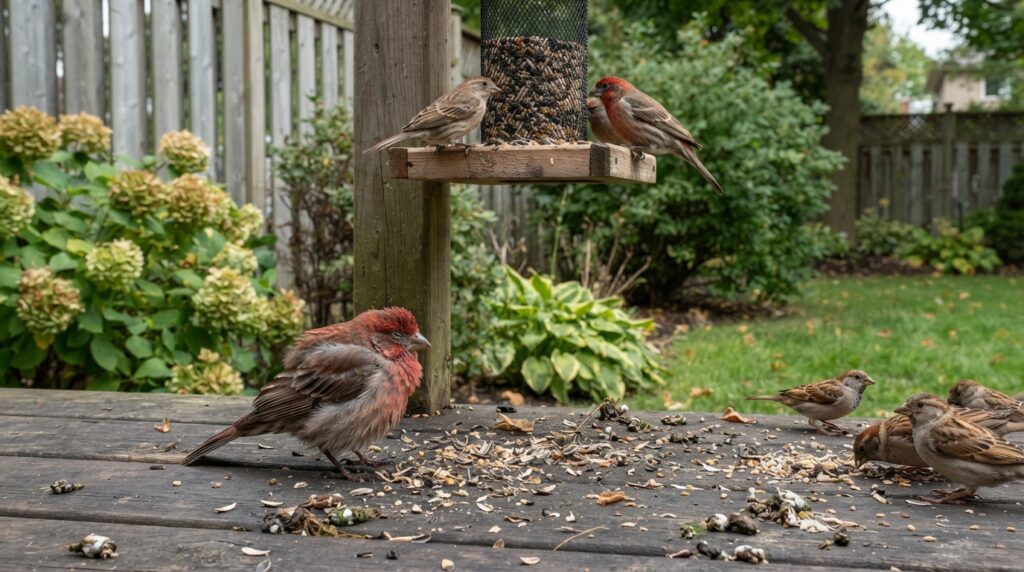
Take your feeders and bird baths down for one to two weeks. Clean and disinfect everything with a 1:9 bleach solution, rake up the debris underneath, and let the birds disperse. Report unusual numbers of sick or dead birds to your state wildlife agency. Wear gloves, and do not handle a sick bird — contact a licensed wildlife rehabilitator instead.
A bird sitting fluffed up on your feeder, not moving when you approach, is the clearest signal you will get that something is wrong. Healthy wild birds do not let you walk up to them.
This page covers what to look for, what the likely causes are, what to do about it, and who to tell. There are no product links on this page and there never will be — if you are here, you need an answer, not a shopping list.
If you have found a sick or injured bird
Contact a licensed wildlife rehabilitator in your state, or your state wildlife agency. Searching for “wildlife rehabilitator” with your state and county will normally find one nearby. Do not try to treat a wild bird yourself — handling most native species without a permit is unlawful under the Migratory Bird Treaty Act, including when you are trying to help, and rehabilitation is skilled work.
Signs a bird is sick
What to look for
- Lethargy. Sitting still for long periods, slow to react, easy to approach
- Fluffed-up posture in mild weather, often with eyes partly closed
- Swollen, crusted or weepy eyes, sometimes swollen shut
- Appearing unusually thin, or oddly puffy
- Staying on the ground beneath the feeder rather than on it
- Growths or lesions around the eyes, bill, legs or feet
- Laboured breathing, or a bird that seems unable to fly properly
- More than one dead bird in the yard over a short period
One dead bird is not necessarily a disease event — window strikes, cats and predation account for a great many. A pattern is what matters: several birds over a few days, several of the same species, or birds showing the signs above.
The four common causes
Salmonellosis
A bacterial infection, and the one behind most large feeder die-offs in the US. Sick birds appear lethargic and fluffed, often with swollen eyelids, and are easy to approach. Birds can die within about a day of showing symptoms, and some carry and shed the bacteria without ever looking ill.
Outbreaks are strongly associated with Pine Siskin irruption years — winters when poor conifer cone crops in the boreal forest push large numbers of siskins south. When they arrive in unusual concentrations, the disease can spread quickly, and it moves on to goldfinches, House Finches and other finches. The 2020–21 irruption produced one of the biggest documented outbreaks, with mass mortality across the Pacific Northwest and beyond.
Where the experts do not fully agree. There is a real difference of emphasis on how salmonellosis spreads and how much feeders are responsible.
Project FeederWatch describes it as a common cause of mortality in feeder birds and says it is transmitted primarily through fecal contamination of food and water, with bird-to-bird contact as a secondary route. Other sources, including guidance drawing on Cornell Lab material, characterize it as an uncommon cause of mortality and put more weight on bird-to-bird transmission during roosting and daily contact — noting that the birds affected are social species that would gather whether feeders existed or not, and that feeders are simply where we happen to observe them.
The practical advice is the same either way: keep feeders clean, and take them down when birds are visibly sick. But it is worth knowing that “feeders cause outbreaks” is a stronger claim than the evidence unambiguously supports.
House Finch eye disease (mycoplasmal conjunctivitis)
Caused by the bacterium Mycoplasma gallisepticum. It first appeared in House Finches in the eastern US in the early 1990s and spread rapidly across the continent, and it is now tracked by Project FeederWatch’s House Finch Disease Survey.
The signs are distinctive: red, swollen, runny or crusted eyes, sometimes swollen shut. Affected birds often sit on or under a feeder for long periods. Most do not die directly of the infection — they die because they cannot see well enough to find food or avoid predators.
It affects House Finches most, with American Goldfinches, Purple Finches and Evening Grosbeaks also susceptible. If you see it, reporting it to Project FeederWatch genuinely contributes to a long-running dataset on how the disease moves.
Avian pox
A virus producing wart-like growths on unfeathered areas — around the eyes, bill, legs and feet. Growths can become large enough to interfere with feeding or vision. It spreads through direct contact, contaminated surfaces and biting insects.
Mild cases often resolve on their own. Birds with growths severe enough to impede feeding usually do not survive.
Aspergillosis
A fungal infection of the respiratory tract, contracted by inhaling spores from moldy seed or damp debris. Signs include laboured breathing, lethargy and weight loss, and it is often fatal.
This one is almost entirely preventable at your end. It comes from wet seed, spoiled seed left sitting in a feeder, and moldy hulls accumulating on the ground — which is why drying a feeder properly after cleaning and raking underneath both matter more than they appear to.
What to do
| Step | Detail |
|---|---|
| 1. Take everything down | Feeders and bird baths, for at least one to two weeks. During an outbreak this matters more than cleaning more often, because it breaks up the crowding |
| 2. Bin the seed | Do not tip it on the ground. Bag it and dispose of it |
| 3. Clean and disinfect | Scrub off all debris, then soak ten minutes in 1 part bleach to 9 parts water. Rinse thoroughly, dry completely. Full method |
| 4. Clear the ground | Rake up hulls, spilled seed and droppings underneath and dispose of them |
| 5. Report it | State wildlife agency, and eBird or Project FeederWatch. See below |
| 6. Wait | Put feeders back only once you have seen no sick or dead birds for a couple of weeks |
If Pine Siskins are the problem specifically: one approach used by wildlife groups is to reintroduce feeding in stages. Bring back foods that do not attract finches first — suet, peanuts, safflower — and hold off on nyjer and finch feeders for another week or two after that. It lets you resume feeding without immediately re-concentrating the species most affected.
Reporting it
This matters more than people assume. Unusual die-offs are largely detected because members of the public notice them and say something.
- Your state wildlife or natural resources agency. The first call for several dead birds, or any bird showing neurological signs. They may want the location, species and numbers, and will say whether they want the carcasses collected
- Project FeederWatch runs the House Finch Disease Survey and collects reports of sick birds at feeders
- eBird lets you record sick or dead birds in a checklist
Handling dead birds
If your state agency has not asked you to leave them in place:
- Wear disposable gloves, or invert a plastic bag over your hand
- Double-bag the bird and dispose of it in household waste, or bury it deep enough that pets and scavengers cannot reach it
- Wash your hands thoroughly with soap and warm water afterwards
- Keep pets away. Cats can contract salmonellosis from eating infected birds, and mammals have contracted avian influenza from scavenging carcasses
Avian influenza
Worth addressing because it generates a lot of alarm and the current guidance is fairly clear.
Highly pathogenic avian influenza (HPAI H5N1) has circulated in North American wild birds since late 2021 and has caused serious mortality in waterfowl, raptors and seabirds. Songbirds — the birds at your feeder — have accounted for a small proportion of detections in wild birds, and as of early 2026 there is no federal recommendation to take feeders down on avian flu grounds unless you also keep poultry. That position comes from the USDA APHIS National Wildlife Disease Program and is reflected in Cornell Lab’s guidance.
Two qualifications. If you keep chickens or other poultry, USDA advises removing food, water and shelter that draw wild birds near your flock. And individual state agencies do occasionally issue local advice to take feeders down — Texas did so in early 2025 — so it is worth checking your own state rather than relying on the national picture.
CDC continues to assess the risk to the general public as low, and there have been no human cases in North America attributed to exposure to wild songbirds.
Common questions
Should I take my feeders down if I see one sick bird?
Yes. One to two weeks down, with everything cleaned and disinfected and the ground raked. It is a low-cost precaution and it is the standard recommendation.
A finch has swollen, crusty eyes. What is it?
Most likely House Finch eye disease, mycoplasmal conjunctivitis. Take feeders down, disinfect, and report it to Project FeederWatch’s House Finch Disease Survey, which has tracked the disease since the 1990s.
How long should feeders stay down?
One to two weeks is the usual guidance, and some agencies suggest waiting up to three weeks after the last sick or dead bird is seen. Judge it by whether birds are still turning up ill rather than by the calendar.
Can I get sick from my bird feeder?
Salmonella is transmissible to people. The risk is low with gloves and handwashing. Do not clean feeders in a sink used for food preparation, and keep cleaning brushes separate from kitchen ones.
Can my cat catch something from an infected bird?
Yes. Cats can contract salmonellosis from eating infected birds, and mammals have contracted avian influenza from scavenging carcasses. Keeping cats indoors during an outbreak protects them as well as the birds.
Is one dead bird under the feeder a disease outbreak?
Usually not. Window strikes, cats and predation account for most single deaths. A pattern — several birds over a few days, or birds showing the signs listed above — is what warrants taking feeders down and reporting.
Related guides
- How to clean bird feeders
- When to feed backyard birds
- Why aren’t birds coming to my feeder?
- Contact us
Sources: Project FeederWatch, Sick Birds and Bird Diseases and the House Finch Disease Survey; Cornell Lab of Ornithology, All About Birds, on avian influenza and feeder disease; USDA APHIS National Wildlife Disease Program; US Centers for Disease Control and Prevention on H5N1 risk; USGS National Wildlife Health Center; National Audubon Society; Virginia Department of Wildlife Resources and other state wildlife agency guidance; regional Audubon chapters and wildlife rehabilitation centers on the 2020–21 Pine Siskin salmonellosis outbreak.
This page is general information and is not veterinary advice. For an individual sick or injured bird, contact a licensed wildlife rehabilitator or your state wildlife agency.