
Affiliate disclosure: some links on this page go to Amazon. If you buy through one we may earn a small commission, at no extra cost to you. Full disclosure.
Bring feeders in at night. That is the answer, and everything else is a partial measure. Raccoons are nocturnal, strong enough to pull a feeder off a hook, and dexterous enough to open most catches. If bringing them in is impractical, a smooth pole at least 6 feet high with a large baffle whose base sits above 4 feet is the best static defense — a standard squirrel baffle is often not enough.
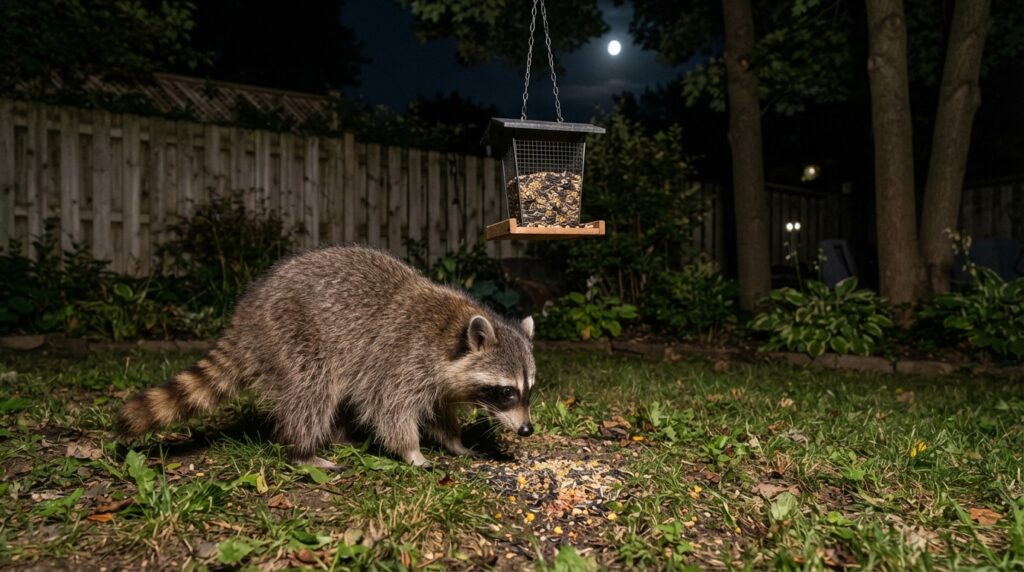
The signature is unmistakable. The feeder was full at dusk and by morning it is on the ground, emptied, sometimes with the lid off and the pole bent. Squirrels do not do that. Raccoons do.
The difficulty is that raccoons combine three things no other yard visitor has together: they work at night when nothing you have set up is being watched, they have genuinely dexterous hands, and an adult can weigh fifteen to twenty pounds — enough to simply pull a hanging feeder down.
What works
- Bringing feeders in at dusk — completely effective
- A tall smooth pole with a large baffle mounted high
- Clearing spilled seed every evening — the ground is half the attraction
- Removing every other food source — trash, pet food, fallen fruit
- Not feeding them deliberately. Illegal in some states, and a bad idea everywhere
Why your squirrel setup is not enough
A baffle sized and placed for squirrels frequently fails against raccoons, for reasons of simple physics.
| Squirrel | Raccoon | |
|---|---|---|
| Weight | About 1 lb | 10–20 lb |
| Reach | Short | Long arms — reaches around a narrow baffle |
| Grip | Claws | Hands. Opens latches and lids |
| Active | Daylight | Night, mostly after you have gone to bed |
| Approach | Climbs and jumps | Climbs, and will also just pull the whole thing down |
A baffle that a squirrel cannot get past may still be reached around by a raccoon’s longer arms, or simply climbed over if it is mounted at squirrel height. And a weight-activated feeder designed to close under a squirrel’s weight is irrelevant to an animal that removes the feeder from the pole entirely.
The static defense, if you need one
If bringing feeders in is genuinely impractical, this is the setup that gives you the best chance:
- A smooth metal pole, at least 6 feet to the feeder. Higher than the standard 5-foot squirrel guidance
- A large-diameter baffle, cylindrical or dome, with the base at least 4 to 5 feet off the ground. Wide matters as much as high — a raccoon reaches further than a squirrel
- Nothing within reach. Fences, sheds, low branches, deck rails, trash cans, woodpiles
- The pole firmly set. A pole pushed into soft ground gets pulled over. Concrete it in, or use a heavy ground socket
- Feeders that latch rather than simply lift off
Check the stated diameter and the clamp fit against your pole before ordering — a baffle that slides down under twenty pounds of raccoon is no baffle at all. The honest position: a large baffle correctly mounted reduces raccoon raids considerably but does not reliably stop a determined animal, and it is visually intrusive. Nothing sold as raccoon-proof is genuinely raccoon-proof.
Bringing feeders in
Unfashionable advice because it is inconvenient, and it is still the only thing that works completely.
Take feeders down at dusk and put them out at first light. Birds feed heavily in the early morning and are not using the feeder overnight, so you lose nothing. Store them in a sealed container in a garage or shed, not on the porch where the smell carries.
Two weeks of this is usually enough to break the habit. A raccoon that checks your yard four nights running and finds nothing moves on to somewhere that reliably has food.
Clear the ground
Half of what a raccoon comes for is on the lawn. Spilled seed and hulls under the feeder are an easy meal that no baffle protects, and they will keep an animal returning even if it never reaches the feeder itself.
Rake underneath in the evening. Use a seed tray to catch spillage. Offer sunflower chips instead of whole seed if debris is the persistent problem — they cost more and spoil faster in wet weather, but there are no hulls.
The rest of the yard
A raccoon visiting your feeder is usually also visiting other things, and dealing with only the feeder rarely settles it:
- Secure trash in bins with locking lids, stored inside until collection morning
- Feed pets indoors; never leave bowls out overnight
- Pick up fallen fruit
- Clean grills after use
- Cap chimneys and close off deck and shed access — raccoons den in those spaces
- Compost in an enclosed bin, not an open heap
Do not feed them, and do not trap them
Deliberately feeding raccoons is illegal in a number of states, and it produces animals that lose their wariness of people and become a problem for the whole street.
Trapping and relocating is regulated or prohibited in many states, partly because raccoons are a significant rabies vector and moving them moves disease. Relocated animals also have poor survival rates, and the vacancy fills within days. Check your state wildlife agency before considering it.
Never approach or corner a raccoon. If one appears sick, disoriented, unsteady, or is active and unafraid in broad daylight, do not go near it — contact your state wildlife agency or animal control.
Common questions
How do I know it is a raccoon and not a squirrel?
Damage happens overnight, the feeder is often on the ground or the pole bent, and lids and latches are opened rather than chewed. Squirrels work in daylight and chew rather than unfasten.
Will a squirrel baffle stop a raccoon?
Often not. Raccoons have longer arms and reach around narrow baffles, and they can climb over one mounted at squirrel height. You need a wider baffle mounted higher, on a taller pole.
Do I really have to bring the feeder in every night?
It is the only completely reliable answer. Birds do not feed overnight, so nothing is lost, and two weeks of empty nights usually persuades a raccoon to look elsewhere.
Can I trap and move a raccoon?
Many states restrict or prohibit it, partly because raccoons carry rabies and relocation spreads it. Survival rates for moved animals are poor and another raccoon replaces it quickly. Check your state agency first.
Is a raccoon out in daylight rabid?
Not necessarily — nursing females forage by day, and urban raccoons adjust their hours. But a raccoon that is disoriented, unsteady, aggressive or unafraid should be reported to animal control or your state agency rather than approached.
Are hummingbird feeders at risk too?
Yes. Raccoons take them for the sugar and will pull them down. If raccoons are active, bring nectar feeders in overnight as well.
Related guides
Sources: Cornell Lab of Ornithology, All About Birds and Project FeederWatch guidance on feeder pests and predator guards; state wildlife agency guidance on nuisance wildlife, wildlife relocation and rabies vector species; university extension service guidance on raccoon management; manufacturer specifications for pole baffles.
Starting out?
One tube feeder with black oil sunflower brings in more species than any other single setup. Metal ports last; all-plastic ports get chewed open within a season or two.
This link goes to Amazon. If you buy through it we may earn a small commission, at no extra cost to you.