
Affiliate disclosure: some links on this page go to Amazon. If you buy through one we may earn a small commission, at no extra cost to you. Full disclosure.
In bear country, take seed and suet feeders down from around April 1 to November 30 — that is the guidance from Vermont, New Hampshire, New York, Maryland and Virginia among others, with exact dates varying by state. Bringing feeders in overnight is not sufficient, because bears feed by day and will work on spilled seed on the ground. Check your own state agency, because the rules and the dates differ.
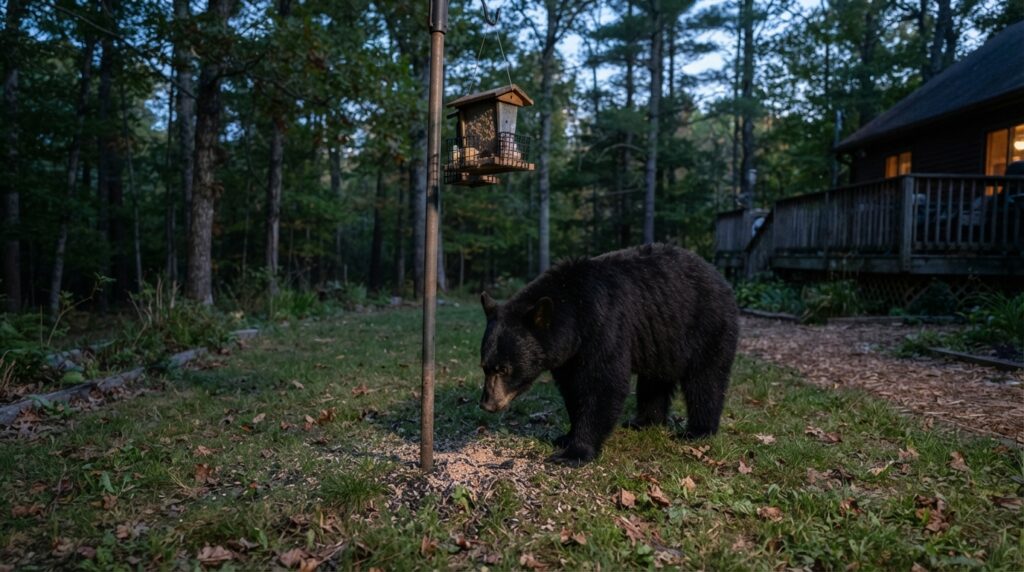
This is the one part of American bird feeding where the advice is genuinely to stop, and it is worth taking seriously. A bird feeder is a concentrated, high-calorie, effortless food source, and it is one of the most common things that draws a black bear into a yard for the first time.
What follows that first visit is the problem. A bear that finds food at a house comes back, expands its search to garbage and grills, loses its wariness of people, and eventually becomes a bear that a wildlife agency has to deal with. That outcome is almost always fatal for the bear.
The essentials
- Roughly April 1 to November 30 is the standard window for taking feeders down, though states differ
- Bringing them in at night does not work. Bears feed in daylight too
- Spilled seed counts. Rake up underneath as well as removing the feeder
- It is illegal to feed bears in many states, and a bird feeder can qualify
- Birds do not need you in summer. Natural food is abundant
- A fed bear is a dead bear — the phrase wildlife agencies use, and it is literal
Where this applies
Black bears occur across a much larger area than most people assume, and their range has expanded in recent decades. New England and the Northeast, the Appalachians down through Georgia, the Great Lakes states, the Rockies, the Pacific Northwest, California, and parts of the Southwest and Gulf states.
If you are not sure whether you are in bear country, your state wildlife agency publishes a range map. Neighborhoods that had no bear activity a decade ago frequently do now.
What the states actually say
The dates cluster but do not match exactly, which is why checking your own state matters.
| State | Guidance |
|---|---|
| Vermont | Fish & Wildlife recommends taking feeders down April 1 through November 30. Most bears den December 1 to April 1, though some emerge in warm spells |
| New Hampshire | Fish and Game: finish bird feeding by April 1, do not resume before December 1. South of the White Mountains, consider removing by March 15 or at the onset of spring weather |
| New York | DEC advises taking feeders down and clearing remaining seed by April 1 throughout bear country, which is much of upstate |
| Maryland | DNR advises removing feeders April through November. Bears are most common in the four westernmost counties |
| Virginia | DWR recommends removing feeders April through November, and notes it is illegal to feed bears on public or private land |
| New Jersey | Takes a different line: if you feed, do so December 1 to April 1, in daylight only, on a free-hanging wire at least 10 feet up and 10 feet from any trunk, not off a house or deck, with spill pans and daily cleanup |
New Jersey is worth noting precisely because it differs. Most states say remove; New Jersey sets conditions instead. That is a good illustration of why “check your state” is not a hedge — the guidance genuinely varies.
Why overnight removal is not enough
The most common half-measure is bringing the feeder in each evening and putting it back in the morning. Vermont Fish & Wildlife addresses this directly: it does not work, because bears also feed during the day, and because seed spilled on the ground stays there whether the feeder is hanging or not.
A bear does not need to reach the feeder. It needs to find the smell of sunflower seed at your house once.
The same applies to “bear-proof” feeders and poles. New Hampshire Fish and Game puts it plainly: bears are clever, strong and agile, and establishing a genuinely bear-proof feeder is very difficult. Anything that keeps the seed out of reach still leaves the scent, and a bear that investigates a yard and finds nothing this time has still learned the address.
What to do instead of feeding
Birds do not need supplemental feeding between April and November. Natural food — insects, seeds, fruit — is at its most abundant, and that is a large part of why state agencies are comfortable telling people to stop.
What you can do in the meantime:
- Plant for birds. Native shrubs, seed-bearing perennials and berry plants feed birds with nothing for a bear to find
- Provide water. A bird bath brings in species a feeder never would, and does not attract bears
- Put up nest boxes. Spring is the season for them anyway
- Hummingbird feeders are a judgment call. Bears will take them for the sugar, and several states include them in removal advice. Ask your state agency — guidance differs
A shallow bath is the sensible summer substitute in bear country — water attracts birds that never touch a feeder and holds nothing a bear is interested in. The genuine drawbacks: baths need scrubbing at least weekly in warm weather, concrete ones crack if left full through a freeze, and a bath too deep or too slippery is unusable by small birds. Under two inches at the edge is the specification that matters.
The full clean-up
Removing the feeder is one part of it. State agencies consistently list the rest together:
- Rake up spilled seed and hulls and dispose of them in a secure container
- Store the seed indoors, in a garage or shed, in a sealed container — not on a porch
- Secure garbage inside until the morning of collection, not the night before
- Feed pets indoors and do not leave bowls outside
- Clean grills after use and store them where the smell is contained
- Protect poultry and beehives with electric fencing
If a bear is already visiting
Remove the feeder immediately, whatever the date. Clean up everything underneath. Secure every other attractant on the list above.
Report the activity to your state wildlife agency — they track it, and they would generally rather hear about it early than be called out later. Never approach a bear, never attempt to move one, and never leave food out to encourage it away.
The legal position
Intentionally feeding bears is illegal in many states, and the wording is often broad enough that a bird feeder which is knowingly attracting bears can count. Vermont and Virginia both state the prohibition explicitly. Some states also require residents to take reasonable steps to remove attractants before other measures can be considered.
Beyond the legal question there is the practical one, and it is the reason agencies repeat the phrase: a bear that becomes food-conditioned around houses usually ends up being destroyed. Taking a feeder down for eight months is a small thing measured against that.
Common questions
When should I take my bird feeders down for bears?
Around April 1, and leave them down until roughly December 1. Vermont, New Hampshire and New York all use April 1; Maryland and Virginia advise April through November. Check your own state, since dates and wording vary.
Can I just bring the feeder in at night?
No. Bears feed during the day as well, and spilled seed on the ground remains regardless. Vermont Fish & Wildlife specifically advises that overnight removal is not effective.
Are bear-proof bird feeders a solution?
Not really. New Hampshire Fish and Game notes that bears’ strength, agility and intelligence make a genuinely bear-proof feeder very difficult to achieve, and the scent of seed draws bears to the property regardless of whether they can reach it.
Will the birds be all right without feeders all summer?
Yes. Natural food is at its most abundant between April and November, which is exactly why agencies are comfortable advising removal for those months.
Is it illegal to feed bears?
In many states, yes, including intentional feeding on private land. A bird feeder that is knowingly attracting bears can fall within that. Check your state wildlife agency for the local position.
What about hummingbird feeders?
Bears will take them for the sugar, and some state guidance includes them. Others focus on seed and suet. Ask your state agency rather than assuming either way.
Related guides
- When to feed backyard birds
- Best bird seed and how to store it
- How to stop squirrels
- Types of bird feeders
Sources: Vermont Fish & Wildlife Department bear and bird feeding guidance; New Hampshire Fish and Game Department, black bear attractant guidance; New York State Department of Environmental Conservation bear guidance; Maryland Department of Natural Resources; Virginia Department of Wildlife Resources bear ordinance guidance; New Jersey Department of Environmental Protection, Fish & Wildlife, feeding birds in bear country.