
Affiliate disclosure: some links on this page go to Amazon. If you buy through one we may earn a small commission, at no extra cost to you. Full disclosure.
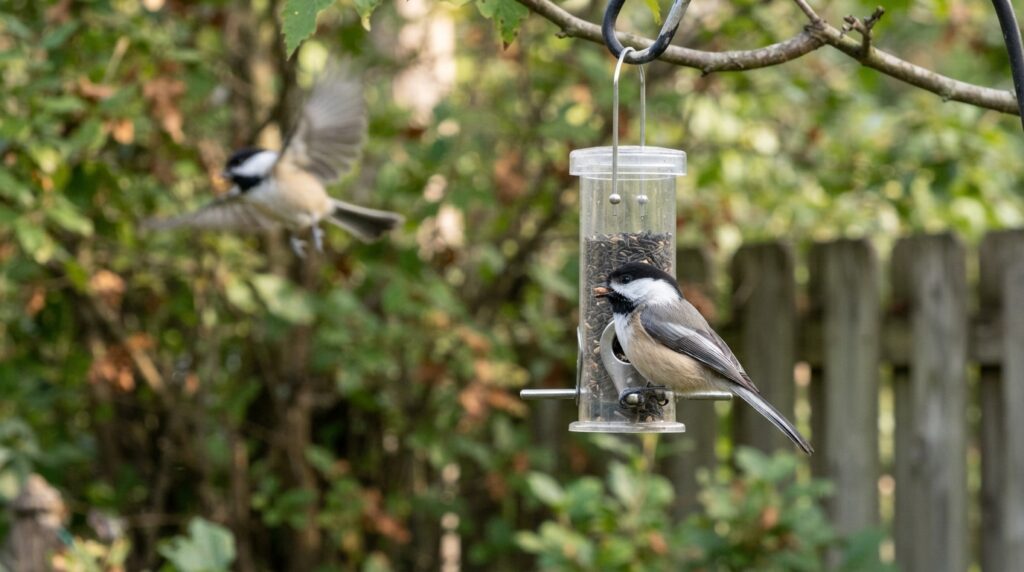
Black oil sunflower in a tube feeder, suet in winter, and a nest box with a 1⅛ inch entrance hole. Chickadees are usually the first birds to find a new feeder, which makes them the species to watch when you are waiting for anything to arrive — everything else follows them in.
The chickadee is the bird most likely to be first at a new feeder, and the one whose behavior repays watching more than almost any other. Two things it does routinely — caching food it remembers the location of, and encoding threat information in its alarm call — are genuinely remarkable, and both are visible from a kitchen window.
Chickadee basics
- Range: Black-capped across the northern US and mountain West; Carolina Chickadee in the Southeast
- Food: black oil sunflower, sunflower chips, suet, peanut pieces
- Feeder: tube. They cling easily and feed upside down
- Nest box: 1⅛ inch entrance hole, no perch
- Behavior: takes one seed and leaves, every time
- First to find a new feeder, and the species other birds follow
Identifying them
Small, round, with a black cap and black bib, bright white cheeks, gray back and buff flanks. Both sexes look alike.
Black-capped or Carolina? Range does most of the work: Black-capped across the northern half of the country and down the mountains, Carolina across the Southeast. Where they meet there is a narrow hybrid zone running roughly from New Jersey through the Appalachians to Kansas, and within it the two interbreed and become genuinely difficult to separate.
Where you can compare them: Black-capped shows more white edging on the wing feathers, giving a frostier look, and has a slightly ragged lower edge to the black bib. Carolina is neater and slightly smaller. Song helps — Black-capped whistles two notes, Carolina typically four — but hybrids sing both, so within the zone it is honestly often unresolvable.
Take one seed and leave
Watch a chickadee at a feeder and it never stays. It lands, takes a single seed, flies to a branch, wedges the seed in bark and hammers it open, then comes back.
Two reasons. Feeding in the open is exposure to predators, and a short visit reduces the risk. And a chickadee cannot crack a sunflower seed in its bill the way a cardinal can — it has to hold it against something and hammer.
Practical consequence: chickadees do not monopolize a feeder. A tube feeder with several ports supports a lot of chickadee traffic without crowding.
Caching and memory
Chickadees store food — individual seeds tucked into bark crevices, under lichen, in curled leaves — and they retrieve it, remembering thousands of separate locations.
The mechanism is unusual. The hippocampus, the region involved in spatial memory, enlarges seasonally in chickadees during autumn caching and shrinks again afterwards, with new neurons generated in the process. A bird weighing less than half an ounce grows extra brain for the job and then gives it back.
If you see a chickadee taking seed repeatedly and far faster than it could be eating it, that is caching, not greed. It peaks in autumn.
The alarm call
The “chick-a-dee-dee-dee” call is not a fixed sound. Research led by Christopher Templeton and colleagues found that the number of “dee” notes on the end encodes information about how dangerous a predator is — and, counterintuitively, smaller predators get more dees.
The logic holds up. A small agile hawk like a Pygmy Owl or Sharp-shinned Hawk is far more dangerous to a chickadee than a large slow one, because it can actually catch one. The call is grading maneuverability, not size.
Other species listen. Nuthatches, titmice and others respond appropriately to chickadee alarm calls, which makes a chickadee flock a functioning early-warning system for a whole yard.
What to feed them
| Food | Notes |
|---|---|
| Black oil sunflower | First choice. Thin shell suits a small bill |
| Sunflower chips | Taken enthusiastically, no hammering needed |
| Suet | Important in winter. High fat, and they use it heavily in cold weather |
| Peanut pieces | Readily taken |
| Safflower | Taken, useful if squirrels are a problem |
| Nyjer | Occasionally, but not a favorite |
A tube feeder with metal-reinforced ports is the right choice — all-plastic ports get chewed wide by squirrels within a season or two, after which seed pours out. The drawback of tubes generally is that seed below the lowest port sits and can go moldy, so empty that last inch when you clean rather than topping up over it.
Nest boxes
Chickadees use nest boxes readily, and the entrance hole size is the specification that matters.
| Feature | Specification |
|---|---|
| Entrance hole | 1⅛ inches — admits chickadees, excludes House Sparrows |
| Floor | About 4 x 4 inches |
| Depth below hole | 6 to 8 inches |
| Height | 5 to 15 feet |
| Material | Untreated wood — the one place wood is right |
| Perch | None. A perch only helps predators and House Sparrows |
| Other | Drainage holes in the floor, ventilation near the top, a side that opens for cleaning |
Chickadees excavate rather than simply occupying, so a box part-filled with wood shavings or sawdust is more likely to be accepted than an empty one. Put boxes up in late winter, before the season starts.
Common questions
Why do chickadees take one seed and fly away?
They cannot crack a seed in the bill, so they carry it to a branch and hammer it open against bark. Short visits also reduce exposure to predators. Many of those seeds are being cached rather than eaten.
What size hole does a chickadee nest box need?
1⅛ inches. Larger admits House Sparrows, which will take the box and may destroy eggs. Do not fit a perch.
Black-capped or Carolina Chickadee?
Range settles most cases — Black-capped north, Carolina southeast. In the narrow hybrid zone from New Jersey through the Appalachians to Kansas the two interbreed and are often genuinely unresolvable in the field.
Do chickadees really remember where they hide food?
Yes, across thousands of locations. Their hippocampus enlarges seasonally during autumn caching, generating new neurons, then shrinks again.
What does the number of dees in the call mean?
It grades how dangerous a predator is. More dees signal a more dangerous predator — which usually means a smaller, more agile one, since those are the ones that can actually catch a chickadee.
Do chickadees stay all winter?
Yes. They are year-round residents and one of the most reliable midwinter feeder birds. They survive cold nights partly by dropping their body temperature in a controlled nightly hypothermia.
Related guides
- Types of bird feeders
- Best bird seed
- Common backyard birds of North America
- Why aren’t birds coming to my feeder?
Sources: Cornell Lab of Ornithology, All About Birds Black-capped and Carolina Chickadee accounts and Birds of the World; NestWatch nest box specifications and right bird, right house; Templeton, C.N., Greene, E. and Davis, K., research on chick-a-dee call complexity and predator threat encoding, published in Science; Project FeederWatch.
Feeding the bigger visitors?
A platform feeder handles peanuts and larger birds that cannot use a tube. It needs a drainage screen and more frequent cleaning, since it is open to the weather.
This link goes to Amazon. If you buy through it we may earn a small commission, at no extra cost to you.