
Affiliate disclosure: some links on this page go to Amazon. If you buy through one we may earn a small commission, at no extra cost to you. Full disclosure.
Hang feeders at least 6 to 8 feet up — a white-tailed deer can reach the best part of 7 feet standing, and higher on its hind legs. Stop offering corn and cheap mixes, clear spillage every day, and check your state rules: feeding deer is illegal in a number of states, and a bird feeder that deer are using can count.
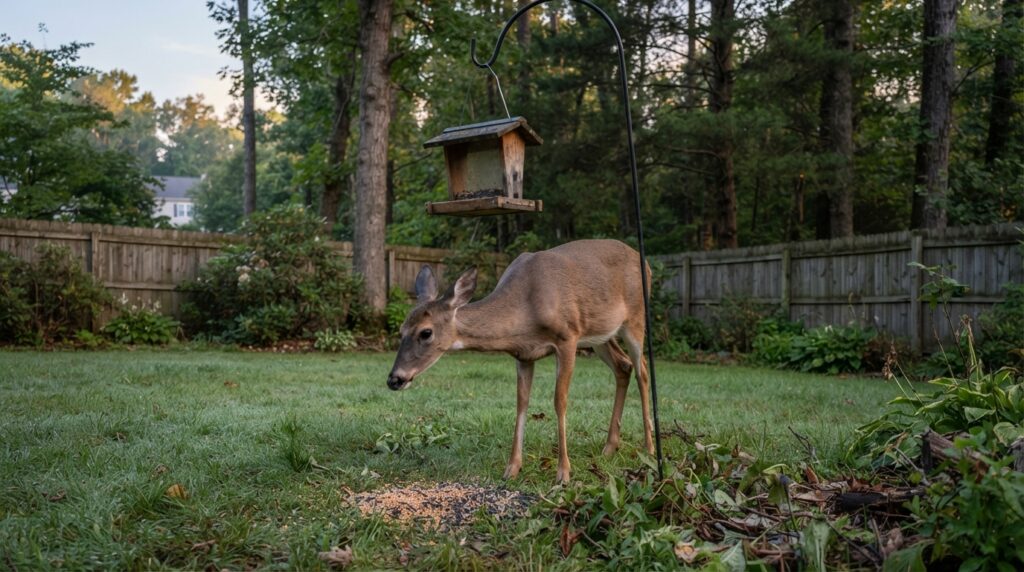
Deer at a bird feeder are a bigger problem than they first appear, for two reasons that have nothing to do with the seed they eat.
The first is legal. A growing number of states prohibit feeding deer, largely because concentrating animals in one spot spreads disease — chronic wasting disease in particular. In several of those states the wording covers any food source deer are congregating at, which can include a bird feeder and the seed underneath it.
The second is that deer are habit-forming visitors. A yard that reliably provides food gets included in a daily route, and the browsing does not stop at the feeder.
What works
- Height: 6 to 8 feet minimum, and further from anything they can stand beside
- Stop offering corn and mixes containing it
- Clear spilled seed daily — the ground is most of what they come for
- Seed trays under feeders to catch spillage
- Check your state law before assuming this is only a nuisance question
Get the height right
Most feeders are hung at a comfortable height for the person filling them, which is roughly the height a deer eats at.
| Height to feeder base | Result |
|---|---|
| 4–5 ft | Easily reached. This is normal feeding height for a deer |
| 6 ft | Reachable by a large deer, especially on its hind legs |
| 7–8 ft | Generally out of reach for white-tailed deer |
| 8 ft plus | Reliable, and awkward to refill |
The trade-off is real: a feeder at eight feet needs a step ladder or a pulley system every time it is filled, which in practice means it gets filled less often. A rope-and-pulley setup fixed to a branch, letting you lower the feeder to shoulder height and haul it back up, is the usual compromise and worth the twenty minutes to rig.
Also check what is next to it. A deer standing on a slope, a raised bed or a bank gains a foot or more of reach.
Change what you offer
Deer are selective, which gives you something to work with.
| They readily eat | They largely ignore |
|---|---|
| Cracked corn — the main attractant | Nyjer |
| Whole corn | Safflower |
| Mixed seed containing corn or milo | Suet in a cage above reach |
| Sunflower seed | Hot pepper treated seed |
| Peanuts |
Stop the corn. If you are offering cracked corn for doves and juncos, or a mix containing it, that is very likely the whole problem. Corn is also the food most associated with deer-feeding regulations.
Hot pepper seed works on deer for the same reason it works on squirrels: birds do not respond to capsaicin and mammals do. Wear gloves when filling and avoid windy days — the dust is genuinely unpleasant.
Buying it pre-treated is more sensible than treating seed yourself. Honest drawbacks: it costs more than untreated seed, the dust is an irritant to handle, it should not go on an open platform feeder where it blows around, and it needs keeping away from where children or pets might reach it.
Clear the ground
This is the part people skip, and it undoes everything else.
Deer are primarily browsing the spillage. A feeder at eight feet with a carpet of hulls and dropped seed underneath is still a reliable food source, and the deer will keep coming for it.
- Rake underneath regularly, daily during a problem
- Fit a seed catching tray beneath the feeder
- Fill with less at a time so there is less to spill
- Consider sunflower chips — no hulls, though they cost more and spoil faster when wet
Physical barriers
Fencing works but needs to be tall: white-tailed deer clear 6 feet readily, and 8 feet is the usual recommendation. Rarely proportionate for a bird feeder alone.
Feeder cages sized for small birds keep deer’s muzzles out, but the spillage problem remains.
Motion-activated sprinklers deter deer reasonably well and are harmless. Deer do habituate over time, so moving the unit periodically helps.
What does not work: reflective tape, hanging soap, scent repellents and plastic predators. Deer habituate to all of them within days, and the seasonal repellent products sold for garden plants are not designed for a feeding station being refilled every few days.
The legal and disease side
Feeding deer is prohibited or restricted in a number of states, and the rules have tightened in recent years in response to chronic wasting disease, a fatal transmissible disease of deer, elk and moose. Concentrating animals at a food source increases contact and therefore transmission, which is the reason for the bans.
Where those rules exist, they frequently include a carve-out for bird feeders — but that carve-out often depends on the feeder being at a height deer cannot reach, or on seed not accumulating on the ground. A feeder that deer are actively using may not qualify.
This varies substantially by state and has changed recently in several. Check your own state wildlife agency rather than assuming, particularly if you are in a CWD management zone, where rules are usually stricter.
There is also a road safety dimension. Yards that reliably provide food bring deer across roads on a routine schedule, and deer-vehicle collisions are a serious matter in many states.
Common questions
How high should a bird feeder be to stop deer?
Seven to eight feet to the base of the feeder. Deer reach around six or seven feet standing and higher on their hind legs, so five feet — the usual squirrel height — is not enough.
What seed will deer not eat?
Nyjer, safflower and hot pepper treated seed. The main attractant to remove is cracked corn, along with any mix containing corn or milo.
Is it illegal to feed deer?
In a number of states, yes, largely because of chronic wasting disease. Many of those rules include a bird feeder exemption that depends on height and on seed not accumulating underneath. Check your state agency, especially in a CWD management zone.
Does hot pepper seed harm deer?
No. It is an irritant that they avoid, not a poison. Birds are unaffected because they lack the receptor that responds to capsaicin.
Will they stop coming if I take the feeder down for a while?
Usually, given a couple of weeks and a properly cleared ground area. Deer drop unproductive stops from their routine reasonably quickly.
Do deer repellent sprays work on feeders?
Not well. They are formulated for garden plants, wash off, and are not something to apply near food birds are eating. Height and removing spillage do far more.
Related guides
Sources: State wildlife agency regulations on deer feeding and chronic wasting disease management zones; US Geological Survey National Wildlife Health Center on chronic wasting disease; Cornell Lab of Ornithology, All About Birds and Project FeederWatch on feeder placement and pests; university extension service guidance on deer management and capsaicin-treated seed.
Deer feeding rules vary by state and change. This page is general information — check your state wildlife agency for the current position where you live.
Restocking?
Black oil sunflower feeds the widest range of species for the money. Check the label for milo and red millet — cheap mixes pad the weight with seed most backyard birds throw on the ground.
This link goes to Amazon. If you buy through it we may earn a small commission, at no extra cost to you.