
Affiliate disclosure: some links on this page go to Amazon. If you buy through one we may earn a small commission, at no extra cost to you. Full disclosure.
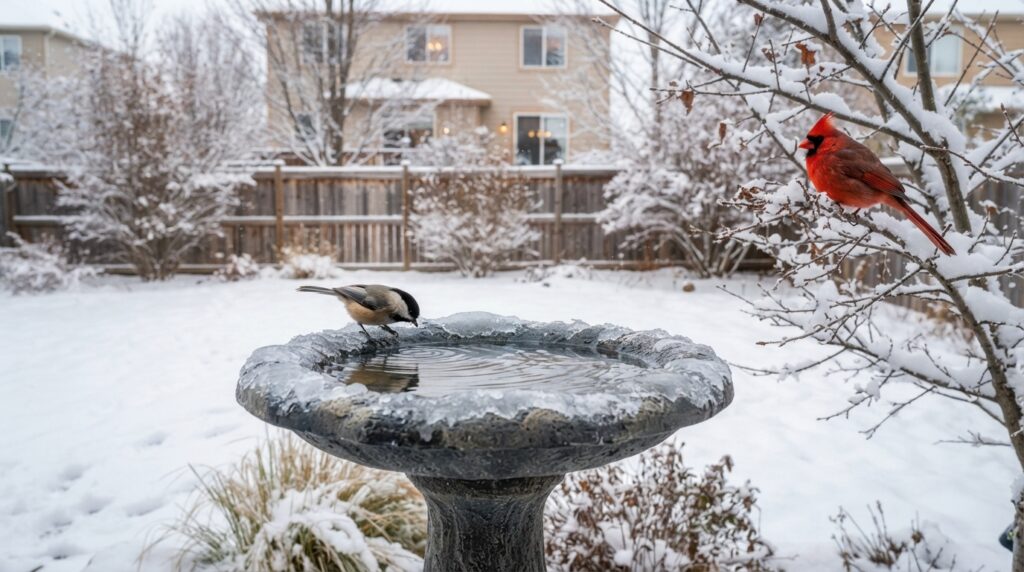
In hard winter, open water is often harder for birds to find than food is, and a heated bath brings in species that never touch a feeder. Look for a thermostatically controlled unit, a basin under two inches deep at the edge and no more than three in the middle, and a rough rather than glazed surface. Never put antifreeze, salt or glycerine in the water — all three are harmful.
Most people set up a feeder and stop there. Water is the part of winter bird provision that gets skipped, and it is arguably the more useful of the two once temperatures stay below freezing.
Birds need water for drinking and for bathing, and bathing matters more in cold weather rather than less — clean, well-arranged feathers trap air, and trapped air is what keeps a bird alive overnight. A bird with dirty or matted plumage insulates badly.
When every puddle, pond edge and gutter is frozen, an open basin in a yard is genuinely scarce.
What to look for
- Thermostatic control — it should only draw power when needed, near freezing
- Under 2 inches deep at the edge, no more than 3 in the middle
- Rough or textured surface for grip, not smooth glaze
- Gently sloping sides, so birds can choose their depth
- An outdoor-rated GFCI outlet — this is mains power outdoors in wet weather
- Easy to lift and scrub — it needs cleaning as often as a feeder
Two ways to do it
| Heated bath | De-icer in an existing bath | |
|---|---|---|
| What it is | A basin with a heating element built in | A separate submersible heater dropped into a bath you already own |
| Cost | Higher — you are buying the bath too | Lower if you already have a suitable bath |
| Appearance | Tidy, cord aside | A visible unit and cord sitting in the water |
| Risk | Designed as one thing | Can crack concrete or ceramic baths as ice and heat work against each other |
Do not put a de-icer in a concrete or ceramic bath unless the manufacturer states it is safe. Repeated freeze-thaw around a heating element is a reliable way to crack a basin, usually in the middle of January.
Check the stated basin depth against the numbers above before buying, and check for thermostatic control rather than a unit that simply runs whenever it is plugged in. The honest drawbacks: heated baths cost more to run than people expect over a long winter, the cord is an eyesore and a trip hazard, and plastic units become brittle and crack after a few seasons of hard freezing. Deicers left running dry burn out, so a bath that empties fast in wind is a liability.
Depth is the specification that matters most
The commonest fault in bird baths sold as ornaments is that they are too deep, too smooth and too steep. Small songbirds will not use water they cannot stand in.
- Under 2 inches at the edge, sloping to no more than 3 in the middle
- A textured base. If yours is glazed and slippery, a flat stone or two in the bottom fixes it and gives shallower standing spots
- Gently sloping sides. A steep-sided bowl is a drinking station and nothing more
What never goes in the water
Never add antifreeze. Ethylene glycol is lethal to birds, mammals and pets, and it tastes sweet, which is precisely the problem.
Never add salt. It does not reliably prevent freezing at useful concentrations and is harmful to birds that drink it.
Never add glycerine. Sometimes suggested online as a harmless alternative. It is not — it coats and mats feathers, wrecking their insulating properties in exactly the weather where that is fatal.
The only correct answer to a frozen bath is heat or fresh water, not an additive.
Placement
- Within about 10 feet of cover, so wet birds have somewhere to reach quickly. A bathing bird is slow to take off and vulnerable
- Not directly under a feeder, or it fills with hulls and droppings
- Out of the worst wind, which chills a wet bird and evaporates the basin
- Where you can see it, and where the cord can reach a GFCI-protected outdoor outlet safely
- Not next to a cat’s route — fences, low walls, dense low planting
Cleaning
A bird bath is arguably a higher disease risk than a feeder, because birds drink from and bathe in the same water they defecate in. Heating does not change that; it just means the water is available all winter.
- Dump and refill every few days
- Scrub weekly with a stiff brush
- Periodically disinfect with 1 part household bleach to 9 parts water, rinsing extremely thoroughly
- Unplug before cleaning, every time
Doing it without electricity
If running power outside is not practical:
- Refill with warm water each morning — it buys several hours on all but the coldest days
- A dark-colored basin in a sunny spot stays open longer
- A ball or floating object moved by wind slows ice forming
- Site it against a south-facing wall, which holds warmth
None of these keeps water open through a hard freeze. They extend the window, which for many yards is enough.
Common questions
Do birds actually bathe in freezing weather?
Yes, and it matters. Clean, well-ordered feathers trap air, and trapped air is insulation. Birds regulate how much they bathe in cold conditions themselves.
How deep should a bird bath be?
Under two inches at the edge, no more than three in the middle, with sloping sides and a textured base. Most decorative baths are too deep and too smooth; a couple of flat stones fix both.
Can I put something in the water to stop it freezing?
No. Antifreeze is lethal, salt is harmful, and glycerine mats feathers and destroys their insulation. Use heat or fresh water.
Are heated bird baths expensive to run?
A thermostatically controlled unit only draws power near freezing, which keeps it modest, but over a long northern winter it is a real running cost. A unit without thermostatic control runs whenever it is plugged in and costs considerably more.
Can I use a de-icer in my existing concrete bath?
Only if the manufacturer says so. Repeated freeze-thaw around a heating element cracks concrete and ceramic. A purpose-made heated bath is the safer route.
Will a heated bath attract other animals?
Possibly — deer, raccoons and others will drink from it, and in bear country an open water source is a lesser attractant than food but not nothing. Water alone is far less of a draw than seed.
Related guides
- When to feed backyard birds
- How to clean bird feeders and baths
- Cats and birds
- Types of bird feeders
Sources: Cornell Lab of Ornithology, All About Birds and Project FeederWatch guidance on water for birds and bath cleaning; National Audubon Society; US Geological Survey National Wildlife Health Center; university extension service winter bird feeding guidance; manufacturer specifications for heated baths and de-icers.
Offering water?
Water pulls in species that never touch a feeder. Depth matters more than size — under two inches at the edge, sloping to no more than three in the middle.
This link goes to Amazon. If you buy through it we may earn a small commission, at no extra cost to you.