
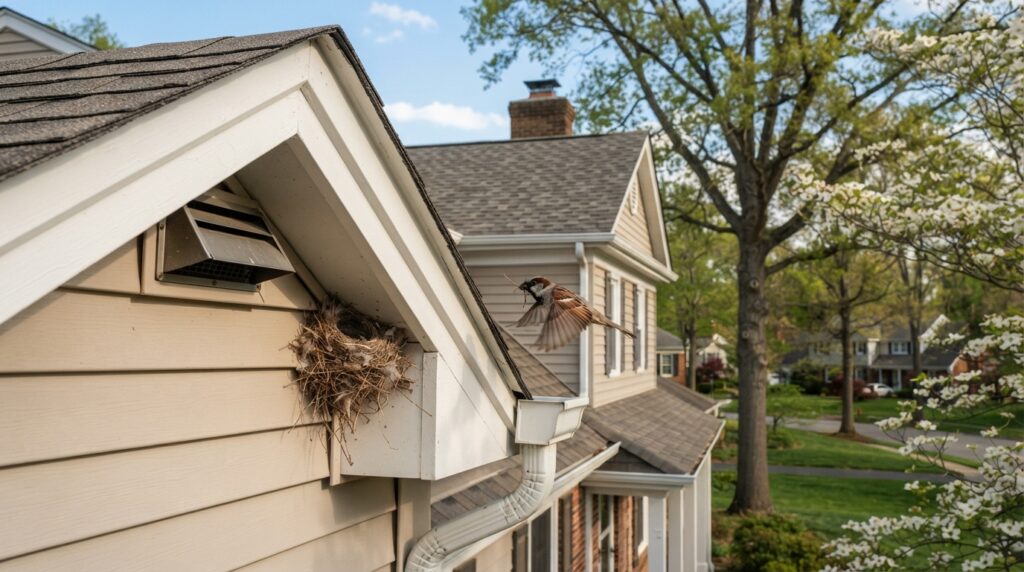
Identify the bird first, because it decides what you are legally allowed to do. House Sparrows, European Starlings and Rock Pigeons are non-native and their nests can be removed. Almost every other bird is protected under the Migratory Bird Treaty Act, and removing an active nest with eggs or young is a federal offense. If the nest is active and protected, the practical answer is usually to wait two to three weeks, then seal the gap permanently.
A bird has got into a dryer vent, a bathroom fan outlet, a soffit gap or the chimney, and there is now scratching and cheeping coming through the wall. It is a genuine nuisance, and there is a right way to deal with it that is neither “block it up today” nor “live with it forever”.
The order matters: identify, then check whether it is active, then act.
The thing not to do
Do not seal a vent or cavity while there are eggs or young inside. It is illegal for protected species, and it leaves nestlings to die in your wall — which produces flies, smell and a considerably worse problem than the one you started with. Sealing is the last step, not the first.
Step one: identify the bird
| Bird | Where it nests on a house | Status |
|---|---|---|
| House Sparrow | Vents, soffits, gutters, signs, light fittings | Non-native, not protected |
| European Starling | Dryer vents, bathroom fan outlets, soffits | Non-native, not protected |
| Rock Pigeon | Ledges, balconies, lofts | Non-native, not protected |
| Chimney Swift | Inside chimneys, clinging to the flue wall | Native, protected |
| Barn Swallow | Mud cup under eaves, porches, garages | Native, protected |
| American Robin | Ledges, porch lights, hanging baskets | Native, protected |
| House Finch | Wreaths, hanging baskets, ledges | Native, protected |
| Carolina Wren | Almost anywhere — boots, sheds, mailboxes | Native, protected |
| Eastern Phoebe | Mud-and-moss nest on ledges and beams | Native, protected |
The starling and sparrow are the ones people most often have in a vent, and they are also the two that are legally straightforward. But identify properly rather than assuming — getting it wrong in the other direction is an offense, and several native species use exactly the same sites.
Step two: is the nest active?
An active nest contains eggs or young, or is being built and used. An inactive nest is finished with — the young have fledged and nobody is coming back this season.
For protected species, the Migratory Bird Treaty Act covers the birds, their nests and their eggs. In practice, an inactive nest of a protected species can generally be removed once the season is over, while an active one cannot be touched. State law sometimes adds further restrictions, so check with your state wildlife agency if there is any doubt.
Most songbirds go from egg-laying to fledging in around three to five weeks. That is the wait, and it is shorter than it feels when it is happening above your bedroom ceiling.
If it is a starling, sparrow or pigeon
These are not federally protected and the nest can be removed. Do it properly:
- Wear gloves and a dust mask. Old nests carry mites, and accumulated droppings in an enclosed space are a genuine respiratory hazard
- Remove the nest material completely and bag it
- Clean the cavity as far as you can reach
- Seal the gap immediately, or they will rebuild within days
- Check there is nothing alive in there first
Some people are uncomfortable with this, which is a reasonable position to hold. The alternative is the same as for protected species: wait for fledging, then seal.
If it is a protected species
Wait it out, then seal permanently. Three to five weeks from the first eggs.
What you can do in the meantime:
- Dryer vents: stop using the dryer if you can, or use it minimally. Lint and heat with a nest in the duct is a fire risk, so if that is not practical, call your state wildlife agency — there are permit routes for genuine safety hazards
- Bathroom fans: generally safe to leave, though airflow will be poor
- Soffits and walls: noisy but harmless. It ends
- Porch and doorway nests: a cardboard shelf below the nest catches droppings, and taping off that entrance for a few weeks is easier than everyone pretending it is fine
Chimneys are a special case. Chimney Swifts nest inside chimneys and are protected. Their populations have declined steeply as suitable chimneys have been capped, and they are a species of conservation concern.
Swifts are in residence roughly May to September. They do no damage — the nest is a small twig cup glued to the flue wall — and the noise from young birds lasts a couple of weeks. If you want to prevent them nesting in future, cap the chimney outside the nesting season, ideally in late fall or winter. Never light a fire with swifts in the chimney.
A loud, rapid chittering that suddenly starts in July is usually swift nestlings being fed, not a bird trapped.
Step three: seal it properly
Once the nest is genuinely finished with, close the gap for good. This is the only step that solves the problem permanently.
| Location | Fix |
|---|---|
| Dryer vent | A proper vent cover with a damper or louvre. Do not use screen mesh — it traps lint and becomes a fire risk |
| Bathroom or kitchen fan outlet | Louvred vent cover |
| Soffit gaps | Repair the soffit. Fill gaps with hardware cloth and seal |
| Gable and attic vents | Hardware cloth behind the vent, fixed on the inside |
| Chimney | A proper chimney cap, fitted outside the nesting season |
| Ledges and light fittings | Angled boards, or move the fitting |
Do this in late fall or winter, when nothing is nesting anywhere. Check every similar gap around the house at the same time — birds that liked one vent will like the identical one on the other elevation.
When to call a professional
- A bird is loose inside the house and will not leave — open a window and close the internal doors first; most leave within an hour
- A bird is trapped in a wall or chimney and cannot get out
- The nest is somewhere you cannot safely reach
- There is a heavy accumulation of droppings in an enclosed space, which needs proper protective equipment
- You need to remove an active protected nest for a genuine safety reason — that requires a permit, and your state wildlife agency is the route to it
Common questions
Is it illegal to remove a bird’s nest?
For native species, yes while it is active — the Migratory Bird Treaty Act protects the birds, their nests and their eggs. House Sparrows, European Starlings and Rock Pigeons are non-native and not covered. State law may add more, so check locally.
There is a nest in my dryer vent. Can I just block it?
Not while there are eggs or young inside. Identify the bird: if it is a starling or sparrow the nest can be removed and the vent sealed. If it is protected, wait for fledging — but a nest in a dryer duct is a fire risk, so minimize dryer use and call your state agency if that is not workable.
How long until the birds leave?
Around three to five weeks from the first egg for most songbirds. Chimney Swifts are in residence roughly May to September.
What is the loud chirping in my chimney?
Usually Chimney Swift nestlings being fed, most noticeable in July. They are protected, they do no damage, and the noise lasts a couple of weeks. Cap the chimney outside the nesting season if you want to prevent it recurring.
Will they come back next year?
Very likely, to the same site, unless you seal it. Many species show strong site fidelity. Sealing in late fall or winter is what breaks the cycle.
Is bird nesting material a health risk?
Old nests carry mites, and accumulated droppings in an enclosed space can be a respiratory hazard. Wear gloves and a dust mask, bag the material, and get professional help for any substantial build-up.
Related guides
- Nest box hole sizes by species
- I found a baby bird on the ground
- Keeping grackles and starlings off your feeders
- Common backyard birds of North America
Sources: US Fish & Wildlife Service, Migratory Bird Treaty Act and non-native species status; Cornell Lab of Ornithology, All About Birds and NestWatch; National Audubon Society on Chimney Swifts and chimney capping; state wildlife agency guidance on nuisance wildlife and nest removal permits.
This page is general information and is not legal advice. Wildlife law varies by state — check with your state wildlife agency before acting.