
Affiliate disclosure: some links on this page go to Amazon. If you buy through one we may earn a small commission, at no extra cost to you. Full disclosure.
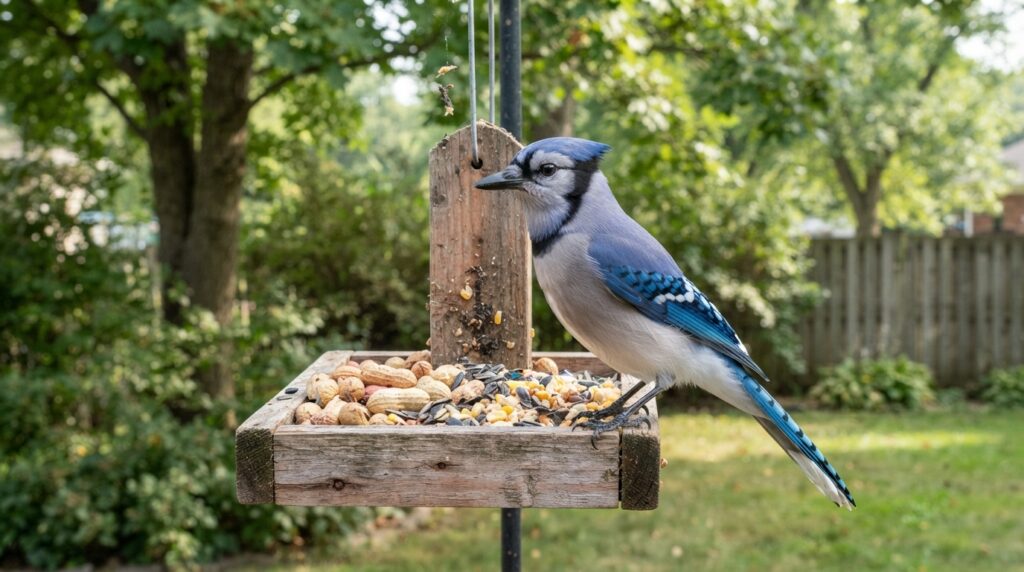
Offer whole peanuts in the shell or striped sunflower on a platform or tray feeder — jays need somewhere to stand and something substantial to carry off. They usually find a new peanut supply within days. If they are dominating your other feeders, the answer is a separate platform away from the main setup rather than trying to exclude them.
The Blue Jay has a reputation problem. It is loud, it is large, it turns up in gangs and clears a feeder, and there is a persistent story that jays raid other birds’ nests. Most of that is either exaggerated or beside the point, and the bird itself is one of the more genuinely interesting animals in an American backyard.
Blue Jay basics
- Range: east of the Rockies, expanding west. The West has Steller’s Jay and California Scrub-Jay instead
- Food: peanuts, striped and black oil sunflower, acorns, suet, corn
- Feeder: platform or tray. Tube feeders are too small for them
- They cache thousands of acorns a year and forget enough to plant oak trees
- They imitate hawks, convincingly, and appear to do it deliberately
- Not blue. The color is structural, not pigment
Identifying them
Hard to mistake: a large crested songbird, blue above with white underparts, black barring and white patches on the wings and tail, and a black necklace across the throat. Males and females look alike.
The crest is expressive and worth watching — raised when the bird is agitated or aggressive, flattened when it is relaxed or feeding calmly among other jays.
They are not actually blue. There is no blue pigment in a Blue Jay’s feathers. The color comes from light scattering off the microscopic structure of the feather barbs. Grind a blue feather up and the powder is brown, because the structure — not a pigment — was doing the work.
What to feed them
| Food | Notes |
|---|---|
| Whole peanuts in the shell | The reliable draw. Jays carry them off whole to cache |
| Striped sunflower | The thick shell is no obstacle to a jay’s bill |
| Black oil sunflower | Readily taken |
| Suet | Taken, especially in winter |
| Cracked corn | Taken from the ground |
| Acorns | Not something you provide, but the center of their year |
Whole peanuts are the thing to try if you want jays specifically. They are large, portable and cacheable, which is exactly what a jay is looking for — and they are largely ignored by the small birds a jay would otherwise displace.
A platform feeder is the right shape for a jay, and a mesh or screened base is the specification that matters — a solid tray holds rainwater and spoils peanuts fast. The honest drawback: platform feeders are the most exposed design there is. They need cleaning more often than any other type, they collect droppings from birds standing on them, and squirrels can simply sit on one and eat.
Acorns and oak trees
The most consequential thing Blue Jays do has nothing to do with feeders.
In autumn a single jay may cache several thousand acorns, carrying them — sometimes several at a time in an expandable throat pouch — up to a couple of miles and burying them individually. They recover a large proportion using spatial memory. They do not recover all of them.
The ones left behind are buried, at appropriate depth, well away from the parent tree, in exactly the conditions an acorn needs to germinate. Ecologists studying the northward spread of oaks after the last glaciation have concluded that jays were a major agent of that expansion — oaks moved north faster than gravity-dispersed acorns could account for, and jays are the plausible mechanism.
Hawk calls
Blue Jays imitate the calls of hawks, particularly Red-shouldered Hawk, and do it well enough to fool people.
Why is not fully settled. Two leading explanations: it may warn other jays that a hawk is genuinely present, or it may be used deceptively to clear a feeder of competitors for a moment. Both behaviors have been observed, and it is likely both happen. It is worth listening for — a hawk call coming from your feeder area with no hawk in sight is often a jay.
The reputation, fairly
Two charges, both worth answering honestly.
Nest raiding. Blue Jays do occasionally take eggs and nestlings. But studies examining stomach contents have found this makes up a very small part of their diet — the great majority is acorns, nuts, seeds and insects. The popular image of the jay as a habitual nest predator overstates a real but uncommon behavior.
Bullying at feeders. This one is fair. Jays are large, they arrive in family groups, and smaller birds give way. But they also do something useful: jays are excellent at spotting predators and give loud alarm calls that other species pay attention to. A yard with jays in it is a yard where the chickadees get more warning.
If they are genuinely dominating your feeders, the practical answer is not exclusion but separation — a peanut platform set well away from the main feeders usually keeps them occupied and elsewhere.
Two more things worth knowing
They are protected. Blue Jays are native and covered by the Migratory Bird Treaty Act, along with their nests and eggs. This matters if you were considering doing anything about them.
Their migration is a genuine puzzle. Some Blue Jays migrate, some do not, and the same individual may migrate one year and stay the next. Thousands are counted moving along the Great Lakes each fall, yet nobody has established what determines which birds go. It is one of the more prominent unsolved questions about a common North American bird.
Common questions
What food attracts Blue Jays?
Whole peanuts in the shell are the most reliable, followed by striped sunflower. Offer them on a platform or tray feeder rather than a tube.
Do Blue Jays really plant oak trees?
Effectively, yes. They cache thousands of acorns each autumn and fail to recover a proportion of them, leaving buried acorns well away from the parent tree. Research on post-glacial oak expansion identifies jays as a major dispersal agent.
Why do Blue Jays sound like hawks?
They imitate hawk calls, especially Red-shouldered Hawk. It may warn other jays of a real hawk, or clear competitors from a feeder. Both explanations have support.
Are Blue Jays bad for other birds?
Less than their reputation suggests. Egg and nestling predation is real but uncommon in their diet, which is mostly acorns, nuts, seeds and insects. They also give reliable predator alarm calls that other species use.
How do I stop jays emptying my feeders?
Give them somewhere else to go: a peanut platform well away from the main feeders. Tube feeders with short perches already exclude them from small-bird food. Trying to exclude them entirely tends to fail.
Do Blue Jays migrate?
Some do, some do not, and individuals are inconsistent between years. Large numbers are counted moving along the Great Lakes each fall, but what determines which birds migrate remains unresolved.
Related guides
- Types of bird feeders
- Best bird seed, including peanuts
- Common backyard birds of North America
- Keeping grackles and starlings off your feeders
Sources: Cornell Lab of Ornithology, All About Birds Blue Jay account and Birds of the World; Project FeederWatch; National Audubon Society; US Fish & Wildlife Service, Migratory Bird Treaty Act; published research on jay-mediated acorn dispersal and post-glacial oak expansion.
Feeding the bigger visitors?
A platform feeder handles peanuts and larger birds that cannot use a tube. It needs a drainage screen and more frequent cleaning, since it is open to the weather.
This link goes to Amazon. If you buy through it we may earn a small commission, at no extra cost to you.