
Affiliate disclosure: some links on this page go to Amazon. If you buy through one we may earn a small commission, at no extra cost to you. Full disclosure.
The Christmas Bird Count runs from December 14 to January 5 every year — those dates never change. You join a local count circle by emailing its compiler in advance, and if your home falls inside a circle you can take part entirely from your own window, counting the birds at your feeder on count day. It is free, and no experience is required.
The Christmas Bird Count is the longest-running community science project in the world. It began in 1900, when the ornithologist Frank Chapman proposed counting birds as an alternative to a Christmas Day hunting tradition, and it has run every winter since. The count now spans thousands of circles from Canada to Chile.
For a backyard bird feeder it has one feature the other counts do not: if you live inside a count circle, you can contribute without leaving the house.
The essentials
- When: December 14 to January 5, every year, without exception
- Your count day: one calendar day within that window, set by your circle
- Where: an established 15-mile diameter circle near you
- From home: yes, if your feeder is inside a circle — arranged in advance
- Cost: free
- Sign up: email your local circle’s compiler ahead of time. You cannot just turn up
How the count works
Each count takes place in a fixed 15-mile diameter circle, run by a volunteer called a compiler. On a single chosen day within the December 14 to January 5 window, teams of volunteers cover assigned routes through the circle and count every bird they see or hear all day — not just a species list, but total numbers, which gives a picture of abundance rather than just presence.
This is a genuine census, not a casual tally, which is why two things are true that surprise people. Effort is recorded alongside the birds — how many observers, how many hours, how far travelled. And single-observer counts are generally not allowed, because one person cannot properly cover that much ground. It is a coordinated effort, and that is the point.
How to join
You cannot simply show up on the day. Participation is arranged in advance through the compiler who runs your local circle.
- Find your circle. The Audubon website has an interactive map of count circles at audubon.org/cbc. Circles are marked by whether they are open to new participants or full
- Email the compiler ahead of count day. Their contact details are on the circle’s entry on the map. Compilers are used to hearing from beginners and are generally glad to
- Say what you want to do — join a field team, or watch your own feeder if you are inside the circle
- Turn up, or watch, on the assigned day
Register early. Compilers organize their circles in advance and appreciate the notice — early November is not too soon to make contact.
You do not need to be an expert. If you are a beginning birder, the compiler will pair you with an experienced one. As Audubon’s own guidance puts it, nobody expects novices to be identification whizzes. It is one of the friendlier ways into birding, and there is usually a social side — many circles finish with a shared meal to tally the day’s results.
Counting from your feeder
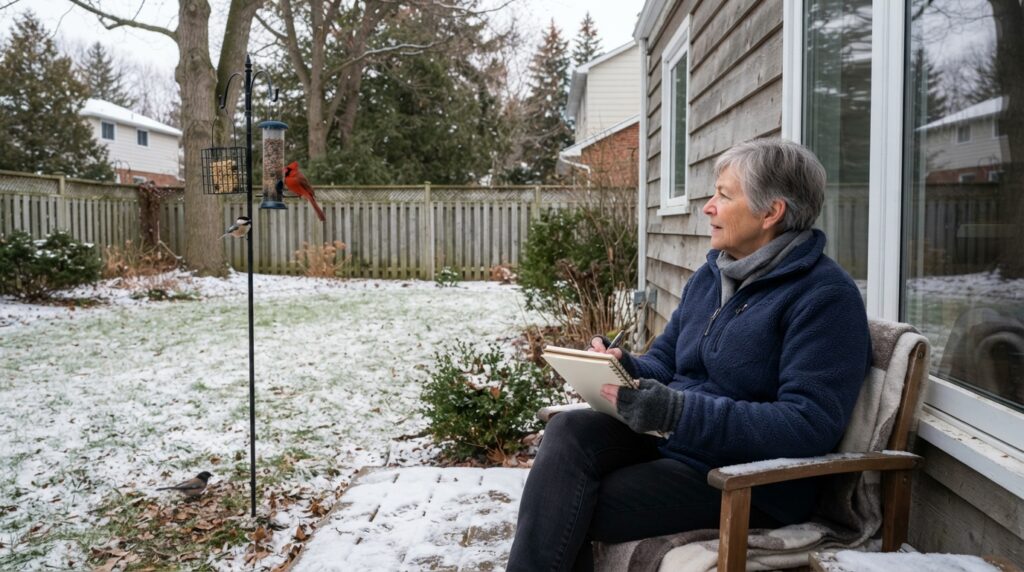
This is the part that suits a backyard bird feeder, and it is a real, valued form of participation rather than a consolation prize.
If your home falls within a count circle’s boundary, you can stay home on count day and report the birds that visit your feeder, provided you have arranged it with the compiler in advance. Feeder-watchers are genuinely useful: they cover ground that field teams pass through quickly, and they catch birds that visit yards but avoid open country.
It is also, Audubon notes, the part best suited to families with young children — warm, indoors, and low pressure.
What you do on the day:
- Watch your feeders and record the highest number of each species seen at one time, the same rule as the other counts — it prevents counting one bird repeatedly
- Note your hours of observation, since effort is part of the data
- Report to your compiler in the way they have arranged
A camera feeder is genuinely handy here — it lets you catch visits you would otherwise miss while making coffee — but verify the identifications yourself before reporting. Automatic identification is helpful rather than authoritative. More on camera feeders.
Getting ready
For feeder-watching:
- Fill the feeders reliably in the days before, so birds are visiting consistently by count day
- Keep water available. Open water in winter brings in species a feeder never will
- Brush up on your regular visitors so you are not identifying from scratch on the day. Common backyard birds and small brown birds cover most of them
- Have Merlin Bird ID to hand for anything unexpected
If you are going out with a field team instead, the advice from experienced counters is simple: dress warmer than you think you need to, because birders move slowly and stand still a lot. Layers, hot drinks, hand warmers.
Binoculars are needed for field work and useful at a feeder. For backyard use, close focus matters more than magnification — look for around six feet, in an 8×42 or 8×32. The honest drawback at entry prices is misaligned barrels that cause eye strain within minutes; a smaller pair from a reputable optics maker beats a large one from an unknown brand. You provide your own transport, binoculars and clothing — the count itself is free.
What 125 years of data shows
The value of the Christmas Bird Count is its length. A single winter’s snapshot is interesting; more than a century of them stacked together is one of the most important datasets in North American ornithology.
It has been used to track long-term population trends, document range shifts as species move north over decades, measure the effect of a changing climate on winter distributions, and underpin a great deal of published conservation research. Because it runs at the same time and in the same places every year, the comparisons hold up.
Data goes to Audubon through the compiler, and results are published in American Birds. Feeder counts and field counts feed into the same census.
Where it sits among the counts
| Project | When | Commitment |
|---|---|---|
| Christmas Bird Count | Dec 14 – Jan 5, one day | A full day out, or feeder-watching from home. Free. Sign up in advance |
| Great Backyard Bird Count | Four days, mid-February | 15 minutes minimum. Free. No sign-up |
| Project FeederWatch | November to April | Regular counts through the season. Small fee |
| NestWatch | Breeding season | Monitoring nests |
| eBird | Year-round | Any time. Free |
The CBC is the most structured and the most sociable. If the advance sign-up and the coordinated day feel like a lot, the Great Backyard Bird Count in February needs no registration and no minimum beyond fifteen minutes — and it is run partly by the same organization.
Common questions
When is the Christmas Bird Count?
Always December 14 to January 5. Your specific circle picks one calendar day within that window. The dates never change from year to year.
Can I do the Christmas Bird Count from home?
Yes, if your home is inside a count circle and you arrange it with the compiler in advance. You watch your feeder on count day and report what visits. Feeder-watchers are a valued part of the census.
How do I sign up?
Find your local circle on the map at audubon.org/cbc and email its compiler ahead of count day. You cannot just turn up — participation is arranged in advance.
Is there a fee?
No. Participation is free. You provide your own transport, binoculars and warm clothing if you go out with a field team.
Do I need to be good at identifying birds?
No. Beginners are paired with experienced birders, and feeder-watching from home mostly involves common, familiar species. Compilers are used to working with newcomers.
How is it different from the Great Backyard Bird Count?
The CBC is a coordinated all-day census in a fixed circle with advance sign-up, in late December. The GBBC in February needs no registration and as little as fifteen minutes. Both are worth doing.
Related guides
- The Great Backyard Bird Count
- Project FeederWatch
- Winter bird feeding in the Upper Midwest and Northeast
- Common backyard birds of North America
Sources: National Audubon Society, Christmas Bird Count, including the join guide, participant FAQ and compiler protocol; local Audubon chapter count pages; Cornell Lab of Ornithology eBird, used for CBC data entry; National Audubon Society press materials on the 126th count.
Starting out?
One tube feeder with black oil sunflower brings in more species than any other single setup. Metal ports last; all-plastic ports get chewed open within a season or two.
This link goes to Amazon. If you buy through it we may earn a small commission, at no extra cost to you.