
Affiliate disclosure: some links on this page go to Amazon. If you buy through one we may earn a small commission, at no extra cost to you. Full disclosure.
Fat is what matters below freezing: black oil sunflower, suet and peanuts. Keep feeders stocked reliably rather than constantly, keep water open if you can, and provide dense evergreen cover for overnight roosting. Watch for irruption years, when Pine Siskins, redpolls and Evening Grosbeaks push south in numbers — those are the winters worth paying attention to, and the ones with a disease risk attached.
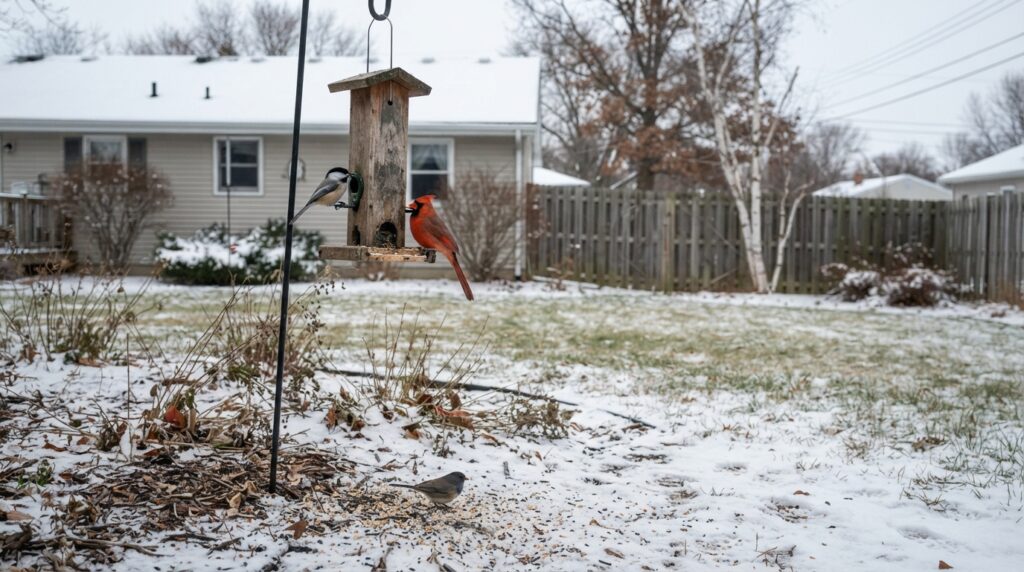
Winter in Minnesota, Wisconsin, Michigan, upstate New York and northern New England is the season this hobby was built around. Natural food is buried, days are short, and a small bird can burn a large share of its body weight overnight simply staying warm.
It is also the season with the most genuinely regional variation in the country, because this is where irruptive northern finches show up — and whether they do changes the whole winter.
What matters below freezing
- Fat. Black oil sunflower, suet, peanuts. Calories per beakful is the metric
- Reliability beats quantity. Birds learn which yards are dependable
- Open water is often harder to find than food
- Roosting cover — dense evergreens matter as much as the feeder
- Irruption years change the species list entirely
- Feeders still need cleaning, cold or not
The winter cast
| Reliable all winter | Irruptive — some years only |
|---|---|
| Black-capped Chickadee | Common Redpoll |
| White-breasted and Red-breasted Nuthatch | Pine Siskin |
| Downy and Hairy Woodpecker | Evening Grosbeak |
| Blue Jay | Pine Grosbeak |
| Dark-eyed Junco | Purple Finch |
| Northern Cardinal | Red and White-winged Crossbill |
| American Goldfinch (in drab winter plumage) | Bohemian Waxwing |
| House Finch, Mourning Dove, Tufted Titmouse | Snow Bunting, in open country |
The goldfinch point catches people every year. They do not leave — they molt into drab olive-brown and stop being recognized. Look for the black wings with white wing bars, which stay put. More here.
Irruption years
Northern finches do not migrate on a schedule. They move south when the boreal cone and seed crop fails, which happens irregularly. In a good cone year they stay north and your feeder sees none of them; in a poor one, Pine Siskins and redpolls arrive in flocks.
The Winter Finch Forecast, published each fall and based on boreal seed crop surveys, predicts which species are likely to move and how far. It is worth reading in September or October — it tells you whether to stock up on nyjer.
Irruption years carry a real disease risk. Large concentrations of finches at feeders are strongly associated with salmonellosis outbreaks — the 2020–21 Pine Siskin irruption produced one of the largest documented die-offs, with mass mortality across multiple states.
If siskins arrive in numbers, increase cleaning to weekly, spread birds across several feeders rather than concentrating them at one, and take everything down for one to two weeks at the first sign of a sick bird. What to look for.
What to put out
| Food | Why it matters in cold |
|---|---|
| Black oil sunflower | Thin shell, high oil. The single most useful thing |
| Suet | Comes into its own below 50°F. Woodpeckers, nuthatches, chickadees |
| Peanuts | High fat. Jays, woodpeckers, nuthatches, titmice |
| Nyjer | Essential in an irruption year. Buy small and often — it stales fast |
| Sunflower chips | No cracking needed, no hull mess under snow. Costs more |
| White proso millet | Ground feeders — juncos, tree sparrows |
| Safflower | Cardinals, and it deters squirrels and grackles |
Buying in larger quantities makes sense here, since consumption is high and cold storage is easy. The honest drawbacks: whole sunflower leaves a substantial hull pile that emerges from the snow in April and will have killed the grass underneath, and a large sack stored somewhere unheated still needs sealing against mice. Chips avoid the hulls at noticeably higher cost.
Snow and ice
The practical problems nobody writes about.
- Feeders with roofs and overhangs stay usable in falling snow. An open platform fills and is useless within an hour
- Brush the snow off after a storm — a capped feeder port is a closed feeder
- Ice in the ports after a thaw-freeze cycle is common. Tap it clear rather than pouring hot water into a cold plastic feeder, which cracks it
- Clear the ground under the feeder after heavy snow. Juncos and tree sparrows feed there and cannot dig through a foot of it
- Scatter seed on a shoveled patch or a low tray for ground feeders
- Suet in extreme cold becomes rock hard and some birds struggle with it. Smaller pieces help
Water
Often more valuable than food in a deep freeze, and the thing most people skip. Birds cannot eat snow efficiently — melting it costs body heat they need — so open water is genuinely scarce when everything is frozen.
A heated bath with thermostatic control brings in species that never visit a feeder. Keep it shallow, under two inches at the edge, and use a GFCI-protected outdoor outlet. Full detail here.
Roosting cover
Overnight survival is about shelter as much as calories.
- Dense evergreens — spruce, fir, cedar, hemlock — are the best winter shelter you can provide, and the reason to think twice before removing one
- Brush piles. Free and effective. A discarded Christmas tree propped beside the feeder works well
- Roost boxes, or nest boxes left up over winter. Chickadees, nuthatches, titmice and bluebirds use cavities to roost, sometimes several birds in one box
- Leave nest boxes up through winter rather than taking them in. Clean them out in late winter instead
Chickadees also survive cold nights by dropping their body temperature in a controlled nightly hypothermia, which is a remarkable thing for a bird weighing less than half an ounce. More on chickadees.
Cleaning in winter
The job people skip because it is unpleasant, and skipping it is how outbreaks start.
Cold does not sterilize a feeder. Every two weeks is still the standard, weekly in an irruption year. Take the feeder indoors to a utility sink rather than trying to scrub it at 10°F, scrub off debris, soak ten minutes in one part bleach to nine parts water, rinse thoroughly and dry completely before refilling — a damp feeder freezes solid. Full method.
Count while you are at it
This region produces some of the most valuable winter feeder data in the country, precisely because irruptions show up here first.
- Project FeederWatch runs November to April — the natural fit
- Christmas Bird Count runs mid-December to early January, organized by local Audubon chapters
- Great Backyard Bird Count, four days in February, free and fifteen minutes
Common questions
What should I feed birds in extreme cold?
High-fat foods: black oil sunflower, suet and peanuts. Calories per beakful is what matters when a bird has a long freezing night ahead.
What is an irruption year?
A winter when boreal seed crops fail and northern finches — Pine Siskins, redpolls, Evening Grosbeaks — push far south in numbers. The Winter Finch Forecast each fall predicts which species are likely to move.
Do birds need me to feed them in winter?
Not strictly. Research on chickadees found feeder food made up only around a fifth of daily energy intake even in cold weather. Consistency still helps, because birds learn which yards are reliable.
Should I clean feeders in winter?
Yes, every two weeks, weekly in an irruption year. Cold does not sterilize anything, and finch concentrations are exactly when salmonellosis spreads.
Can birds get water from snow?
Inefficiently — melting snow costs body heat they need. Open water in a hard freeze is often scarcer than food, which is why a heated bath is so effective.
Should I take nest boxes down for winter?
No. Chickadees, nuthatches, titmice and bluebirds roost in cavities overnight, sometimes several birds to a box. Clean them out in late winter instead.
Related guides
- Heated bird baths and winter water
- Sick birds at your feeder
- Turn your Christmas tree into a brush pile
- Where do birds sleep in winter?
Sources: Cornell Lab of Ornithology, All About Birds and Project FeederWatch, including winter feeding guidance and finch irruption data; the annual Winter Finch Forecast; Project FeederWatch, Sick Birds and Bird Diseases, on salmonellosis in irruption years; National Audubon Society and the Christmas Bird Count; Brittingham and Temple, University of Wisconsin, on supplemental feeding and chickadee survival; NestWatch on winter roosting in nest boxes.
Starting out?
One tube feeder with black oil sunflower brings in more species than any other single setup. Metal ports last; all-plastic ports get chewed open within a season or two.
This link goes to Amazon. If you buy through it we may earn a small commission, at no extra cost to you.