
Affiliate disclosure: some links on this page go to Amazon. If you buy through one we may earn a small commission, at no extra cost to you. Full disclosure.
Jelly works, but quantity and dish design decide whether it is safe. Offer plain grape jelly with no artificial sweeteners, in a shallow dish about an inch deep, in small amounts — a rough guideline used by experienced oriole watchers is around a quarter cup a day once the local breeding season starts, more only during peak migration. Birds have needed rehabilitation after getting stuck in jelly, and a deep bowl of it is how that happens.
Putting out grape jelly for orioles is long-established practice, and it does what people say it does: orioles find it fast, and so do catbirds, tanagers, Brown Thrashers and the occasional warbler. It brings spectacular birds to within a few feet of a window.
It has also become genuinely contested, and for a reason worth taking seriously rather than dismissing.
The rules that matter
- Shallow dish, roughly 1 inch deep and 3 to 4 inches wide — not a bowl
- Small amounts. Around a quarter cup a day once breeding starts
- Plain grape jelly only. No artificial sweeteners — sugar-free products can contain xylitol
- Clean frequently. Jelly molds and gets sticky fast in heat
- Scale back or stop in hot weather, when it melts and runs
- Taper off once young fledge if parents are bringing them to it repeatedly
The problem, stated plainly
Jelly is stickier and sweeter than anything in a bird’s natural diet, and birds can get stuck in it. A bird with jelly through its plumage cannot fly properly and cannot insulate itself, which is a life-threatening situation rather than a cosmetic one.
This is not hypothetical. Wildlife rehabilitators in Wisconsin have publicized cases including an oriole so coated in jelly that it could not fly at all, and a rehabilitation group reported treating three Ruby-throated Hummingbirds covered in jelly in a single year, one of which died.
The common factor in these cases, according to the rehabilitators involved, is the setup rather than the jelly itself — large quantities in deep containers that a small bird has to reach into.
The reasonable conclusion is not “never offer jelly”. Rehabilitation centers reporting these cases have generally said it remains acceptable in a small dish in small amounts. The conclusion is that the filled-bowl approach, which is what most oriole feeders on sale encourage, is the thing to stop doing.
How much, and when
Guidance from experienced oriole watchers converges on offering more during migration and considerably less afterward.
| Period | Approach |
|---|---|
| Spring migration — April in the South, early May in the North | The most useful time. A little more is reasonable, especially during cold spells when migrants need calories |
| Local breeding season | Scale back. Around a quarter cup a day is a commonly cited working limit |
| After young fledge | Taper off, particularly if adults are bringing fledglings to the jelly more than once or twice a day |
| Hot weather | Reduce or pause. Jelly melts, runs and sticks to feathers |
| Fall migration | Small amounts again as birds build reserves |
Some very experienced birders go further and offer jelly only during spring and fall migration, mostly in cold spells, on the reasoning that this is when it does the most good and the least harm. That is a defensible position and worth knowing about.
Why nestlings are the sticking point
Orioles are substantially insectivorous through the breeding season, working through caterpillars, beetles and spiders. Nestlings need protein, and protein is what builds a growing bird.
Jelly is sugar, fruit solids and pectin, often with added corn syrup. There is no protein, no fat and no micronutrient content worth mentioning.
An adult oriole taking jelly for its own energy while hunting insects for its young is a reasonable arrangement. An adult carrying jelly back to the nest repeatedly because it is the easiest thing available is not. That is the basis for scaling back during nesting, and for closing the feeder down if you see parents shuttling fledglings to it.
The dish
This is where most of the safety lives.
- Shallow — about an inch deep. A bird should never have to reach down into it
- Wide enough to feed from the edge — three to four inches across
- Glass or smooth plastic that washes properly. Jelly gets into every texture
- Removable, so it can go in a sink rather than being rinsed in place
- Small volume, so what you put out gets eaten rather than sitting
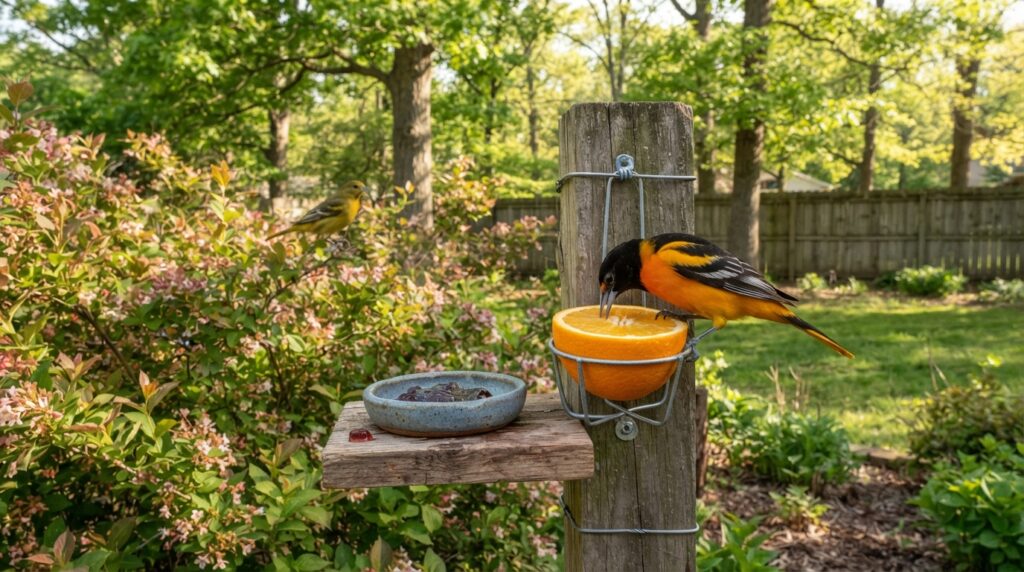
Look for a design with a small removable glass dish rather than a deep molded well, and with spikes or prongs for orange halves alongside. Honest drawbacks: most oriole feeders on sale have jelly wells far deeper than they should be, which is the exact hazard described above — you can simply not fill them to the top. Many also have no roof, so rain dilutes the jelly into a runnier and stickier mess, and none of them are pleasant to clean.
Oranges
Simpler, safer and arguably better. Halve an orange and spike it on a prong, a nail on a post, or a deck rail.
- Cut side up so birds can feed from the flesh
- Replace every couple of days, sooner in heat — fruit ferments and grows mold
- Expect interest to drop off as the season progresses. Orioles often lose enthusiasm for oranges by early summer
- Wasps and ants find fruit quickly, so site it away from where people sit
Halved grapes, and jelly served in an orange half, are both popular. The orange-half-of-jelly trick looks charming and is one of the deeper containers people use, so keep the quantity small if you do it.
The better protein option
If what you want is to support orioles through nesting rather than just to see them, mealworms do the job jelly cannot. Rehydrated dried mealworms or live ones provide the protein that actually builds nestlings, and orioles will take them. More on mealworms here.
Nectar is the other option: orioles take sugar water from oriole-specific feeders, which have larger ports and perches than hummingbird feeders. Same 4:1 recipe, same changing schedule, and none of the stickiness problem. Recipe here.
Cleaning
Jelly feeders need cleaning more often than almost anything else in a yard. Jelly molds, and in warm weather it does it within days.
- Empty and wash every couple of days in warm weather
- Hot water and a brush; rinse extremely thoroughly if you use any detergent
- Discard anything with visible mold rather than scraping it off
- Wipe up drips and residue underneath, which is what draws ants and wasps
Common questions
Is grape jelly bad for birds?
Not inherently, but large quantities in deep containers have put birds into rehabilitation, including hummingbirds that became coated and could not fly. A shallow dish and small amounts is the widely recommended approach.
How much jelly should I put out?
A rough working figure used by experienced oriole watchers is around a quarter cup a day once the local breeding season starts, with somewhat more acceptable during peak spring migration.
What kind of jelly?
Plain grape jelly with no artificial sweeteners. Sugar-free products can contain xylitol, which is dangerous to many animals. Some specialty bird stores sell jelly formulated for birds.
Can hummingbirds really get stuck in it?
Yes. A Wisconsin rehabilitation group reported treating three Ruby-throated Hummingbirds coated in jelly in one year, one of which died. Shallow dishes and small servings are what prevents it.
Should I stop offering jelly during nesting?
Scale it back. Nestlings need insects, not sugar. If you see adults bringing fledglings to the jelly repeatedly, close it down for the season.
Why did the orioles stop taking oranges?
Normal. Interest in oranges commonly drops off by early summer as natural fruit and insects become abundant. Jelly and nectar often hold their attention longer.
Related guides
- Mealworms for birds: live vs dried
- Hummingbird nectar recipe
- Best bird seed
- How to clean bird feeders
Sources: Wisconsin Humane Society Wildlife Rehabilitation Center and Raptor Education Group Inc. on birds treated after becoming coated in jelly; guidance from Kenn and Kimberly Kaufman on jelly quantities and dish dimensions; Laura Erickson on seasonal jelly feeding; Cornell Lab of Ornithology, All About Birds, on oriole diet and feeding; National Audubon Society.
Want a closer look?
A pair of 8x42 binoculars is the single thing that changes backyard birding most. Close focus matters more than magnification when the bird is fifteen feet away.
This link goes to Amazon. If you buy through it we may earn a small commission, at no extra cost to you.