
Affiliate disclosure: some links on this page go to Amazon. If you buy through one we may earn a small commission, at no extra cost to you. Full disclosure.
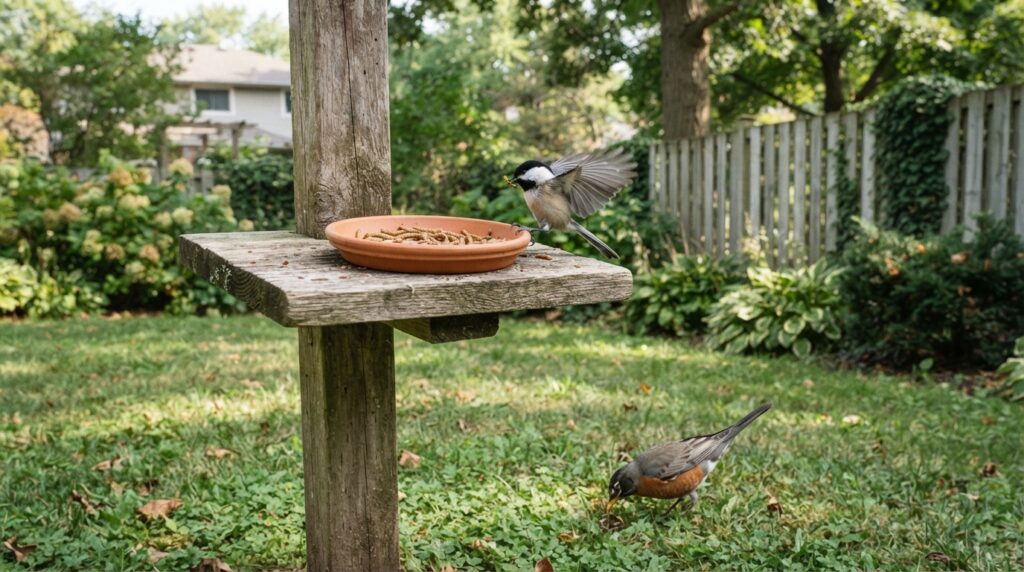
Live mealworms are better and more trouble; dried are easier and need rehydrating, especially during nesting season when nestlings get most of their water from food. Offer them in a smooth-sided dish so they cannot crawl out, in small measured amounts — a rough guide is around 15 mealworms per bird per day — and treat them as a supplement rather than a food source.
Mealworms are the one thing at a feeder that resembles what most songbirds actually eat during breeding season. Seed feeds adults; insects feed nestlings. That makes mealworms genuinely useful in a way jelly and sunflower are not, and it also means the timing and the quantity matter more.
They are the standard way to attract Eastern Bluebirds, which largely ignore seed, and they bring in chickadees, titmice, wrens, nuthatches, robins, catbirds and orioles.
The essentials
- Live — more attractive, more nutritious, needs refrigerating
- Dried — keeps indefinitely, no upkeep, rehydrate before nesting season
- Dish with smooth sides, an inch or two deep, so they cannot crawl out
- Small amounts. Roughly 15 per bird per day as a working guide
- Not a complete diet. A supplement, not a staple
- Same time each day trains birds to turn up
Live vs dried
| Live | Dried | |
|---|---|---|
| Attractiveness | Higher — movement draws birds in | Good once birds learn what they are |
| Moisture | Around 60% water | Almost none until rehydrated |
| Storage | Refrigerate. Feed them bran and carrot | Sealed container, keeps months |
| Cost | Higher per feeding | Lower |
| Hassle | They are live insects in your fridge | None |
| Escapes | Real. Use a dish with sides | Not an issue |
| Best for | Nesting season, first attracting bluebirds | Year-round convenience |
Rehydrate dried mealworms during nesting season. This is the part most people miss and it matters.
Nestlings get most of their water from the food their parents bring. Dry mealworms fed to young birds are a dehydration risk, and the problem is worst in exactly the hot weather when it is hardest for nestlings to cope.
Soak them in warm water for 15 to 30 minutes, drain, and put them out. Do it in small batches, because rehydrated mealworms spoil within a day.
How many
More is not better here. Mealworms are high in fat and protein but are not a balanced diet on their own, and a bird that fills up on them is eating less of the varied invertebrate diet it would otherwise find.
A commonly used working figure is around 15 mealworms per bird per day. In practice that means putting out a small measured amount once or twice a day rather than keeping a dish topped up.
Offer at the same time each morning and birds learn the schedule quickly — bluebirds in particular will start waiting. A dish left permanently full mostly feeds starlings, House Sparrows and whatever mammal finds it overnight.
The dish
Live mealworms climb. A flat tray means most of them are in the grass within minutes.
- Smooth vertical sides, at least an inch or two high — glass, glazed ceramic or smooth plastic
- Not mesh or rough plastic, which they climb easily
- Drainage or a roof if it stays out, so rain does not fill it
- A cage or guard if starlings and House Sparrows are a problem — they find mealworms fast and will clear a dish
- Somewhere visible and open for bluebirds, which like a clear view
Look for a smooth-sided dish deep enough to hold live worms, with a removable tray for cleaning. Honest drawbacks: caged versions that exclude starlings also exclude robins and thrashers, which are larger; open dishes get emptied by squirrels and are raided overnight by raccoons; and glass dishes crack if left out through a freeze.
Which birds take them
| Reliably | Sometimes | Rarely or never |
|---|---|---|
| Eastern Bluebird | Northern Mockingbird | American Goldfinch |
| Carolina and House Wren | Gray Catbird | House Finch |
| Chickadees and titmice | Baltimore Oriole | Mourning Dove |
| American Robin | Brown Thrasher | Dark-eyed Junco |
| Nuthatches | Warblers, occasionally | Cardinals, mostly |
Goldfinches are worth singling out: they are essentially strict vegetarians and will not take mealworms at all, even when raising young. More on that.
Timing through the year
- Late winter and early spring: useful for bluebirds prospecting nest sites, and for establishing the habit before the season starts
- Nesting season: the period they do the most good. Rehydrate dried ones
- Fledging: adults bring young to the dish. Worth watching for and the best argument for doing this at all
- Hot weather: put out tiny amounts. Live mealworms die and dried ones spoil once rehydrated
- Winter: genuinely helpful for bluebirds and wrens in cold snaps when insects are unavailable
Keeping live mealworms
Not difficult, and worth knowing before you buy a tub of a thousand.
- Refrigerate at around 40 to 50°F, which slows them into dormancy
- Keep them in wheat bran or oatmeal, a couple of inches deep
- Add a slice of carrot or potato for moisture, and replace it before it molds
- Take out what you need and let it warm up before offering — cold mealworms do not move, and movement is the attraction
- Ventilated lid. They need air
- If they pupate into beetles, they were too warm
Common questions
Do I need to soak dried mealworms?
During nesting season, yes. Nestlings get most of their water from food, and dry mealworms are a dehydration risk. Soak in warm water 15 to 30 minutes, drain, and offer in small batches.
How many mealworms should I put out?
Around 15 per bird per day is a common working guide. Offer a measured amount once or twice daily rather than keeping a dish permanently full.
Are live mealworms better than dried?
More attractive and more nutritious, particularly for their moisture content. Dried are far more convenient and work well provided you rehydrate them when it matters.
Can mealworms be a bird’s main food?
No. They are high in fat and protein but not a balanced diet. Treat them as a supplement alongside the varied invertebrates birds find themselves.
How do I stop starlings taking them all?
A caged dish with openings sized for smaller birds, and offering a measured amount at a set time rather than leaving food out. The trade-off is that a cage also excludes robins and thrashers.
Will mealworms attract bluebirds to a nest box?
They help considerably, particularly in late winter when pairs are prospecting. Box specification matters just as much — a 1½ inch hole and a pole with a baffle. Full specification here.
Related guides
- Nest box hole sizes by species
- Grape jelly and oranges for orioles
- Best bird seed
- Black-capped Chickadee
Sources: Cornell Lab of Ornithology, All About Birds and NestWatch, on mealworm feeding and nestling diet; North American Bluebird Society guidance on mealworm quantities and feeding practice; Project FeederWatch, Feeding Birds; National Audubon Society; university extension service guidance on mealworm husbandry.
Want a closer look?
A pair of 8x42 binoculars is the single thing that changes backyard birding most. Close focus matters more than magnification when the bird is fifteen feet away.
This link goes to Amazon. If you buy through it we may earn a small commission, at no extra cost to you.