
Affiliate disclosure: some links on this page go to Amazon. If you buy through one we may earn a small commission, at no extra cost to you. Full disclosure.
Take the feeders down for one to two weeks. The hawk moves on to somewhere with birds, and your feeder birds come back when you put them out again. Add dense cover within about ten feet of the feeder before you restart. Do not attempt to harm, trap or remove the hawk — every native hawk in North America is federally protected, and the penalties are serious.
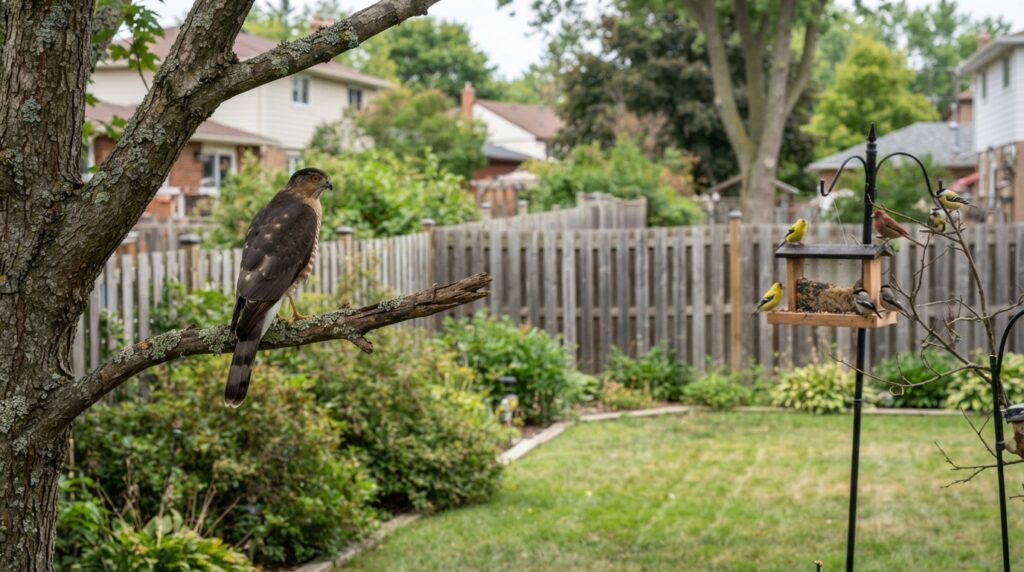
A feeder is a reliable concentration of small birds in a predictable place, and Cooper’s Hawks and Sharp-shinned Hawks have worked this out thoroughly. Both species have adapted well to suburbs specifically because we put feeders in them.
Watching it happen is genuinely unpleasant, and the impulse to do something about it is understandable. But the range of legal, effective options is narrow — and the one that actually works is the simplest.
What to do
- Take feeders down for 1–2 weeks. Removes the reason the hawk is there
- Add dense cover about 10 feet from the feeder before restarting
- Move feeders closer to shrubs, not into the open
- Keep an eye on window collisions — panicked flushes cause them
- Do not harm, trap or handle the hawk. Federally protected
- Accept some of it. A hawk in the yard is a functioning food web
Which hawk
Two accipiters account for almost all feeder hunting. They are notoriously difficult to separate, and it does not much matter which you have.
| Cooper’s Hawk | Sharp-shinned Hawk | |
|---|---|---|
| Size | Crow-sized | Jay-sized |
| Head | Larger, more projecting in flight | Small, rounded |
| Tail tip | Rounded | Squared or notched |
| Flight | Flap-flap-glide, powerful | Quicker, more erratic |
| Adult | Blue-gray back, rusty barred chest, red eye | Same pattern, smaller |
| Juvenile | Brown above, streaked brown below, yellow eye | Same, smaller |
Both have short rounded wings and long tails, built for maneuvering through vegetation at speed rather than soaring. Red-tailed Hawks, the large soaring hawks on roadside poles, are not usually feeder hunters — they take rodents and rabbits in open ground.
Merlin Bird ID will help if you get a photograph. Juvenile accipiters confuse experienced birders, so do not feel bad about it.
The legal position
All native North American hawks are protected under the Migratory Bird Treaty Act, and most also under state law. It is a federal offense to kill, capture, harm, possess or attempt to take one, or to possess feathers, nests or eggs.
This is not a technicality that nobody enforces. Penalties for taking a protected raptor are substantial, and can include fines and imprisonment.
It also covers things people occasionally consider without thinking of them as illegal: trapping and relocating, destroying a nest, or using any substance intended to harm. If a hawk is causing a genuine problem beyond taking feeder birds, the route is your state wildlife agency, not a hardware store.
Why removing the feeder is the answer
The hawk is not attached to your yard. It is attached to the concentration of prey in it, which you are supplying.
Take the feeders down and the small birds disperse to their normal foraging range within a few days. The hawk, finding nothing, moves on. One to two weeks is generally enough, and it is what the Cornell Lab recommends for exactly this situation.
Your feeder birds return when you put food back out. They have not gone far and they have not forgotten.
Cover is the long-term fix
The reason some yards get hit repeatedly and others do not is usually cover.
A feeder in open lawn gives small birds nowhere to go when an accipiter comes through fast and low. A feeder near dense shrubs gives them somewhere to dive in the half-second they have.
Roughly ten feet is the working distance. Much closer and a cat has an ambush point. Much further and the cover is unreachable in the time available.
What works:
- Dense native shrubs — viburnum, dogwood, serviceberry, native brambles
- Evergreens, which hold cover through winter when it matters most
- A brush pile, which is free and effective. Stack prunings loosely near the feeder
- A discarded Christmas tree propped beside the feeding area works well through the winter
Watch for window strikes
An accipiter flushing a flock causes panicked flight in every direction, and that is a common cause of window collisions.
If you have a hawk working the yard, it is worth checking your feeder placement: under three feet from glass or over thirty feet, never the middle range where birds build up enough speed to be injured. External markings spaced no more than two inches apart are the fix if the window is a problem. Full detail here.
If you buy decals, buy enough to cover the whole pane at two-inch spacing — a pack of six on a picture window does essentially nothing. Check the product is for external application. Honest drawbacks: a properly treated window is visibly patterned from inside, adhesive lifts and yellows after a few years of sun, and ultraviolet-only products marketed as invisible to people have shown mixed results in testing.
What does not work
| Method | Why not |
|---|---|
| Plastic owls and predator decoys | Hawks habituate within days. Sometimes attract mobbing crows |
| Reflective tape and spinners | Same. Brief effect at best |
| Ultrasonic devices | No credible evidence against birds |
| Scaring it off each time | Ineffective, and harassment of a protected species is legally questionable |
| Trapping or relocating | Illegal without federal and state permits |
| Netting or caging the whole feeder | Entangles the birds you are trying to protect |
The wider view
Accipiters take small birds because that is their diet, and they have done so for far longer than feeders have existed. Cooper’s Hawk populations recovered substantially after the banning of DDT, and their success in suburbs is generally regarded as a conservation good-news story.
A hawk hunting your yard means the yard supports enough life to be worth hunting. That is not much consolation while it is happening, but it is the accurate framing — and the practical answer remains the same either way: take the feeders down for a fortnight, add cover, and start again.
Common questions
How do I get a hawk to leave my yard?
Take the feeders down for one to two weeks. Small birds disperse, the hawk follows the prey elsewhere, and your feeder birds return when you restart.
Is it illegal to scare a hawk away?
Harming, capturing or killing one certainly is — all native hawks are federally protected under the Migratory Bird Treaty Act. Deliberate repeated harassment is legally questionable and does not work anyway.
Which hawk hunts bird feeders?
Almost always Cooper’s Hawk or Sharp-shinned Hawk. Both have short rounded wings and long tails built for chasing birds through cover. Red-tailed Hawks mostly take rodents.
Will my feeder birds come back?
Yes. They disperse rather than leave. Once feeders go back out they return within days, usually faster than a new feeder takes to be discovered.
Should I move the feeder into the open so birds see the hawk coming?
No — that makes it worse. Accipiters hunt by surprise and speed, and birds in the open have nowhere to go. Move the feeder nearer dense cover, about ten feet away.
Do hawk decoys work?
No. Hawks habituate to plastic owls and decoys within days, and they sometimes attract mobbing crows instead. Removing the food source is what works.
Related guides
- Why aren’t birds coming to my feeder?
- Why birds fly into windows
- Cats and birds
- Types of bird feeders
Sources: Cornell Lab of Ornithology, All About Birds, on hawks at feeders and Cooper’s and Sharp-shinned Hawk species accounts; US Fish & Wildlife Service, Migratory Bird Treaty Act protections and penalties; Project FeederWatch; National Audubon Society; state wildlife agency guidance on protected raptors.
Starting out?
One tube feeder with black oil sunflower brings in more species than any other single setup. Metal ports last; all-plastic ports get chewed open within a season or two.
This link goes to Amazon. If you buy through it we may earn a small commission, at no extra cost to you.