
Affiliate disclosure: some links on this page go to Amazon. If you buy through one we may earn a small commission, at no extra cost to you. Full disclosure.
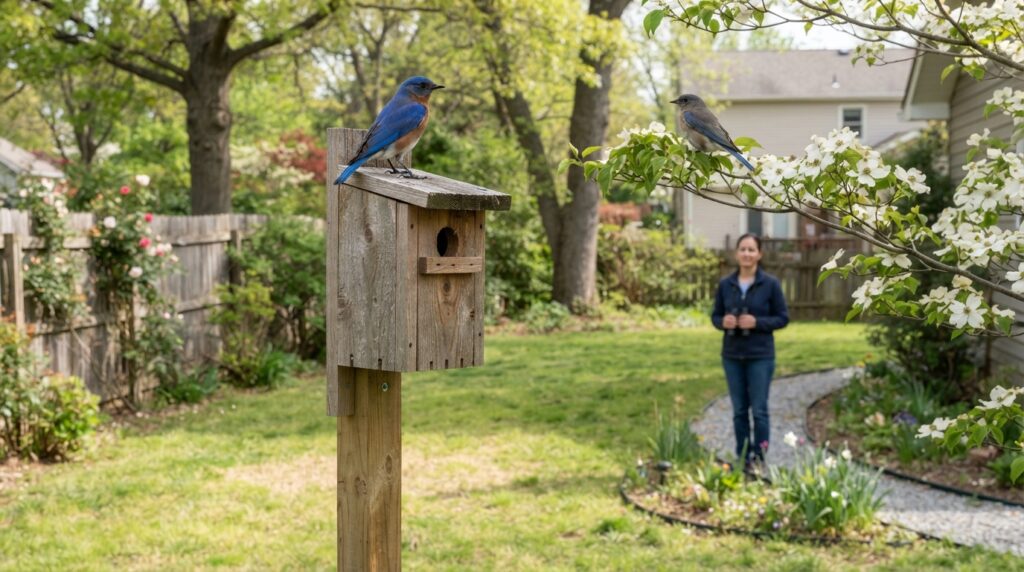
A bluebird box wants a 1½-inch entrance hole, no perch, mounted on a smooth pole with a predator baffle, five to six feet high, facing an open area. Put it up in late winter. Then commit to checking it weekly through the season — an unmonitored box that raises non-native House Sparrows does more harm than no box at all, and monitored boxes fledge substantially more young.
Nest boxes for Eastern Bluebirds are one of the more successful conservation interventions of the last century. Populations recovered from steep declines partly on the back of a movement of ordinary people putting up boxes in their yards.
Getting one right is not complicated, but the details matter more than most guides make clear. A box put up wrong, or left unmonitored, can genuinely damage bluebird populations rather than help them.
The specification
- Entrance hole: 1½ inches for Eastern and Western Bluebird, 1 9/16 inches for Mountain
- No perch — a perch mainly helps House Sparrows and predators
- Pole-mounted, five to six feet high, with a predator baffle
- Facing open area, away from prevailing wind
- Side or front that opens for monitoring and cleaning
- Untreated wood or PVC — not stained, painted or pressure-treated
- Ventilation and drainage holes
The hole size decides who moves in
This is the number that matters most, and it excludes species by size.
| Hole size | Intended species |
|---|---|
| 1½ inch | Eastern Bluebird, Western Bluebird, chickadees, titmice, nuthatches, Tree Swallow, House Wren |
| 1 9/16 inch | Mountain Bluebird — slightly larger and needs a slightly larger hole |
| 1¼ inch | Chickadee-specific, excludes House Sparrow |
A hole any larger than 1½ inches invites European Starlings, which are aggressive cavity competitors, and it does not attract bluebirds any faster. Get this dimension exactly right and use a template if you are drilling it yourself. Full hole size chart by species.
Where to put it
- Open area, where bluebirds can hunt insects from the box. Meadows, pastures, cemeteries, golf courses and large yards all work
- Facing an open flight path away from the box, so fledglings have somewhere to go
- Facing east is often ideal — the box warms in the morning and stays out of the worst afternoon sun and prevailing wind
- Five to six feet high, measured to the entrance hole
- On a smooth metal or PVC pole with a baffle, not on a tree
- At least 100 yards from another box, as bluebirds are territorial. Boxes paired within about 15 feet can allow bluebirds and Tree Swallows to share a site without conflict
- Not near feeders — too much activity discourages nesting
- Away from dense brush and heavily wooded areas — that is House Wren habitat, and wrens will destroy other species’ eggs to reduce competition for cavities
- Away from barns, farmyards and feedlots, which are House Sparrow strongholds. A box there is likely to be a “sparrow factory”
Why the pole and baffle matter
Data on this is compelling. Bluebird nests in natural cavities succeed roughly 65% of the time; nests in monitored boxes on poles with predator baffles succeed over 90%. The difference is almost entirely raccoons, snakes and cats reaching nests on trees and unbaffled poles.
A tree-mounted box, however traditional it looks, is asking a raccoon to climb up and empty it. Snakes climb trees and unbaffled poles readily. A smooth metal pole with a wide baffle underneath the box denies both.
A pole-and-baffle kit is more useful than a decorative box on its own for exactly this reason. Look for a stovepipe or wobbling-cone baffle wide enough to actually stop a raccoon — small conical baffles are largely decorative. Honest drawbacks: poles need firm ground and are awkward in frozen or rocky soil; a metal baffle rattles in wind and needs occasional tightening; and a properly baffled setup does not look particularly quaint. Function over charm here.
When to put boxes up
Late winter, ahead of the breeding season — February in the South, March in the middle of the country, late March in the North. Bluebirds prospect for nest sites weeks before they lay, and a box that appears in late April misses the peak.
If you have boxes up already, do a pre-season check in late winter: repair cracks, tighten fasteners, check the baffle is secure, clean out any old nest material, and remove any paper wasp nests that started last summer.
To discourage wasps building in a box, rub the inside roof corners with a bar of Ivory soap or paint them with plain liquid soap. Do not use insecticide in a nest box.
Monitoring: what a bluebird landlord actually does
This is the part that separates helping bluebirds from harming them.
An unmonitored box that raises House Sparrows is worse than no box at all. House Sparrows are a non-native invasive species that kill adult bluebirds, destroy their eggs and evict them from cavities. A box left unchecked becomes what bluebird groups call a “sparrow factory”, producing more of the birds that are threatening the ones you meant to help.
The Michigan Bluebird Society and the North American Bluebird Society are unusually direct about this: do not put up a box you will not monitor.
Weekly check
Check the box weekly through the breeding season. Bluebirds are notably tolerant of nest checks — monitoring up to twice a week does not deter them, and monitored nests fledge substantially more young. Approach quietly, tap the side gently to warn any adult inside, and keep your head back from the opening as you open it. Look, note what you see, close and leave.
What you are looking for
- Species using the box — the nest itself tells you: bluebirds build tightly woven grass, about two inches deep; Tree Swallows similar but with feathers; chickadees use moss and animal hair; wrens fill the box with sticks; House Sparrows make a messy tangle of grass, feathers and trash
- Number of eggs and their appearance
- Signs of predation — damaged nest, broken shells on the ground, muddy tracks on the pole
- Signs of the parents — feathers, droppings, activity nearby
- Anything wrong — wasp nest, mice, blowfly infestation of nestlings
Timing rules
- Do not check in the morning if egg laying is in progress — females typically lay early
- Do not check on cold or rainy days — you expose the contents to weather
- Stop opening the box once nestlings are 12 days old. Older nestlings may fledge prematurely if disturbed, which is a fatal outcome
- After fledging, clean the box out promptly — bluebirds often raise two or three broods in a season and want a fresh box
Consider joining NestWatch from the Cornell Lab, which collects nest data and provides the monitoring protocol in more detail than this page can.
House Sparrow control
Non-native House Sparrows are the single biggest problem for bluebird boxes. Native cavity nesters are protected under the Migratory Bird Treaty Act; House Sparrows and European Starlings are not, which is why control measures targeting them are legal.
- Remove House Sparrow nests as they appear. If eggs are laid, they can be removed. Regular removal — once or twice a week — prevents a brood from fledging
- Do not just tip out sparrow nests and hope they leave. They rebuild the same week, all summer. Persistence is required
- A sparrow spooker — strips of mylar tape fastened above the box, brushing the roof over the hole — deters House Sparrows once installed. Only install after your bluebirds have laid at least one egg, and remove it as soon as young have fledged so sparrows do not habituate
- Reduce sparrow food nearby — avoid cheap mixes with milo, red millet and cracked corn, which sparrows prefer. Detail here
- Trapping is legal for House Sparrows in most states and used by experienced monitors. In-box traps and ground traps are available, but require commitment and appropriate follow-through — not a beginner’s tool
Identify the bird before you interfere. Only House Sparrows and European Starlings can legally be removed from nest boxes. Native House Wrens, chickadees, titmice and Tree Swallows all use bluebird-sized boxes and are federally protected. If you cannot identify the sparrow with certainty, leave it alone until you can.
When boxes fail: common reasons
| Problem | Fix |
|---|---|
| Nothing moved in | Wrong location, or too close to another box, or too late in the season. Move to open ground, well away from woods and feeders |
| House Sparrows took over | Weekly nest removal, sparrow spooker, reduce sparrow food nearby |
| Predator emptied the nest | Add or upgrade the baffle. Tree-mounted boxes are highly vulnerable |
| Nest with broken shells on the ground | Raccoon, snake or cat access. Baffle, and check the pole for reach from nearby structures |
| Overheating in a hot climate | Ventilation holes near the roof, shade the box from afternoon sun, PVC or light-colored wood |
| Blowfly larvae on nestlings | Common in some regions, and rarely fatal in low numbers. Consult NestWatch or local bluebird society for treatment guidance |
Common questions
What size hole for a bluebird house?
1½ inches for Eastern and Western Bluebirds; 1 9/16 inches for Mountain Bluebirds. Anything larger admits starlings and does not attract bluebirds any faster.
How high should a bluebird box be?
Five to six feet, measured to the entrance hole, on a smooth pole with a predator baffle. Higher gives predators no benefit and makes monitoring harder.
Which way should a bluebird box face?
Facing an open area, generally east or southeast, away from prevailing wind and afternoon sun. The exact direction matters less than the flight path in front of the box being clear.
Do I have to check bluebird boxes?
Yes. Monitored boxes produce substantially more fledglings than unmonitored ones, and an unmonitored box left to raise House Sparrows does more harm than good.
Can I remove a House Sparrow nest?
Yes. House Sparrows are a non-native species not covered by the Migratory Bird Treaty Act. Nests, eggs and adults may all be legally removed — but be certain of the identification before acting, since native species also use bluebird boxes.
When should I put up a bluebird box?
Late winter, ahead of prospecting. February in the South, March in the middle of the country, late March in the North. Boxes put up in late spring miss the peak.
Related guides
- Nest box hole sizes by species
- Mealworms for birds
- Cats and birds
- Nestling or fledgling? Baby bird decision tree
Sources: North American Bluebird Society and its state affiliates including Michigan Bluebird Society and Virginia Bluebird Society, on nest box specification, placement, monitoring and House Sparrow control; Sialis.org monitoring protocols; NestWatch (Cornell Lab of Ornithology); Cornell Lab of Ornithology, All About Birds, on cavity-nesting species; US Fish & Wildlife Service, Migratory Bird Treaty Act, on protected and non-protected species; research on nest success rates in monitored versus unmonitored boxes.
Putting up a nest box?
The entrance hole diameter decides which species can use it and which cannot get in. Untreated wood, ventilation, drainage and a side that opens for cleaning are the four things to check.
This link goes to Amazon. If you buy through it we may earn a small commission, at no extra cost to you.