
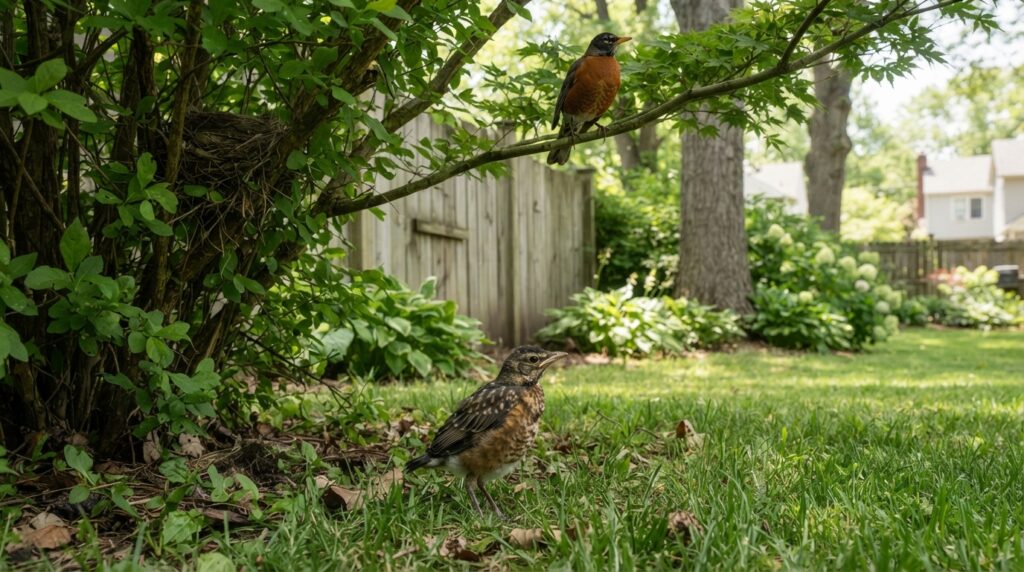
One question decides most of these calls: does the bird have feathers and can it hop or grip a twig? If yes, it is a fledgling — its parents are almost certainly nearby, it is meant to be out of the nest, and the best thing you can do is walk away and keep pets indoors. If it is naked or has only wisps of down and cannot grip, it is a nestling and needs to go back in the nest or into a licensed rehabilitator’s hands.
This is the single most common wildlife call people make in spring and summer, and the great majority of the time it is a false alarm. Fledglings on the ground are not lost or abandoned — they are doing exactly what fledglings do, which is spend a few days on the ground learning to fly while their parents keep feeding them.
The decision that matters is nestling versus fledgling, and it takes about ten seconds to make.
The decision tree
- Feathered, can hop or grip a twig → fledgling → leave it alone
- Naked or only downy, cannot grip → nestling → return to nest or call a rehabilitator
- Visibly injured, bleeding, cold, limp, or has been in a cat’s mouth → licensed rehabilitator immediately, whatever age
- Not sure → take a photograph and call a rehabilitator to ask
Fledgling: feathered, can grip
A fledgling is a young bird that has left the nest but cannot fly yet, or flies very badly. It is fully or nearly fully feathered, sometimes with a short stubby tail and a few tufts of down on the head, and it can hop, shuffle and grip a finger or twig firmly with its toes.
This is normal. Fledglings leave the nest two to five days before they can properly fly, and depending on the species they spend several days to a few weeks on the ground and in low branches while their parents keep feeding them. The Cornell Lab is unambiguous about this: most baby birds people find are fledglings, and intervening in their lives usually makes things worse.
What actually helps:
- Leave the bird where it is, or, if it is somewhere dangerous like a driveway or path, move it a few feet to a nearby low branch or dense shrub. The parents will find it — they can hear it
- Keep cats indoors for a few days. Cats are the leading cause of fledgling mortality by a large margin. More on that
- Keep dogs on a leash in the area
- Keep children back, and watch from a distance if you want to
- Give the parents space. They will not come down to feed while people are standing over the bird. Watch from inside if you can
- Do not feed it. Well-meaning offerings do more harm than good, and parents know what to bring
- Do not give it water. Dripping water into the mouth of a bird easily enters the airway and drowning is a common cause of death in home-rescued birds
The “walk away” instruction is not indifference. Fledglings raised by hand imprint on people and, as one wildlife rehabilitator quoted by Audubon put it, “they don’t know how to be a bird”. A fledgling that lives with its parents for a few awkward ground days grows up as a wild bird. One taken indoors, however kindly, often does not survive release.
Nestling: naked or downy, cannot grip
A nestling is younger — naked or with only sparse down, eyes possibly still closed, unable to stand properly, unable to grip a twig or a finger. It cannot survive on the ground and needs help.
The best help is usually the simplest: put it back in the nest.
- Look for the nest. It is almost certainly within a few yards. Check overhead branches, ledges, gutters and any shrub near where you found the bird
- Put on gloves, or wash your hands. It is a persistent myth that parents reject a chick a person has touched — most songbirds have a poor sense of smell — but for hygiene, gloves are better
- Gently place the nestling in the nest and move away
- Watch from a distance for the parents to return. Give it an hour at least, from somewhere they cannot see you
If the nest has been destroyed, or you cannot reach it, a substitute nest often works:
- A small woven basket, plastic container with drainage holes, or margarine tub with holes punched in the base
- Line it with dry grass or the material from the damaged nest
- Fasten it securely to a branch or bracket as close to the original location as possible
- Place the nestling inside, move well back, and watch for the parents to find it
Call a licensed wildlife rehabilitator if any of these apply, whatever the age:
- The bird is bleeding, has a drooping wing, or looks lifeless
- It feels cold to the touch
- It has been in a cat’s or dog’s mouth — bacteria in their mouths cause fatal infection within days, even from punctures too small to see
- You have watched for an hour and no parent has come back to the nest
- You are not sure whether it is a nestling or fledgling and cannot get advice quickly
How to find a wildlife rehabilitator
This is the number that matters and it is worth having before you need it.
- Your state wildlife agency maintains a list of licensed rehabilitators. Searching for “[your state] wildlife rehabilitator” reaches it quickly
- Animal Help Now at ahnow.org has a directory searchable by location and by animal type
- Local Audubon chapters generally know who to call in the area
- A local veterinarian may take the bird for you or direct you to the right person
Rehabilitators are licensed under federal and state law and have permits to handle native birds — something you legally cannot do without training and paperwork under the Migratory Bird Treaty Act. Almost all rehabilitators work as volunteers or on donations, so calling first rather than turning up with a bird is standard courtesy.
The legal position, briefly
Almost every native bird in North America is protected under the Migratory Bird Treaty Act, and it is illegal to keep, handle, transport or attempt to rehabilitate one without the appropriate federal and state permits. This applies even with the best intentions.
The three exceptions in most states are the non-native House Sparrow, European Starling and feral pigeon (Rock Pigeon), which are not covered. Everything else — robins, wrens, warblers, jays, hummingbirds — goes to a licensed rehabilitator.
What if you cannot reach a rehabilitator immediately
Sometimes it will be an evening, a weekend, or a distant answering machine. Short-term:
- Put the bird in a small ventilated box lined with soft cloth or paper towels (not terrycloth, which catches claws)
- Keep it warm, quiet and dark — on top of a warm heating pad on low, or beside a bottle of warm water wrapped in a towel
- Do not offer food or water. Wrong food kills, and inhaled water causes drowning
- Do not handle or check on it repeatedly. Stress alone can be fatal
- Keep it away from pets, children and noise
- Call again as soon as anyone is available
Common questions
Is a baby bird on the ground abandoned?
Almost never. If it is fully feathered and can hop or grip, it is a fledgling — parents are nearby and continuing to feed it. Leave it alone and keep pets indoors.
Will a mother bird reject a baby if a person touched it?
No. This is a myth. Most songbirds have a poor sense of smell and readily continue caring for young that have been handled briefly. Gloves are still sensible for hygiene.
Can I raise a baby bird myself?
No, and it is illegal to try under the Migratory Bird Treaty Act for almost all native species. Wrong food and improper care kill more birds than the situation they were rescued from.
How long do I watch before deciding parents are not coming?
At least an hour, from somewhere the parents cannot see you. They will not come down to feed with a person standing over the nest. Watch through a window if you can.
My cat brought a fledgling in. What do I do?
Contact a licensed wildlife rehabilitator immediately, whatever the bird’s condition looks like. Cat mouth bacteria cause fatal infection within days from punctures too small to see, and the bird needs antibiotics it can only get from a rehabilitator or vet.
Where can I find a licensed wildlife rehabilitator?
Your state wildlife agency’s website lists licensed rehabilitators, and Animal Help Now at ahnow.org has a searchable directory. Local Audubon chapters and vets can point you at the right person too.
Related guides
- I found a baby bird on the ground: fuller detail
- Birds nesting in your house, vents and chimney
- Cats and birds
- Why birds fly into windows
Sources: Cornell Lab of Ornithology, All About Birds, on distinguishing nestlings from fledglings and when not to intervene; National Audubon Society; Wildlife Center of Virginia, baby bird season guidance; Tufts Wildlife Clinic; Washington Department of Fish & Wildlife; US Fish & Wildlife Service, Migratory Bird Treaty Act; Animal Help Now rehabilitator directory.