
Affiliate disclosure: some links on this page go to Amazon. If you buy through one we may earn a small commission, at no extra cost to you. Full disclosure.
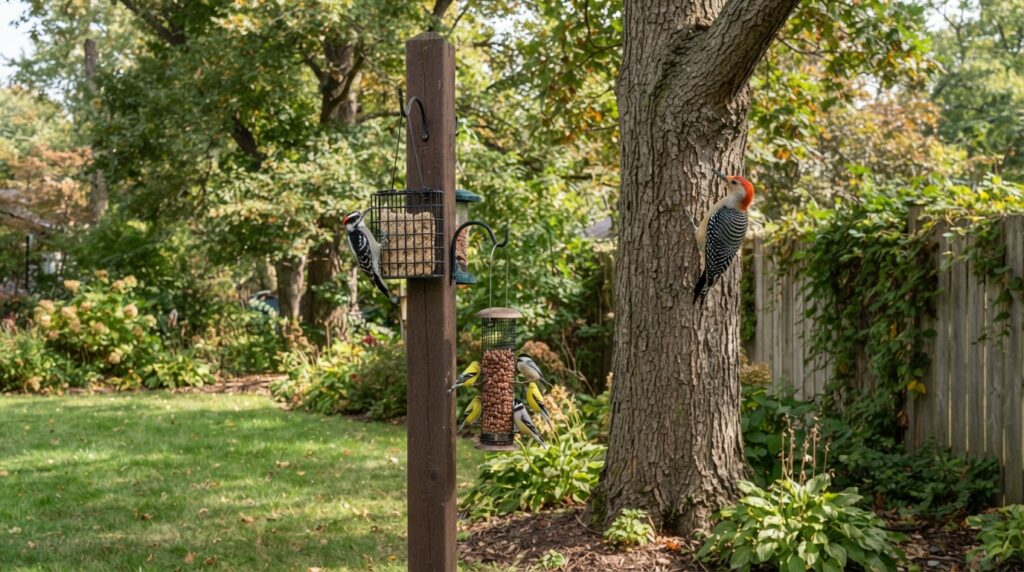
Suet is the single most effective draw, and a tail-prop feeder is what brings in the larger species. Downy Woodpeckers will use almost any suet cage; Red-bellied, Hairy and Pileated brace with their tail against a flat back panel the way they would on a tree trunk. Place feeders around six to eight feet high, on or near a mature tree, and keep them out of full summer sun.
Woodpeckers are among the most photogenic birds a feeder attracts, and getting them takes more thought than throwing up any suet cage. The two things that decide which species you see are the food you offer and the feeder design, and design matters more than most guides let on.
The essentials
- Suet is the reliable draw. Peanut suet outperforms plain
- Tail prop feeder for Red-bellied, Hairy and Pileated
- Peanuts and sunflower take some species that use less suet
- Around 6–8 feet high, on or near a mature tree
- Out of full afternoon sun, always
- Standing dead wood matters as much as anything you can buy
Why tail prop matters
A woodpecker’s tail is not just an ornament. The tail bone, lower vertebrae and supporting muscles are enlarged, so the tail acts as a rigid third leg when the bird is climbing or hammering on a trunk. Cornell Lab and Wild Birds Unlimited both make the same point: this is a load-bearing structure.
A plain suet cage hanging in the air gives a woodpecker nothing to brace against. Small species like Downy manage anyway; larger species like Pileated cannot get comfortable, so they visit briefly or not at all.
A tail-prop feeder is a suet cage with a flat panel extending down below it, giving the bird a surface to press its tail against exactly the way it would on a tree trunk. The change in what visits is often dramatic.
Species and what each one wants
Downy Woodpecker
The smallest and easiest. Will use almost any suet feeder, hanging or clinging, and readily takes peanuts and black oil sunflower from tube and hopper feeders. Bold about human presence — often the first woodpecker at a new setup, and the one most willing to feed near the house. If you have any woodpecker, this is probably it.
Hairy Woodpecker
Looks like an oversized Downy — same black-and-white pattern, but larger, with a longer bill. Uses the same foods but prefers a tail-prop feeder for comfort, and is more cautious than Downy. Often present but not seen without a proper feeder setup.
Red-bellied Woodpecker
Gray-and-white barred back, bright red cap (the “red belly” is a faint pink wash you rarely see). Common across the East and Midwest and spreading northward. Takes suet, whole peanuts, sunflower, and occasionally orange halves. Wants a tail-prop feeder and will use a large hopper.
Northern Flicker
The oddball. Large, brown-and-spotted, with a bold facial mark. Spends about 75% of its time on the ground eating ants and other insects, and visits feeders less consistently than the others. Suet, mealworms and Bark Butter-type spreadable products bring them in. Leave a patch of lawn unmown near the feeder and you make the yard more useful to them.
Pileated Woodpecker
The one everyone wants: crow-sized, black with a bright red crest, spectacular. Primary food is carpenter ants inside dead and dying wood, so suburban yards without mature trees rarely see them. Where they occur they take suet and Bark Butter, and they need:
- A large tail-prop or trunk-mounted feeder
- Position at six to ten feet, on or beside a large tree
- Minimal disturbance nearby — more sensitive than smaller species
- Patience. Two to three months of consistent setup is not unusual before regular visits
Red-headed Woodpecker
Entirely red head, black back, white belly, bold and distinctive. Populations are declining across much of the country. Takes suet and peanuts, and uses natural cavities heavily — standing dead trees on the property are the strongest draw.
Yellow-bellied Sapsucker
Winter visitor across much of the South and East. Drills neat horizontal rows of small holes in tree trunks and feeds on the sap and the insects it attracts. Uses suet sometimes, but sap and insects are the primary interest. Distinctive rows of holes in a maple or birch mean one has been in the yard.
Feeder types
| Feeder | Which species |
|---|---|
| Tail-prop suet | The workhorse. All the common species, and essential for larger ones |
| Upside-down suet | Downy, Red-bellied and Hairy manage; excludes starlings, which mostly cannot feed inverted |
| Plain suet cage | Downy, small numbers of others. The lowest common denominator |
| Log or bark-butter feeder | Excellent for Pileated and Bark Butter mixes; woodpeckers grip naturally |
| Peanut feeder (whole or shelled) | Blue Jays too, but Red-bellied and Hairy take them readily |
| Hopper or platform | Larger species will use them for sunflower and peanuts |
| Tube with sunflower | Downy will hang and feed; larger species mostly cannot |
A double-cake tail-prop feeder is the useful upgrade over a plain single cage — twice the capacity, twice the birds able to feed at once, and enough tail surface for even a Pileated to settle. Honest drawbacks: cheap wire cages rust through in two or three seasons; a full double cage is heavier than lightweight brackets will hold; and starlings work them over enthusiastically, which is when an upside-down design comes into its own. Recycled-plastic frames outlast wire in wet climates.
What to fill it with
Beyond plain suet, several products significantly outperform it.
- Peanut suet — the reliable upgrade. High fat and protein, more attractive than plain
- Insect or mealworm suet — closer to natural woodpecker diet
- Whole or shelled peanuts — the second most effective draw
- Bark Butter or peanut butter spread — smeared onto tree bark or into holes in a log feeder, excellent for Pileated and warblers
- Black oil sunflower — takes some species, and near universal at other feeders anyway
- No-melt dough in summer — plain suet turns rancid above about 90°F. Detail here
Peanuts and cracked corn carry the highest aflatoxin risk of any common bird food — aflatoxin is a toxin produced by Aspergillus molds that grow in stored grain. Buy from a source that stores properly, keep peanuts sealed and dry, and never use damp or musty peanuts. More on seed storage and mold.
Placement
- Around 6 to 8 feet high. Comfortable working height for the birds, easy for you to service
- On or near a mature tree. Woodpeckers approach food with a clear flight path from cover
- Not in the open middle of a lawn. Larger woodpeckers particularly dislike exposed feeders
- Shade for at least the afternoon. Suet melts and turns rancid in sun
- Not right next to a window. Bracing woodpeckers on a nearby feeder occasionally drive off other birds — and if the window is between three and thirty feet, collisions from flushed feeder birds are a real risk. Detail here
- A dead tree left standing is the single most useful thing on the property. Insects colonize dead wood, woodpeckers excavate cavities in it, and yards with a snag or two see substantially more woodpecker activity than yards without. Only remove where it is a genuine hazard
Timing
Woodpeckers take time to commit. Downy may show up within days, particularly in fall as natural insect food thins out. Larger species commonly need weeks or months of consistent setup before they establish a regular route through the yard.
Fall and winter are the peak visiting seasons, since natural food is scarcest then. A feeder set up in September and October is discovered earlier and used more.
Summer is when to switch to no-melt dough or take suet down entirely, because plain suet fouling head feathers is a real problem in heat. Full detail.
Drumming and pecking on the house
The other reason people search for woodpecker information — wanting them to stop drumming on the siding or drilling holes in the cladding.
Drumming is territorial signaling and mostly happens in spring, on whatever surface makes the loudest noise. Hollow gutters, downspouts and siding are favorites. Drilling holes is different — either feeding excavation (looking for insects in the wood) or nest excavation, and it means there is something in the siding worth investigating.
In a Cornell Lab study, reflective streamers hung loose over the damaged area were the only deterrent that worked with any consistency, stopping damage at half the test homes. Plastic owls and scare eyes worked briefly at best. For a persistent bird, cover the spot with metal flashing or hardware cloth, or hang lightweight netting taut from the eaves, at least 3 inches off the siding. Never use sticky substances, which can fatally trap birds. All woodpeckers are federally protected under the Migratory Bird Treaty Act, so lethal control is not an option without a federal permit. Full guide to woodpecker damage.
Common questions
What is the best food to attract woodpeckers?
Suet, especially peanut or insect suet. Whole peanuts are the second most reliable draw, and Bark Butter or peanut butter spread onto bark works particularly well for Pileated Woodpeckers.
Do woodpeckers need a special feeder?
A tail-prop suet feeder is significantly better than a plain cage for anything larger than a Downy. The flat panel below the cage lets the bird brace its tail against something the way it would on a tree trunk.
How high should I hang a woodpecker feeder?
Around six to eight feet, on or near a mature tree. Larger woodpeckers dislike exposed feeders in open lawn and prefer approaches from cover.
How do I attract a Pileated Woodpecker?
Suet or Bark Butter, on a large tail-prop or trunk-mounted feeder, near mature trees, with minimal disturbance. If your property borders woodland or has several large trees, it is worth trying — but expect it to take two to three months of consistent setup, not days.
Should I cut down a dead tree?
Only if it is a hazard to people or buildings. Standing dead wood is one of the most valuable features a yard can offer for woodpeckers — it holds the insects they feed on and it provides nest and roost cavities.
A woodpecker is drilling holes in my house. How do I stop it?
Hang reflective streamers over the damaged area as soon as it starts, which is what worked best in Cornell Lab’s testing. Cover persistent spots with metal flashing or hardware cloth. Never use sticky substances, and never attempt lethal control — woodpeckers are federally protected under the Migratory Bird Treaty Act. More detail here.
Related guides
- Types of bird feeders
- Suet in summer
- Keeping starlings off your feeders
- Common backyard birds of North America
Sources: Cornell Lab of Ornithology, All About Birds and Birds of the World species accounts for Downy, Hairy, Red-bellied, Northern Flicker, Pileated, Red-headed and Yellow-bellied Sapsucker; Project FeederWatch, Feeding Birds; Wild Birds Unlimited on woodpecker anatomy and tail-prop feeders; US Fish & Wildlife Service, Migratory Bird Treaty Act, on lethal-control permit requirements.
Feeding the bigger visitors?
A platform feeder handles peanuts and larger birds that cannot use a tube. It needs a drainage screen and more frequent cleaning, since it is open to the weather.
This link goes to Amazon. If you buy through it we may earn a small commission, at no extra cost to you.