
Affiliate disclosure: some links on this page go to Amazon. If you buy through one we may earn a small commission, at no extra cost to you. Full disclosure.
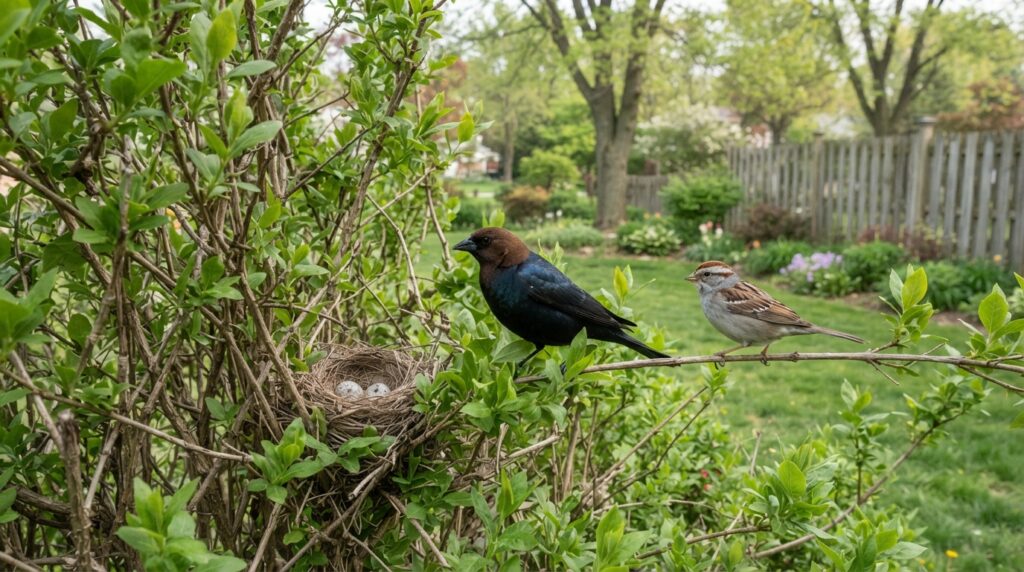
A large speckled egg in a small bird’s nest is almost certainly a Brown-headed Cowbird’s. Cowbirds build no nests of their own — the female lays her eggs in other species’ nests and lets those birds raise her young. It is a legal, native strategy protected by federal law, so the answer for a backyard is not to remove eggs but to make your yard less useful to cowbirds: clean up seed spills and stop offering the foods that concentrate them.
The Brown-headed Cowbird is one of the more genuinely peculiar birds in North America, and it turns up in yards all across the country. Understanding what it does clears up a lot of “what is this weird egg?” queries and settles the question people ask next, which is whether they should do something about it.
What a cowbird actually is
- An obligate brood parasite — the only way it breeds is by using other species’ nests
- Native to North America, and federally protected under the Migratory Bird Treaty Act
- Uses over 220 host species, from tiny warblers to birds larger than itself
- Female can lay 40 eggs in a season, spread across multiple host nests
- Range and numbers have expanded substantially with forest fragmentation
- Backyard action: reduce spilled seed, not attempt to control the birds themselves
What is going on
Cowbirds do not build nests, incubate eggs or raise young. The female quietly searches for females of other species that are actively laying, waits for one to leave, sneaks onto the nest, usually damages or removes one of the host eggs, and lays one of her own in the space. Then she leaves.
The host bird generally accepts the new egg, incubates it, and raises the cowbird chick as if it were one of her own — often at the expense of her actual offspring, because the cowbird nestling hatches early, grows fast, and outcompetes the host’s chicks for food.
Different species respond differently. Some accept without recognition. Some recognize the egg and eject it. A few — Yellow Warblers famously among them — will build a new nest floor over the top of the cowbird egg to start again. American Robins often reject cowbird eggs outright. Most smaller songbirds cannot.
Why the strategy exists
The leading hypothesis, from work by researchers including Mark Hauber, is that Brown-headed Cowbirds evolved this behavior alongside the American bison. Cowbirds followed the great herds across the plains, feeding on the insects the bison disturbed, and the herds moved constantly — too fast for cowbirds to stay put long enough to raise young themselves.
Brood parasitism was the answer. Drop your eggs in someone else’s nest and keep moving. The bison are largely gone; the strategy remains.
Why it matters more now
Cowbirds evolved with grassland-edge birds, which have coevolved defenses. The problem is that forest fragmentation has expanded cowbird range dramatically into habitats where forest-interior songbirds — warblers, vireos, tanagers, thrushes — never encountered them, and have no defenses at all.
For neotropical migrants already stressed by habitat loss and other pressures, cowbird parasitism can be a significant additional problem. Populations of several forest songbirds have declined partly because of it.
The mafia hypothesis. Research by Jeffrey Hoover and others has documented a striking pattern: when host birds eject cowbird eggs from their nests, cowbirds sometimes return and destroy the host’s remaining eggs or nestlings in retaliation. This appears to enforce cooperation — hosts that accept the cowbird egg raise fewer of their own young than they would have; hosts that reject it may lose the entire nest. It is not universally seen, and the mechanism is contested, but it is one of the more striking findings in the field.
How to identify a cowbird egg
Cowbird eggs are:
- Whitish with dense brown or gray speckling
- Noticeably larger than most host eggs, particularly in small hosts like warblers
- Often the odd one out in shape, size or pattern in a nest that otherwise looks uniform
If a robin, cardinal or wren nest suddenly contains an egg that looks wrong, cowbird is the first suspect.
What is legal to do
Brown-headed Cowbirds are native and are protected under the Migratory Bird Treaty Act. Removing cowbird eggs from another bird’s nest is not legal for private citizens without a federal permit, and permits are generally granted only where an endangered species is at direct risk — such as the recovery programs for Kirtland’s Warbler and Least Bell’s Vireo.
This is different from non-native House Sparrows and European Starlings, which have no federal protection and whose eggs can be removed from nest boxes. Cowbirds cannot be treated the same way.
What you can and should do is make your yard less useful to cowbirds. That is legal, effective, and the approach the National Audubon Society and Cornell Lab both recommend.
Reducing cowbird activity in your yard
Cowbirds are drawn by exactly the kind of open ground feeding the ground-feeding songbirds also use, and by seed spills that concentrate birds in one place. The changes below reduce their presence without harming anything else.
- Do not feed cowbirds directly. They eat cracked corn, milo, red millet, wheat — the same filler grains that are the case against cheap seed mixes anyway. More on that
- Stop platform feeding for a week or two in late spring if cowbirds are numerous
- Clean up seed spills. Ground food under feeders is where cowbirds gather. A seed catcher tray and a switch to hulled sunflower reduces this dramatically. Similar approach
- Use tube and finch feeders that cowbirds cannot easily use — goldfinches on nyjer and chickadees on tubes are largely unaffected
- Do not visit songbird nests when cowbirds are around. NestWatch guidance is explicit: your visits can advertise a nest’s location to a watching cowbird
- Maintain habitat edges as habitat rather than clearing them. Cowbird range has expanded partly through creating more edge; consolidating cover works against that
A nyjer feeder or sock is worth having as part of this — goldfinches and siskins take it and cowbirds do not. Honest drawbacks: nyjer stales fast and gets rejected within weeks if it dries out, socks tear and leak in wind, and pure nyjer sold as “thistle” is expensive per pound compared with other seeds. A small feeder refilled often beats a large one refilled seldom.
Cowbirds at feeders directly
Adult cowbirds are common feeder visitors, particularly in flocks with grackles and Red-winged Blackbirds. Males are glossy black with a dark brown head; females are a plain dusty gray-brown and much easier to overlook. They are also legally protected, so trapping or lethal control is not an option.
The strategies for large blackbirds also work here: safflower instead of sunflower on hoppers (cowbirds mostly avoid it), tube feeders with small perches, and taking down platform feeders for a week or two when the flock arrives. Full detail.
The bigger picture
A cowbird egg in a wren’s nest is upsetting. It is also normal. Brood parasitism is what this bird has done for many thousands of years, and eliminating cowbirds from a suburb is not achievable, legal or particularly useful — the problem is the habitat fragmentation that gave them access to species they never used to encounter.
The useful backyard actions are to reduce spills, avoid concentrating birds in one spot, plant native trees and shrubs that build the layered cover forest-interior songbirds need, and support broader habitat conservation. Complaining to the cowbird is not part of the plan.
Common questions
What does a Brown-headed Cowbird look like?
The male is glossy black with a brown head; the female is a plain dusty gray-brown, easy to miss. Both are stocky, seed-eating birds about the size of a Red-winged Blackbird.
Can I remove a cowbird egg from a nest?
No, not without a federal permit. Cowbirds are native and protected under the Migratory Bird Treaty Act. Permits are generally issued only in endangered-species recovery programs.
What does a cowbird egg look like?
Whitish with dense brown or gray speckling, and noticeably larger than the eggs of most host species. In a warbler or wren nest, it is the odd egg out.
Which birds do cowbirds parasitize?
Over 220 species, though not equally. Common hosts include Yellow Warblers, Song Sparrows, Chipping Sparrows, Red-eyed Vireos, phoebes, Northern Cardinals and many warblers and thrushes.
How do I keep cowbirds out of my yard?
Reduce seed spills, use tube and nyjer feeders that cowbirds cannot readily use, avoid cheap mixes with milo and red millet, and take down platform feeders for a week or two if a flock is present.
Does the host bird know it is raising a cowbird?
Some do — robins often reject the egg, and Yellow Warblers sometimes build over it. Most smaller songbirds accept without recognizing, and raise the cowbird chick as one of their own, often losing their real young in the process.
Related guides
- Bluebird nest boxes
- Keeping grackles, starlings and blackbirds off feeders
- Best bird seed
- Nestling or fledgling? Baby bird decision tree
Sources: Cornell Lab of Ornithology, All About Birds and NestWatch, on Brown-headed Cowbird biology, host species and brood parasitism; research by Mark Hauber and colleagues, and by Jeffrey Hoover on the “mafia hypothesis”; National Audubon Society; US Fish & Wildlife Service, Migratory Bird Treaty Act; The Nature Conservancy on cowbird ecology.
Putting up a nest box?
The entrance hole diameter decides which species can use it and which cannot get in. Untreated wood, ventilation, drainage and a side that opens for cleaning are the four things to check.
This link goes to Amazon. If you buy through it we may earn a small commission, at no extra cost to you.