
Affiliate disclosure: some links on this page go to Amazon. If you buy through one we may earn a small commission, at no extra cost to you. Full disclosure.
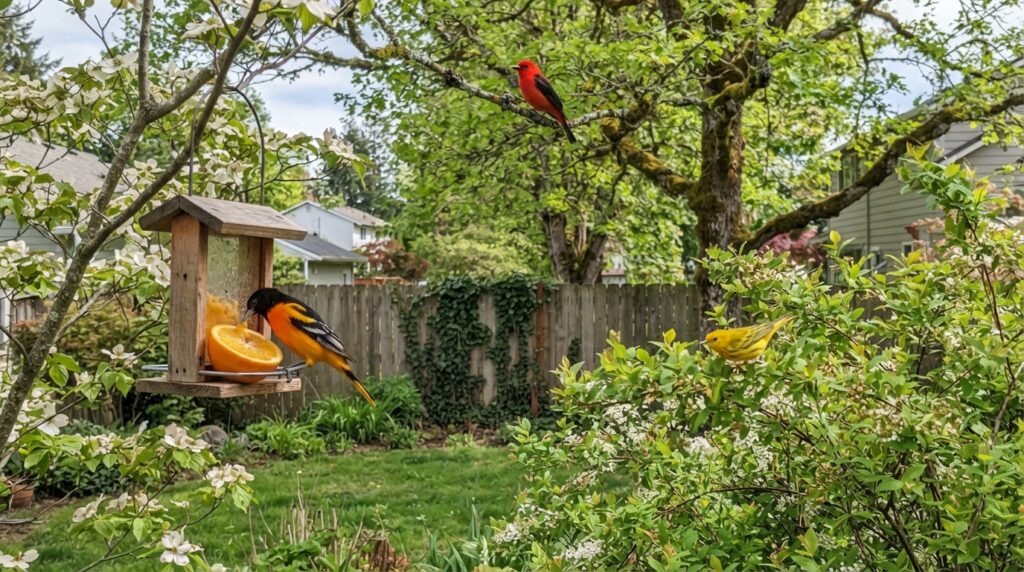
For a few weeks each spring most yards get birds they will not see again for a year — warblers, tanagers, buntings, orioles and grosbeaks passing through on migration. In much of the country the peak runs from late April through mid-May. What pulls them in is water and native trees more than feeders, though oriole feeders, jelly and orange halves catch a few. Use BirdCast to know when big movement nights happen.
Winter feeding gets attention. Spring migration is a quieter opportunity, and it produces the most spectacular birds a yard sees all year. Warblers in fresh plumage passing through a maple in first leaf is worth planning for, and a small amount of preparation makes a real difference to what you see.
What matters in spring
- Water outperforms feeders for migrants that do not visit feeders at all
- Native trees and shrubs host the insects most migrants are actually eating
- Oriole feeders and jelly catch orioles, tanagers, catbirds and warblers
- Hummingbird feeders out early for arriving migrants
- BirdCast tells you which nights big movements are happening
- The window is short — often two to three weeks in any one place
Timing, roughly
Migration is a wave that moves north with warming temperatures and lengthening days. The exact timing varies by region and species, but the general pattern is consistent.
| Region | Peak |
|---|---|
| Gulf Coast, Deep South | Late March through April — arrivals and early passage |
| Mid-Atlantic, Midwest, mid-latitudes | Late April through mid-May — the classic peak |
| Great Lakes, Northeast | Early through late May |
| Northern New England, upper Midwest | Mid-May through early June |
| Pacific Northwest | April through May, with resident hummingbirds year-round |
| Interior West and Rockies | April in the low country, May in the mountains |
Migrants move mostly at night, driven by the same day-length cues that make hummingbirds move. Weather fronts stall or accelerate movement, and a warm south wind after a cold spell can bring in extraordinary numbers overnight.
BirdCast, from the Cornell Lab, forecasts nocturnal migration nightly using weather radar. It publishes maps and county-level predictions of how many birds are moving. Checking it in April and May tells you which mornings are worth being outside for, and which nights to turn off outdoor lighting. It is free at birdcast.info.
What you might see
Warblers
The big draw and the hardest to identify. Small, hyperactive, often in the tops of newly-leafed trees. A short list of the more likely visitors in migrant traps around the East and Midwest: Yellow-rumped, Palm, Black-throated Green, Yellow, Magnolia, Black-and-white, American Redstart, Common Yellowthroat, Ovenbird. Most do not use feeders. Jelly and orange halves catch a few, particularly in cold snaps when they need the sugar.
Orioles
Baltimore in the East, Bullock’s in the West, Orchard through the middle. Grape jelly, orange halves, mealworms and oriole-specific nectar feeders bring them in reliably during the first weeks after they arrive. Interest often drops off through summer. Full oriole feeder guide.
Tanagers
Scarlet in the East, Western in the West, Summer through the South. Grape jelly and orange halves, especially in migration cold snaps. Otherwise mostly insect eaters that pass through the canopy.
Grosbeaks and buntings
Rose-breasted Grosbeaks take sunflower and safflower at hopper feeders, and Indigo Buntings will visit for millet and sunflower chips. Both often appear briefly during peak passage.
Hummingbirds
Ruby-throated in the East, Rufous and Black-chinned in much of the West, arriving on a fairly predictable schedule from March in the Deep South to May in the North. Feeders out before the first arrivals is the standard advice. Detail on timing.
Migrant sparrows and thrushes
Less celebrated but genuinely interesting. White-throated Sparrows and White-crowned Sparrows in ground feeders; Hermit and Swainson’s Thrushes in dense cover under mealworm feeders; Chipping Sparrows arriving en masse in April.
What pulls migrants in
Feeders are secondary here. Most passage warblers, tanagers and thrushes are eating insects and fruit, and the yard features that matter are the ones that produce those.
Water is the single biggest attraction. A dripper or mister running in the morning brings in warblers that never touch a feeder, and the sound of moving water carries far enough to pull them from adjacent yards. A shallow bath with a drip attachment is one of the most productive spring bird-attracting setups there is.
A dripper or mister attached to an existing bath is a cheaper and more effective addition than another feeder. Check the fitting matches your outdoor tap thread before ordering — mismatched threads are the usual annoyance. Honest drawbacks: mains-fed drippers run continuously unless you put them on a timer, which matters in drought-restricted areas; solar-only versions work in full sun and stop dripping in cloud; and fine mister nozzles clog with hard-water deposits and need periodic soaking in vinegar.
Native trees and shrubs host far more insects than ornamental non-natives. Oaks in particular support hundreds of species of caterpillar — the single most important food for migrating and nesting songbirds — and a mature native oak in the yard is worth more than any feeder. Native cherry, willow, birch, hickory and maple all do similar work.
Layered structure. Migrants use the yard vertically — canopy, midstory, understory, ground. Tanagers stay in the treetops; ovenbirds walk the ground under the shrubs; warblers work every layer. A yard with trees but no shrubs sees far fewer migrants than one with structure at every level.
Feeders that help. Oriole feeders, jelly dishes, orange halves, hummingbird feeders, and a mealworm dish for the wrens and warblers that will take them. Standard sunflower feeders catch resident birds and passing grosbeaks but few migrants.
Identifying what you see
Two apps do most of the heavy lifting.
- Merlin Bird ID from the Cornell Lab — free, filters suggestions by your location and the current date, identifies from photograph or sound recording. The sound identification in particular is genuinely useful in a canopy full of warblers you cannot see
- eBird for recording what you find and seeing what other people are seeing nearby. Free, same account as Merlin
Spring migrants are in their brightest plumage of the year, which makes identification easier than in fall — but there are still species pairs to be careful of. Yellow-rumped Warbler subspecies, thrush species, Empidonax flycatchers (identifiable by song more than sight), and female tanagers all deserve a second look.
Light pollution kills migrating birds. Migrants moving at night are drawn off course by artificial light and disoriented by lit buildings, sometimes fatally so. Turn off external lights during peak migration nights — BirdCast forecasts them — and close blinds on windows facing lit interior rooms. The window strike problem spikes during migration and is worst at lit buildings.
A migration weekend
A useful pattern for a peak-passage weekend, based on how experienced yard birders work these mornings:
- Check BirdCast for the previous night’s movement
- Be outside or at a window by first light — migrants feed heavily in the early morning after arriving overnight
- Have the dripper running
- Have jelly and orange halves out
- Have Merlin open
- Watch for a couple of hours. Activity typically drops off through mid-morning
- Submit an eBird checklist for what you saw — even common species during migration are useful data
Common questions
When do warblers migrate through backyards?
In much of the middle of the country, late April through mid-May. Earlier in the South, later in the North. The window in any one place is usually two to three weeks.
How do I know when a big migration night is happening?
BirdCast at birdcast.info publishes nightly forecasts and maps of nocturnal migration using weather radar. A big movement forecast is a strong signal to be outside at first light.
What is the best way to attract warblers?
Water, especially moving water — a dripper or mister. Native trees hosting caterpillars are what warblers are actually eating. Feeders catch few warblers directly, though jelly attracts some.
When should I put my oriole feeder out?
A week or two before the first orioles typically arrive in your area — late March in the Deep South, early to mid-April through the middle of the country, late April in the North. Better a few days too early than a few too late.
Should I keep winter feeders up during migration?
Yes. Passage birds use whatever is available, and cold snaps during migration can be genuinely dangerous. Add spring feeders alongside rather than replacing.
Do outdoor lights affect migrating birds?
Yes, badly. Migrants moving at night are drawn to and disoriented by artificial light, sometimes fatally. Turn off external lights and close blinds during peak migration nights, particularly during the movements BirdCast forecasts as heavy.
Related guides
- Grape jelly and oranges for orioles
- When to put out and take down hummingbird feeders
- Why birds fly into windows
- The Great Backyard Bird Count
Sources: Cornell Lab of Ornithology, All About Birds, BirdCast, eBird and Merlin Bird ID; National Audubon Society, including the Plants for Birds database; research by Doug Tallamy and others on native plants and caterpillar populations; American Bird Conservancy on light pollution and window collisions during migration.
Want a closer look?
A pair of 8x42 binoculars is the single thing that changes backyard birding most. Close focus matters more than magnification when the bird is fifteen feet away.
This link goes to Amazon. If you buy through it we may earn a small commission, at no extra cost to you.