
Affiliate disclosure: some links on this page go to Amazon. If you buy through one we may earn a small commission, at no extra cost to you. Full disclosure.
Yes, when installed correctly they generally work — but “correctly” excludes almost all the ways people actually hang them. A weight-activated feeder must be at least 10 feet from any horizontal surface a squirrel can jump from, out of range of an overhead branch, and calibrated for the birds you want. Miscalibration cuts out cardinals and grosbeaks along with squirrels, which is the complaint nobody warns you about.
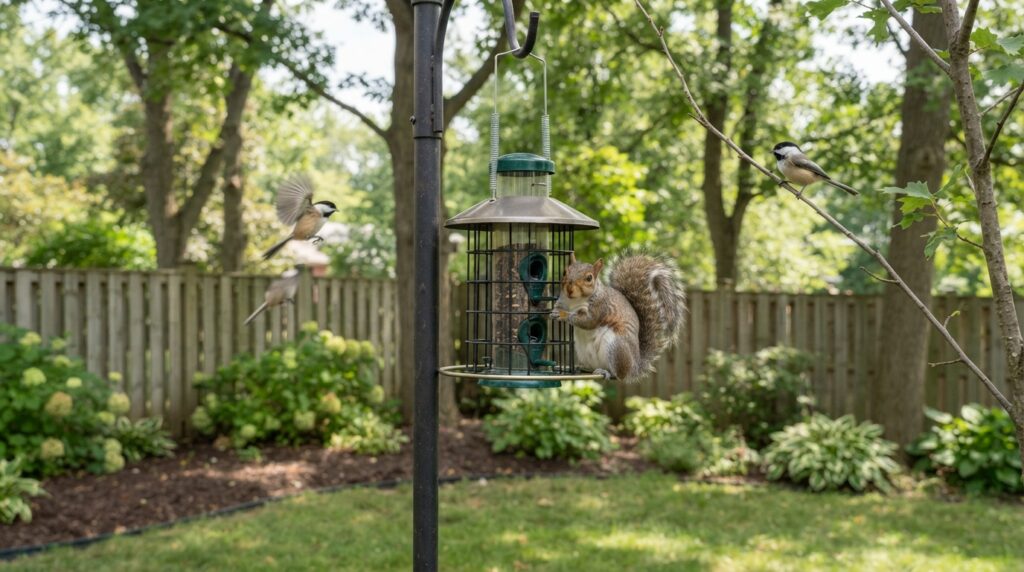
Squirrel-proof feeders are the biggest single upgrade a squirrel-plagued yard can make, and they are also the source of the most persistent buyer disappointment on the market. The gap is not because the products fail. It is because they only work under conditions that are much more specific than the packaging suggests, and because “squirrel-proof” turns out not to be exactly what people wanted.
The essentials
- Mechanism: a squirrel’s weight closes the ports, cutting off access
- Placement: 10 feet from any launch point, 5 feet off the ground, 3 feet below overhead branches
- Calibration: the setting matters — heavier birds close ports too
- Cardinals and grosbeaks are often the losers, not the squirrels
- Cage feeders are a different, sometimes better answer
- No feeder is chew-proof forever
How the mechanism works
The dominant designs work on the same principle: a spring-loaded shroud, tube or perch that stays open under a light bird’s weight but drops or closes when a heavier animal — a squirrel — puts its weight on it.
Two variants are common:
- Weighted shroud (Brome Squirrel Buster and similar) — an outer sleeve drops when a squirrel climbs on and closes the ports
- Motorized spinning perch (Droll Yankees Flipper and similar) — a battery-driven perch spins the squirrel off when a threshold weight is detected
Both work well within their intended range. The problems arise when the assumptions built into “intended range” don’t match your yard.
Placement is 80% of the story
A squirrel-proof feeder that a squirrel can jump onto directly is a normal feeder. The mechanism does not care whether the squirrel walked onto it from a fence or climbed a pole from the ground — if it can get to it without triggering the mechanism, or from an angle the mechanism does not defend against, none of the cleverness helps.
The manufacturer specifications people ignore:
- At least 10 feet horizontally from any launch point — fence, tree trunk, deck railing, wall, gutter, roof edge
- At least 5 feet off the ground
- At least 3 feet below any overhead branch. Squirrels drop straight down and land on the top of the feeder, defeating almost all mechanisms
A typical suburban yard often does not have a location that satisfies all three. If yours does not, a pole and baffle system is a more realistic answer than any weight-activated feeder.
The calibration problem
The complaint that comes up most in reviews is not that squirrels defeat the feeder. It is that cardinals or grosbeaks defeat it — that is, they close the ports themselves.
A Northern Cardinal weighs about 1.5 ounces, which is at the top of the weight range for small birds. A Rose-breasted Grosbeak is heavier. Blue Jays heavier still. If the calibration is set to keep squirrels out, and squirrels weigh 12 to 20 ounces, then a two-ounce cardinal is more than a tenth of the threshold — and two cardinals on the perches at once may trip the mechanism.
Some models have adjustable calibration, and this is worth checking before buying. A feeder set to exclude squirrels reliably will often exclude larger songbirds too. A feeder set to admit larger songbirds reliably will sometimes admit smaller squirrels.
The honest position is that “squirrel-proof” is a range rather than an absolute. Every model has a weight boundary, and larger animals inside the boundary get the food while heavier ones do not. If you want cardinals, you probably want to buy from the top of the boundary and accept that a small squirrel might occasionally get lucky.
Cage feeders: the other approach
A cage feeder is a plain tube feeder surrounded by an outer wire cage with openings sized for small birds. It admits chickadees, titmice, finches and nuthatches through the mesh, and excludes squirrels, grackles, jays and starlings entirely by size rather than weight.
It does not calibrate. It does not need a specific hanging position. It has no moving parts to seize, no batteries to replace, and no weight setting to tune. It just works.
The trade-off is the same fact stated backwards: it excludes everything larger than the mesh, which means no cardinals, no grosbeaks, no jays. If those are the birds you want, cage feeders are the wrong answer.
| Weight-activated | Cage feeder | |
|---|---|---|
| Squirrel exclusion | Good, if placed correctly | Complete, by geometry |
| Cardinal access | Sometimes — depends on calibration | No |
| Starling and grackle exclusion | Partial — some are light enough | Complete |
| Placement demands | Very specific | Almost none |
| Mechanism to fail | Yes — springs, batteries | No |
| Cost | Higher | Lower to mid |
| Cleaning | Fiddly — more parts | Straightforward |
A cage feeder is the sensible first purchase if starlings, grackles and squirrels all bother you and you can live without cardinals at that particular feeder — put a separate hopper or platform for cardinals somewhere else. Honest drawbacks: cages catch feathers and droppings and are more awkward to scrub than a plain tube; cheap cages rust through in two or three seasons; and larger woodpeckers and doves are also excluded, which is exactly the point but not what everyone wants.
The pole and baffle option
For a yard where an ordinary hopper or platform feeder is what you want to run, and squirrels are the problem, a mounted pole with a wide baffle is often the most cost-effective answer of all.
What matters:
- Smooth metal or PVC pole, not wood and not a shepherd’s hook (thin, easy to chew, easy to climb)
- A wobbling-cone or stovepipe baffle, mounted at least 4 feet up the pole. Small conical baffles are decorative rather than functional
- Pole placement that meets the same 10 / 5 / 3 rule as above
- Ground clear of things a squirrel can climb to reach the pole above the baffle
Full detail in how to stop squirrels raiding your feeders.
What does not work
- Slinkies on shepherd’s hooks. Sometimes cited as a hack. Squirrels rapidly learn to ride them down and eventually to bypass them
- Cayenne pepper in the seed. Birds cannot taste capsaicin; squirrels can. It does work as a deterrent — but if you get it in your eyes or on your hands during refilling, and everyone eventually does, it is genuinely painful. Handle with real caution
- Ultrasonic deterrents. No credible evidence they work on squirrels or birds
- Live trapping and relocation. Illegal in many states without a permit, ineffective (a vacated territory fills within days), and generally lethal for the relocated animal, which is dropped into unfamiliar territory it may not survive
What actually works long-term
The most successful yards use a combination: a cage or weight-activated feeder for small birds, a properly baffled pole system for a hopper or platform, and often a scatter of cheap corn or peanuts on the ground away from the main feeders as a decoy for the squirrels. Feeding the squirrels somewhere else, on food you do not mind losing, reduces the pressure on the feeders you care about. Not romantic, but effective.
Common questions
Do squirrel-proof feeders really work?
Yes, when placed correctly — at least 10 feet from any launch point, 5 feet off the ground and 3 feet below any overhead branch. The mechanism generally does what it claims. The issue is that most people cannot achieve all three placement rules.
Why can’t my cardinals use my squirrel-proof feeder?
The calibration is set to exclude squirrels, and a cardinal weighs enough to close the ports too, especially with two on the perches at once. Some models have adjustable calibration — try setting it higher, or use a separate hopper feeder for cardinals.
Is a cage feeder better than a weight-activated one?
Different answer, not a better one. A cage excludes squirrels completely and needs almost no placement care, but it also excludes cardinals, jays and larger woodpeckers. Weight-activated feeders can admit cardinals but need specific placement and calibration.
How far from a fence does a squirrel-proof feeder need to be?
At least 10 feet from any fence, tree trunk, deck rail or roof edge a squirrel could jump from. Squirrels can jump remarkable distances — four to five feet horizontally is routine, and further with a downward slope.
Can a squirrel jump onto a feeder from above?
Yes, and this defeats almost every mechanism, because they land on the top rather than pulling weight against a shroud or perch. Keep feeders at least 3 feet below any overhead branch or eave.
Is cayenne pepper safe to add to bird seed?
Birds cannot taste it and squirrels avoid it, so it does work as a deterrent. But it is genuinely painful if you get it in your eyes or on your hands during refilling. Handle with real caution or avoid it.
Related guides
- How to stop squirrels raiding your bird feeders
- Types of bird feeders
- Keeping grackles, starlings and blackbirds off feeders
- Mice and rats under the bird feeder
Sources: Cornell Lab of Ornithology, All About Birds and Project FeederWatch, on feeder types, placement and squirrel deterrence; manufacturer specifications and placement guidance for Brome Squirrel Buster and Droll Yankees Flipper; American weight data on Northern Cardinal, Rose-breasted Grosbeak and Blue Jay; state wildlife agency guidance on legality of squirrel trapping and relocation.
Dealing with squirrels?
A pole-mounted baffle placed correctly beats any squirrel-proof feeder on its own. Check the baffle diameter against your pole before ordering — the common failure is a baffle a squirrel can reach around.
This link goes to Amazon. If you buy through it we may earn a small commission, at no extra cost to you.