
Affiliate disclosure: some links on this page go to Amazon. If you buy through one we may earn a small commission, at no extra cost to you. Full disclosure.
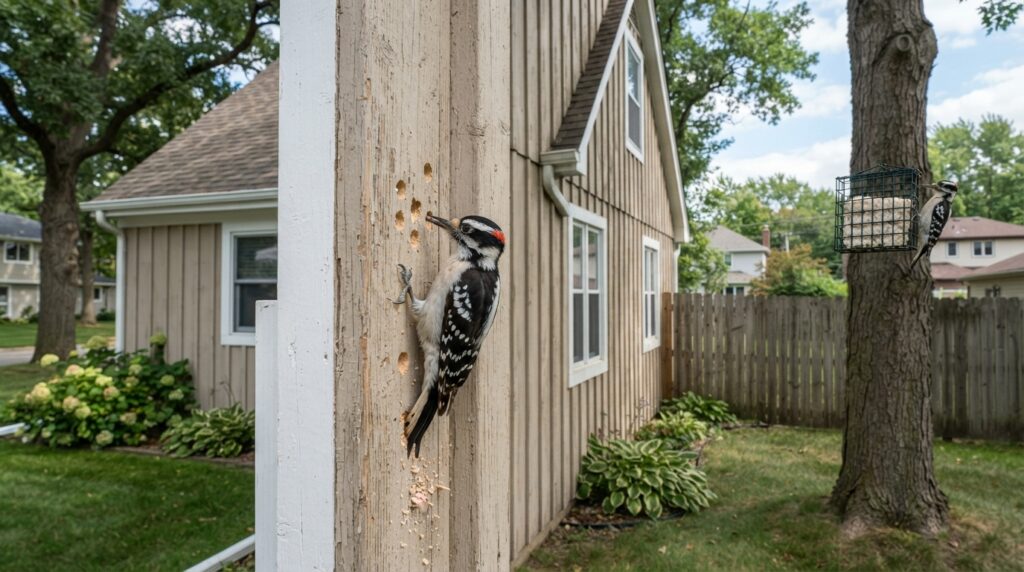
Woodpeckers hit houses for three reasons: drumming to claim territory, feeding on insects in the wood, or digging a nest or winter roost hole. The hole pattern tells you which. In a Cornell Lab study, reflective streamers hung over the damaged area were the only deterrent that worked with any consistency, stopping damage at half the test homes. Plastic owls, fake eyes, sound devices and suet feeders didn’t. For a stubborn bird, cover the spot with metal flashing or hardware cloth, or hang taut netting at least 3 inches off the siding.
It usually starts on a spring morning: a machine-gun rattle on the gutter, or a steady tapping somewhere on the wall. Then one day there’s a neat round hole in the cedar siding, big enough to put a thumb in.
This is a common problem. When Cornell Lab researchers surveyed 1,185 homes around Ithaca, New York, a third had some woodpecker damage. The good news is that the same research tells us a fair amount about which houses get hit, why, and what makes a difference.
The essentials
- Three causes: drumming, feeding, excavating a nest or roost
- Worst seasons: spring, and again in fall
- Most targeted: stained wood, grooved plywood, cedar and redwood
- Best tested deterrent: reflective streamers
- Most reliable fix: physically cover or net the area
- All native woodpeckers are federally protected
Read the holes first
The fix depends on the reason, and the damage tells you the reason.
| What you see | What it means | When |
|---|---|---|
| Loud rapid rattles, often on gutters, downspouts, chimney caps or trim; small, shallow dents | Drumming: territorial signaling and attracting a mate. Researchers describe drumming holes as shallow and under about ⅜ inch across | Mostly spring |
| Scattered small, irregular holes, or neat rows of small holes | Feeding on insects in the wood, such as carpenter bee or leafcutter bee larvae | Any time, often spring and summer |
| One large, round, deep hole | Excavating a nest cavity (spring) or a winter roost (fall) | Late April–May for nests; September–October for roosts |
| Many snug holes, each stuffed with an acorn | An Acorn Woodpecker storing food. West Coast and Southwest only | Fall into winter |
In the Ithaca study, nest and roost holes made up 55% of damage, foraging 28%, and drumming 18%. Homeowners reported damage most often in April and May, and again in September and October.
If you see rows of holes, look for insects. Iowa State University Extension describes leafcutter bees nesting in rough-sawn plywood, with woodpecker holes about ½ inch across and ½ inch apart in long straight lines. Utah State University Extension describes flicker feeding holes as about the size of a dime in horizontal lines. If insects are the draw, deterring the bird without dealing with the insects only buys time.
Which woodpeckers do it
- Downy and Hairy Woodpeckers: in the Ithaca study, every woodpecker seen working on siding was one of these two
- Northern Flicker: a major culprit nationally, and a loud drummer on metal. More on flickers
- Red-bellied Woodpecker: common across the East and Southeast
- Pileated Woodpecker: less often on houses, but its holes are big
- Acorn Woodpecker: California and the Southwest, where it can drill hundreds or thousands of storage holes in a single season, according to UC Integrated Pest Management
The Internet Center for Wildlife Damage Management also lists Red-headed, Golden-fronted and Ladder-backed Woodpeckers. Yellow-bellied Sapsuckers were seen drumming on metal fixtures in the Ithaca study.
Which houses get hit
The Cornell survey found siding type and finish mattered more than almost anything else:
| Siding | Share damaged |
|---|---|
| Grooved plywood (such as T1-11) | 73% |
| Shakes | 60% |
| Tongue-and-groove or board-and-batten | 45% |
| Clapboard | 29% |
| Non-wood | 21% |
Finish mattered too. The modeled probability of damage was 72% for stained wood, 29% for painted wood and 10% for non-wood siding. Stained wood houses in heavily wooded yards had a 97% probability of damage. UC IPM also singles out cedar and redwood, especially rough-hewn plywood, and the Connecticut Department of Energy and Environmental Protection adds pine, fir and stucco.
If you’re re-siding, that’s worth knowing. If you’re not, it explains why your neighbor with vinyl siding doesn’t have the problem.
What Cornell found actually works
In a Cornell Lab study published in 2007, researchers tested six deterrents on homes with active damage: plastic owls, reflective streamers, plastic “scare eyes,” roost boxes, suet feeders, and sound systems playing distress calls and hawk cries.
According to Cornell’s summary, reflective streamers completely eliminated damage at half of the 16 test sites, and were the only method that worked with any consistency. Owls and sound systems worked briefly, then the birds got used to them. Roost boxes and suet feeders did not reduce damage.
How to hang streamers. Use long strips of shiny, holographic scare tape or Mylar, fixed above the damaged area so they hang down over it and move freely in the breeze. The movement and flashes of light are what work, so they need to be loose. Put them up as soon as damage starts. A bird that has already put days into a hole is harder to dislodge.
Reflective scare tape is cheap and matches what worked in the Cornell trial. Honest drawbacks: it worked at half the test homes, not all of them; it looks untidy on the front of a house; it needs replacing as it tears or fades in sun and wind; and it does nothing about insects in the wood. Treat it as the first step, not a guarantee.
When streamers aren’t enough: physical barriers
Cover the spot
The most reliable fix is to make the target unreachable. UC IPM and the Internet Center for Wildlife Damage Management recommend covering the damaged area with aluminum flashing or ¼-inch hardware cloth, which can be painted to match. Virginia Cooperative Extension advises extending the covering at least 6 to 12 inches beyond the damage. Woodpeckers tend to come back to the same spot, so covering it early often ends the problem.
Net the wall
For larger areas, Cornell recommends lightweight bird netting hung from the eaves, taut, and at least 3 inches from the siding, so the bird can’t reach the wood through it. UC IPM specifies ¾-inch mesh. The US Fish & Wildlife Service calls netting typically effective, but it must be kept taut and maintained. Loose, sagging netting defeats the point and can trap birds, so check it regularly.
Fix the holes, carefully
Fill holes with wood putty and repaint or restain. Before sealing any large hole, Cornell advises making sure there are no birds inside. This matters most in fall, when woodpeckers dig roost holes and sleep in them at night, and in spring, when a hole may hold a nest. Check at dusk, and watch the hole for a day before closing it.
Where leafcutter bees are nesting in plywood grooves, Iowa State recommends caulking the grooves. That removes the food and the reason for the holes.
What doesn’t work, or makes things worse
- Plastic owls and hawk decoys. UC IPM calls predator models ineffective, and Cornell found woodpeckers quickly got used to them.
- Sticky repellents. Cornell warns that sticky products can fatally trap or injure birds, and the US Fish & Wildlife Service notes they can impair flight and a bird’s ability to stay warm. Don’t use them
- Suet as a distraction. The evidence is mixed. Cornell’s trial found suet feeders didn’t reduce damage, and University of Missouri Extension notes suet may attract more woodpeckers. If you feed suet, keep the feeder well away from the house
- Roost boxes. They didn’t reduce damage in the Cornell trial, though they’re harmless to put up
The legal side
All native woodpeckers are protected under the Migratory Bird Treaty Act. Scaring birds away with the methods above needs no permit. Killing or trapping one requires a federal depredation permit from the US Fish & Wildlife Service, which is only issued alongside ongoing non-lethal measures, and destroying an active nest with eggs or young also requires a permit. For almost every homeowner, the answer is deterrence and repair.
A season-by-season plan
| Season | What to do |
|---|---|
| Late winter | Walk around the house and look for new holes. Put streamers up over any fresh damage right away |
| Spring | Drumming peaks. Hang streamers by the drumming spot. Don’t seal holes that may hold nests |
| Summer | After young have fledged, fill holes, cover damaged areas, deal with insect problems |
| Early fall | Roost digging starts. Streamers back up, check for birds at dusk before sealing any new holes |
Common questions
Why is a woodpecker pecking my house?
To drum for territory, to feed on insects in the wood, or to dig a nest or roost hole. Shallow dents on metal mean drumming; rows of small holes mean feeding; one big round hole means nesting or roosting.
Does reflective tape stop woodpeckers?
It’s the best-tested option. In a Cornell study, reflective streamers stopped damage completely at half of 16 test homes. It needs to hang loose so it moves.
Do fake owls keep woodpeckers away?
Not for long. Woodpeckers get used to them within days, and UC Integrated Pest Management rates predator models as ineffective.
Is it illegal to kill a woodpecker?
Yes, without a federal depredation permit. All native woodpeckers are protected under the Migratory Bird Treaty Act. Scaring them away is legal.
Why does a woodpecker drum on my metal gutter?
Metal is loud. Drumming is a signal to rivals and mates, and the louder the surface, the better. It mostly happens in spring and stops when nesting starts.
Should I fill the woodpecker holes?
Yes, with wood putty, but check first that no bird is roosting or nesting inside. Cover the patched area with flashing or hardware cloth if the bird keeps returning.
Related guides
- How to attract woodpeckers (to feeders, not the house)
- Northern Flicker digging in your lawn
- Why is a bird attacking my window?
- Birds nesting in your house, vents and chimney
Sources: Cornell Lab of Ornithology, All About Birds, “Why do woodpeckers like to hammer on houses, and what can I do about it?”; Harding, E.G., Vehrencamp, S.L. and Curtis, P.D., “Factors influencing woodpecker damage to houses,” Human–Wildlife Conflicts 3(1), 2009; University of California Integrated Pest Management, Woodpeckers; Internet Center for Wildlife Damage Management, Woodpeckers; Virginia Cooperative Extension; Iowa State University Extension and Outreach; Utah State University Extension; University of Missouri Extension; Connecticut Department of Energy and Environmental Protection; US Fish & Wildlife Service, “Woodpeckers and your home” and migratory bird depredation permits.
Protecting your siding?
In a Cornell Lab study, reflective streamers hung loose over the damaged area were the only deterrent that worked with any consistency. Put them up as soon as new holes appear.
This link goes to Amazon. If you buy through it we may earn a small commission, at no extra cost to you.