
Affiliate disclosure: some links on this page go to Amazon. If you buy through one we may earn a small commission, at no extra cost to you. Full disclosure.
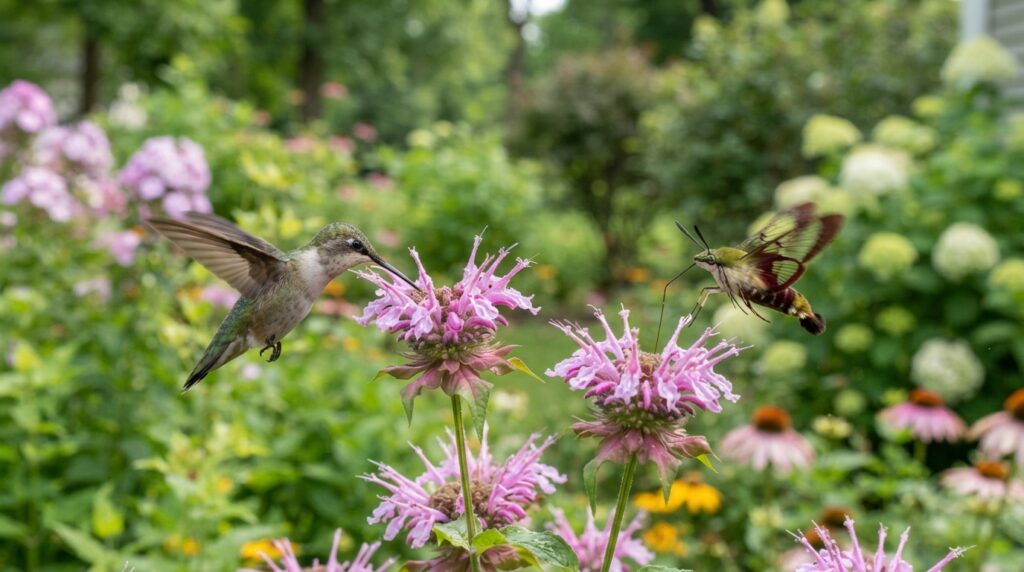
If it has antennae, it’s a moth. Hummingbird moths are daytime sphinx moths that hover at flowers exactly like hummingbirds, but they’re smaller, fuzzy rather than feathered, and have visible antennae and often clear, window-like wings. The most common in backyards are the Hummingbird Clearwing, the Snowberry Clearwing and the White-lined Sphinx. They’re harmless pollinators, and a sighting is worth celebrating.
It’s one of the most-searched “what did I just see?” questions in summer. Something tiny hovers at the bee balm, wings a blur, darting from flower to flower with a long tongue. It looks exactly like a baby hummingbird, except something is off.
There’s no such thing as a baby hummingbird at a flower, as it happens. Hummingbirds stay in the nest until they’re nearly adult-sized. What you saw was almost certainly a moth.
How to tell in five seconds
- Antennae — moths have them, hummingbirds never do
- Size — moths are usually 1½ to 2 inches long, noticeably smaller
- Clear wings — clearwing species have see-through wing panels
- Fuzzy body with bands, not feathers
- A coiled tongue instead of a rigid beak
- Six legs dangling, if you get a close look
Side by side
| Hummingbird moth | Hummingbird | |
|---|---|---|
| Antennae | Yes, clubbed | None |
| Body | Fuzzy, banded, olive, tan or reddish | Feathered, often iridescent green |
| Wings | Often clear panels bordered with brown | Opaque, feathered |
| Feeding tool | Long tongue (proboscis) that coils up | Rigid bill with a tongue inside |
| Size | About 1½–2 inches long | About 3–3½ inches long |
| Tail | Fan-like tuft of hair-like scales | Feathered tail |
| Feeders | Almost never visits a nectar feeder | Visits feeders readily |
The antennae settle it. If you only get a glimpse, the other giveaway is behavior at a sugar-water feeder: hummingbird moths almost never use one, even when they’re working the flowers right beside it.
The species you’re likely to see
All belong to the sphinx moth family, Sphingidae, known for strong, fast flight and hovering.
Hummingbird Clearwing (Hemaris thysbe)
The classic “hummingbird moth”. Olive-green and reddish-brown, with a dark reddish band across the abdomen and clear wings edged in brown. Wingspan about 1½ to 2¼ inches. Common across the eastern half of the United States and into Canada, and active by day. According to University of Wisconsin Extension, its caterpillars feed on viburnum and related plants.
Snowberry Clearwing (Hemaris diffinis)
Smaller and more bumblebee-like, with a yellow-and-black body and clear wings. Found across much of the country. Its caterpillars feed on snowberry, honeysuckle and dogbane. Often mistaken for a large bee as much as a hummingbird.
White-lined Sphinx (Hyles lineata)
The one most often seen in the West and Southwest, though it ranges across almost the whole country. Larger, with fully scaled brown wings crossed by a pale stripe, pink hindwings, and white lines along the body. It’s most active at dusk and dawn, sometimes into the night, which is why it’s often seen at evening flowers like evening primrose and four o’clocks. In some years its caterpillars appear in enormous numbers.
Others
The Graceful Clearwing (Hemaris gracilis) is smaller and scarcer. Several larger night-flying sphinx moths, including the adult form of the tomato hornworm, hover at flowers after dark and are sometimes glimpsed at dusk.
Where and when
- Season: mostly late spring through early fall, with one or two generations a year depending on region
- Time of day: clearwings fly in full daylight; the White-lined Sphinx mostly at dusk and dawn
- Flowers: bee balm, phlox, verbena, butterfly bush, purple coneflower, Joe-pye weed, honeysuckle, lilac, petunia and evening primrose
These are the same tubular, nectar-rich flowers that bring in hummingbirds, which is exactly why the two turn up side by side.
How to attract them
Plant for them, and plant for their caterpillars, which is what most gardens miss.
- Nectar plants: native bee balm, phlox, Joe-pye weed and blazing star work for moths, hummingbirds and butterflies alike
- Caterpillar host plants: native viburnums and honeysuckles (not the invasive Japanese honeysuckle), snowberry and dogbane
- Leave the leaf litter. Clearwing caterpillars pupate in loose cocoons in fallen leaves. Raking every leaf in fall removes next year’s moths
- Skip the insecticides. They kill the caterpillars, and the moths are pollinators, not pests
Bee balm is one of the best single plants for this: hummingbirds, hummingbird moths, butterflies and bees all work it. Look for native Monarda species suited to your region. Honest drawbacks: bee balm spreads vigorously and needs dividing every few years, it’s prone to powdery mildew in humid summers without good air circulation, and seed packets take a season to reach flowering size. Plants from a local native nursery flower sooner.
Is a hummingbird moth a pest?
The adults, no. They’re pollinators. The caterpillars of some sphinx moths, including the tomato hornworm, do eat garden plants, but the clearwing caterpillars feed on shrubs like viburnum and snowberry and rarely do noticeable damage.
The White-lined Sphinx is the one that can occasionally produce large caterpillar outbreaks, usually in desert areas after wet springs. Even then, they’re a food source for many birds.
Common questions
Is a hummingbird moth a bird?
No. It’s an insect, a sphinx moth, that hovers and feeds like a hummingbird. Look for antennae and six legs.
Was it a baby hummingbird?
Almost certainly not. Hummingbirds leave the nest at nearly adult size, so a tiny “hummingbird” at a flower is usually a hummingbird moth.
Do hummingbird moths use hummingbird feeders?
Very rarely. They feed at flowers, even when a feeder hangs right beside them.
Do hummingbird moths sting?
No. They’re completely harmless. The Snowberry Clearwing looks like a bumblebee, but it can’t sting.
Where do hummingbird moths live?
Across most of the United States. The Hummingbird Clearwing is common in the East, the Snowberry Clearwing is widespread, and the White-lined Sphinx ranges almost nationwide.
Why did I see one at dusk?
That was probably a White-lined Sphinx, which feeds mainly at dusk and dawn. The clearwing species fly in full daylight.
Related guides
- How to attract hummingbirds
- Hummingbird nests
- One hummingbird is chasing all the others away
- Why hummingbirds aren’t coming to your feeder
Sources: University of Wisconsin–Madison Extension, Hummingbird Moth (Hemaris thysbe); Ohio State University Extension, The Sphinx Moths of Ohio; Mass Audubon, Hummingbird Moth (Clearwing Moth); Cornell Lab of Ornithology, All About Birds, on hummingbird size and nestling development; National Audubon Society Plants for Birds.
Setting up for hummingbirds?
A saucer feeder that dismantles fully is easier to keep clean than a larger bottle feeder, and cleaning matters far more than capacity. Look for no yellow parts, which draw wasps.
This link goes to Amazon. If you buy through it we may earn a small commission, at no extra cost to you.