
Affiliate disclosure: some links on this page go to Amazon. If you buy through one we may earn a small commission, at no extra cost to you. Full disclosure.
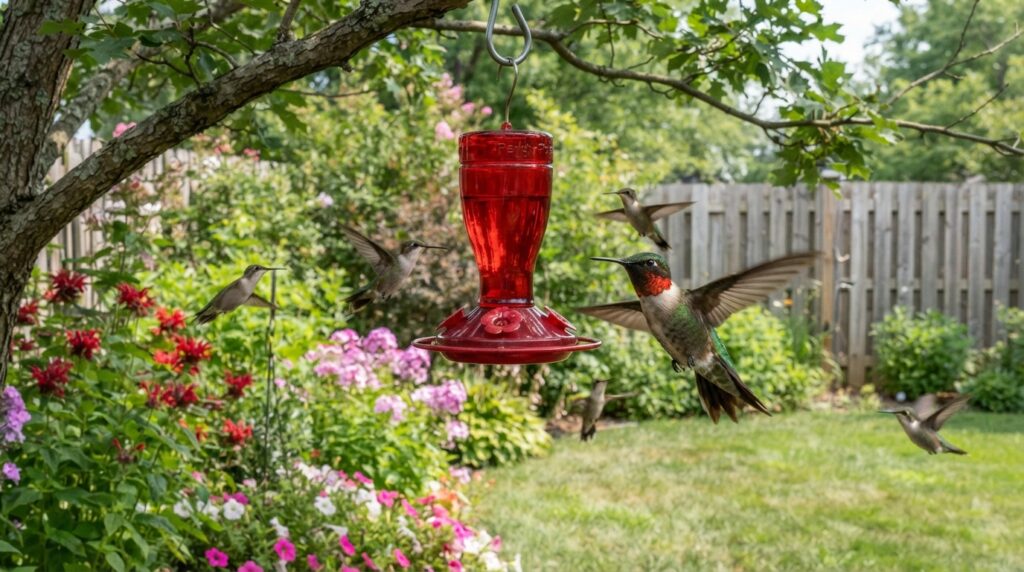
This is normal territorial behavior, not a problem bird. One dominant hummingbird has claimed your feeder as a food source worth defending and is driving off everything else. The fix is more feeders — but specifically feeders placed out of sight of one another, around corners of the house or screened by shrubs. Two feeders side by side change nothing, because one bird can guard both from a single perch.
You put up a feeder, several hummingbirds find it, and then within a week there is only one, sitting on a nearby twig and launching at anything that approaches. Everyone else gets chased off before they can drink.
This is the most common hummingbird question there is after the nectar recipe, and the standard advice — “put out more feeders” — is right in outline and usually fails in practice, because of a detail that gets left out.
The essentials
- Normal behavior, not aggression you need to correct
- Males usually, though females defend feeders too
- The fix is line of sight, not just feeder count
- Around corners, behind shrubs, different sides of the house
- It eases during migration, when numbers overwhelm any one bird
- Native flowers help by spreading the food source out
Why they do it
Hummingbirds have among the highest metabolic rates of any vertebrate. A Ruby-throated Hummingbird weighs about as much as a penny and has to feed constantly through the day to survive the night.
In that situation, a concentrated, reliable, unlimited food source is worth a great deal — and worth defending. A hummingbird that controls a feeder has solved its energy problem for the season. Spending a portion of the day chasing rivals is a sound investment, and the birds doing it are behaving exactly as they evolved to.
The same thing happens at flowering patches in the wild. Your feeder is simply an unusually rich patch.
The defending bird typically picks a lookout perch — a bare twig, a wire, a trellis top — a few feet away with a clear view, and sits there between feeds. Recognizing that perch is useful, because it tells you exactly what the bird can and cannot see.
Why a second feeder next to the first does nothing
This is the part most advice leaves out.
A dominant hummingbird guards what it can see. Two feeders on the same porch rail, or on either side of the same window, are both visible from one perch — so one bird defends both, and you have doubled your nectar-changing workload for nothing.
The trick is to break line of sight. Feeders around the corner of the house, on opposite sides of a garage, separated by a hedge or a dense shrub, or at very different heights with something solid between them. The defender commits to one and physically cannot police the other.
Practical placements that work:
- Front of the house and back of the house
- Either side of a garage or shed
- Opposite ends of a deck with a solid screen, trellis or planting between
- One at eye level near a window, one at the far end of the yard behind a shrub
- Three or four spread widely, if you have the space and the patience for the cleaning
The number matters less than the separation. Two well-separated feeders beat four clustered ones.
If you are buying a second and third feeder, small saucer designs suit this better than one big bottle feeder. They hold less — which matters when you are changing nectar every two days in summer heat and would otherwise pour most of it away — they cannot leak, and wasps generally cannot reach nectar sitting below the port. Honest drawbacks: small capacity means more frequent refilling in a busy yard, you cannot see the level at a glance so it is easy to let one run dry, and some shallow designs let rain in and dilute the nectar. Full comparison.
Other things that spread the pressure
Plant for them. A feeder is a single point that one bird can hold. A border of tubular flowers is dozens of points that no bird can. Native options by region include bee balm, cardinal flower, trumpet honeysuckle and columbine in the East; penstemon, salvia, desert willow and red yucca in the West and Southwest. Audubon’s free Plants for Birds database is searchable by zip code.
Remove the lookout perch, if there is an obvious one right beside the feeder and you can do it without stripping the yard of cover. Sometimes this alone breaks the habit; often the bird simply picks another twig.
Move the feeder a short distance. It can disrupt an established defense for a few days, though the bird usually reasserts itself.
Accept some of it. A territorial hummingbird is a healthy hummingbird doing well. Other birds still feed — they wait, they sneak in while the defender is chasing someone else, and they feed at dawn and dusk when defense relaxes. Watching a busy feeder carefully usually reveals more visitors than it first appears.
What the chasing actually looks like
Worth knowing, partly because it is one of the better things to watch in a backyard.
- Dive displays — a steep power dive past a rival or a perched female, often with a sound made by the tail feathers at the bottom of the arc. In Anna’s Hummingbirds this dive-sound is produced by the tail, not the voice
- Chatter and chip notes — rapid scolding
- Gorget flaring — the male turns his throat to catch the light, flashing the iridescent patch as a threat display
- Direct chases — two or three birds spiraling away at speed
- Physical contact, occasionally. Bills and feet, briefly. Injuries are rare
Collisions with windows during chases do happen. If your feeder sits in the risky three-to-thirty-foot band from glass, that is worth addressing. How to do it.
When it eases
Migration. Through late summer and early fall, numbers passing through can simply overwhelm a single defender — there are too many birds to chase and the territory collapses. Yards that had one bully in July can have a dozen birds feeding together in late August.
Nesting. Females on nests feed more quickly and fight less.
Weather. In cold snaps and before storms, birds feed urgently and tolerate more company.
Dawn and dusk. Defense relaxes at the edges of the day, which is when subordinate birds get their turn.
A note on more feeders meaning more work
Every extra feeder is another one that needs emptying, scrubbing and refilling on schedule — every two days above 90°F, every three or four in cooler weather. Fermented or moldy nectar is genuinely harmful, and four neglected feeders are worse than one well-kept one.
Be honest about how many you will actually maintain. Two clean, well-separated feeders is a better answer than five that get topped up when you remember. The recipe and the changing schedule.
Common questions
Why is one hummingbird chasing all the others away?
It has claimed the feeder as a territory worth defending. Given their metabolism, controlling a reliable food source is a sound investment, and the behavior is completely normal.
How many hummingbird feeders should I have?
At least two, but placement matters more than number. Feeders must be out of sight of each other — around a corner, behind a shrub, on opposite sides of the house. Two well-separated feeders beat four clustered together.
Will putting a second feeder next to the first help?
No. A dominant bird guards what it can see, so one perch covers both feeders. You get the same problem and twice the cleaning.
Should I remove the bully?
No, and you could not legally. Hummingbirds are protected under the Migratory Bird Treaty Act. The bird is behaving normally — change the layout of your feeders instead.
Will the other hummingbirds go hungry?
No. They feed while the defender is busy chasing someone else, at dawn and dusk when defense relaxes, and at flowers elsewhere. A carefully watched feeder usually has more visitors than it first appears.
When will it stop?
Usually during late summer and fall migration, when the number of birds passing through overwhelms any single defender. Yards with one bully in July often have many birds feeding peaceably by late August.
Related guides
- Why hummingbirds aren’t coming to your feeder
- Best hummingbird feeders
- Hummingbird nectar recipe
- How to attract hummingbirds
Sources: Cornell Lab of Ornithology, All About Birds and Birds of the World, on hummingbird territoriality, dive displays and feeder placement; research on tail-generated sound in Anna’s Hummingbird dive displays; National Audubon Society hummingbird guidance and the Plants for Birds database; Project FeederWatch; US Fish & Wildlife Service, Migratory Bird Treaty Act.
Setting up for hummingbirds?
A saucer feeder that dismantles fully is easier to keep clean than a larger bottle feeder, and cleaning matters far more than capacity. Look for no yellow parts, which draw wasps.
This link goes to Amazon. If you buy through it we may earn a small commission, at no extra cost to you.