
Affiliate disclosure: some links on this page go to Amazon. If you buy through one we may earn a small commission, at no extra cost to you. Full disclosure.
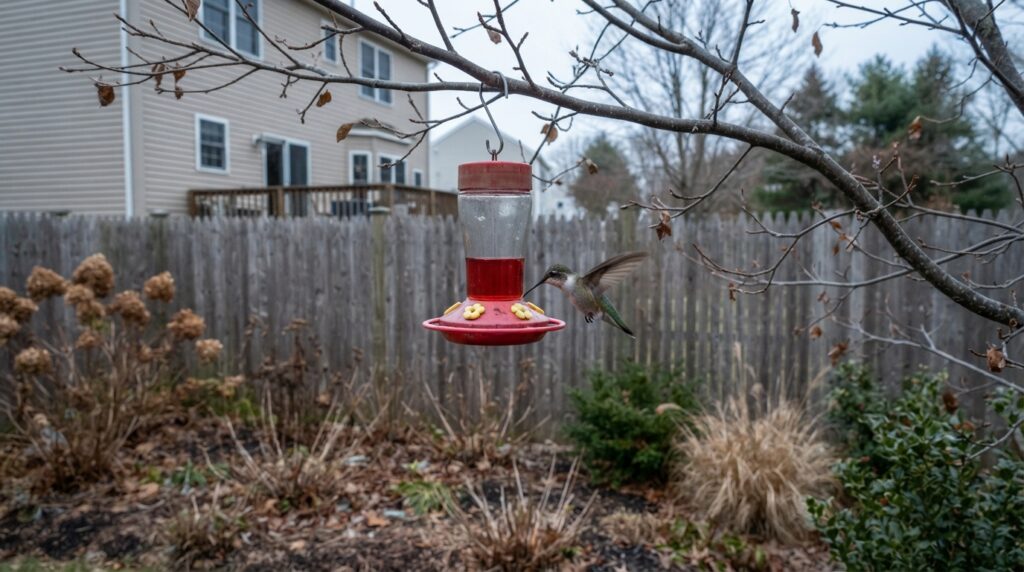
Leave the feeder up and keep the nectar from freezing. A hummingbird present in late fall or winter is not stranded and your feeder did not cause it to stay — migration is triggered by day length, not food. In the East it is often a western species that has wandered, which makes it a genuinely notable record worth reporting. On the Pacific coast, Anna’s Hummingbirds are simply resident.
Two things happen every November. People with a late hummingbird panic that they have trapped it by leaving the feeder up, and people take the feeder down out of a misplaced sense of duty, which is the one thing that actually makes the situation worse.
Neither reaction is necessary. Here is what is going on and what to do about it.
The essentials
- Your feeder did not make it stay. Day length triggers migration, not food supply
- Keep the feeder up and keep it usable
- Nectar freezes around 27°F. Rotate two feeders, or use a heated one
- Same 4:1 recipe. Do not make it stronger to “help it cope”
- Report it. In the East especially, this is a record worth having
- Pacific coast: normal. Anna’s Hummingbirds winter there routinely
Three different situations
| Where | What is likely happening |
|---|---|
| Pacific coast | Anna’s Hummingbird, a year-round resident across much of the coast and increasingly further north. Completely normal |
| Gulf Coast and Southeast | Small numbers overwinter, often western species — Rufous especially — that have wandered east |
| Northeast, Midwest, interior | A genuine vagrant. Usually a western species, most often Rufous. Uncommon and worth reporting |
In the East, a hummingbird at a feeder in December is not usually a Ruby-throated that failed to leave. Far more often it is a Rufous Hummingbird or another western species that has taken an unusual route. These birds breed as far north as Alaska and are considerably hardier than their size suggests.
The myth, dealt with properly
Leaving a feeder up does not prevent a hummingbird migrating. Migration is driven primarily by changing day length, an internal seasonal clock that food availability does not override. Cornell Lab states this plainly.
The practical consequence runs the other way: taking a feeder down in fall removes a fuel stop for late migrants that genuinely need it. Birds that linger do so for their own reasons — often because they are young, or in poor condition, or simply wired differently — and a feeder is the thing making their situation better rather than worse.
Keeping nectar liquid
Nectar freezes at roughly 27°F, a little below plain water because of the dissolved sugar. Below that the feeder is decorative.
Rotating two feeders is the simplest method and costs nothing beyond a second feeder. Keep one indoors thawing and swap them morning and afternoon. Hummingbirds feed heavily at first light after a cold night, so the priority is having a thawed feeder out before dawn.
Wrapping the reservoir with pipe insulation, a sock or bubble wrap slows freezing by an hour or two. Not enough on its own in hard cold.
A trouble light or outdoor-rated incandescent bulb clamped near the feeder is a long-standing method. Use an outdoor-rated fitting on a GFCI outlet and keep it clear of anything flammable.
Purpose-made heated feeders and feeder heaters exist and are the tidiest answer where winter hummingbirds are a regular thing.
Check whether the unit is thermostatically controlled and what temperature it is rated down to, and confirm it fits the feeder you already own if you are buying a heater rather than a complete feeder. Honest drawbacks: these need an outdoor-rated GFCI outlet and a cable run to the feeder, which constrains placement; they add a running cost through winter; and the cheaper ones run whenever plugged in rather than only when needed. For an occasional vagrant, two rotating feeders is the more sensible answer.
What not to change
Do not make the nectar stronger. The instinct to go to 3:1 or 2:1 “because it is cold” is understandable and it is not supported. Four parts water to one part plain white sugar remains the recommendation year-round. A heavier mix is thicker, harder to feed on, and places extra load on the kidneys of a very small bird.
It also freezes at a different point and behaves unpredictably in a heated feeder.
Still no red dye, no honey, no brown or raw sugar, no artificial sweeteners. Full recipe here.
Nectar still needs changing, though less often — cold slows fermentation considerably, so every five to six days is generally fine in winter. Change it immediately if it clouds.
How they survive the cold
Worth knowing, because it explains why the situation is less desperate than it looks.
Hummingbirds enter torpor overnight: a controlled state in which body temperature drops substantially, heart rate and breathing slow dramatically, and energy use falls to a fraction of normal. A bird in torpor is cold, unresponsive and can appear dead, and it takes twenty minutes or more to rouse.
If you find a hummingbird hanging upside down from a feeder on a cold morning, apparently lifeless, it is very likely in torpor. Leave it alone. It will warm up as the sun comes up.
They also shelter in dense evergreens, which is a reason to leave conifer cover standing near the feeder.
Report it
This is the part people skip and it is the most valuable thing you can do.
Winter hummingbird records, particularly east of the Rockies, are genuinely useful. Patterns in western species wintering in the East have only become clear because people reported birds at their feeders.
- eBird — submit a checklist. Photographs help considerably, since winter vagrants are often difficult to identify
- Your state bird records committee or local Audubon chapter — they will want to know, and they can often tell you what you have
- Licensed hummingbird banders operate in several states and specifically study winter vagrants. Local birding groups can usually put you in touch
Identification is a real challenge here. Rufous and Allen’s Hummingbirds are extremely similar, and immature birds of several western species overlap. Do not assume — photograph it and ask.
When to be concerned
A hummingbird that is feeding, alert and flying normally is fine, however cold it is. Contact a licensed wildlife rehabilitator if it is on the ground and unable to fly during the day, visibly injured, or has been touched by a cat — the bacteria in a cat’s mouth will kill a bird within days even from punctures too small to see.
A bird hanging motionless from a feeder at dawn is almost certainly in torpor. Do not handle it.
Common questions
Did my feeder stop the hummingbird migrating?
No. Migration is triggered mainly by day length, not food supply. Removing the feeder would not have sent it south and would have removed its fuel source.
Should I take the feeder down so it leaves?
No. That makes things worse. Keep it up, keep it thawed, and let the bird make its own decisions.
At what temperature does hummingbird nectar freeze?
Around 27°F, slightly below plain water because of the dissolved sugar. Below that you need rotating feeders, wrapping, a nearby heat source or a heated feeder.
Should I make the nectar stronger in winter?
No. Four parts water to one part plain white sugar all year. A stronger mix is harder to feed on and adds load to a very small bird’s kidneys.
I found a hummingbird hanging upside down and it looks dead.
Almost certainly torpor — an overnight state where body temperature and metabolism drop sharply. It can take twenty minutes or more to rouse. Leave it alone and let the sun do it.
What species is it likely to be?
On the Pacific coast, Anna’s, which is resident. Elsewhere, usually a western vagrant, most often Rufous. Photograph it and ask your local Audubon chapter — winter hummingbirds are difficult to identify and worth getting right.
Related guides
- When to put out and take down hummingbird feeders
- Hummingbird nectar recipe
- Best hummingbird feeders
- Heated bird baths and winter water
Sources: Cornell Lab of Ornithology, All About Birds and Birds of the World, on hummingbird migration triggers, torpor and Anna’s and Rufous Hummingbird species accounts; eBird winter distribution data; National Audubon Society; state bird records committees and licensed hummingbird banding projects studying winter vagrants in the eastern United States.
Setting up for hummingbirds?
A saucer feeder that dismantles fully is easier to keep clean than a larger bottle feeder, and cleaning matters far more than capacity. Look for no yellow parts, which draw wasps.
This link goes to Amazon. If you buy through it we may earn a small commission, at no extra cost to you.