
Affiliate disclosure: some links on this page go to Amazon. If you buy through one we may earn a small commission, at no extra cost to you. Full disclosure.
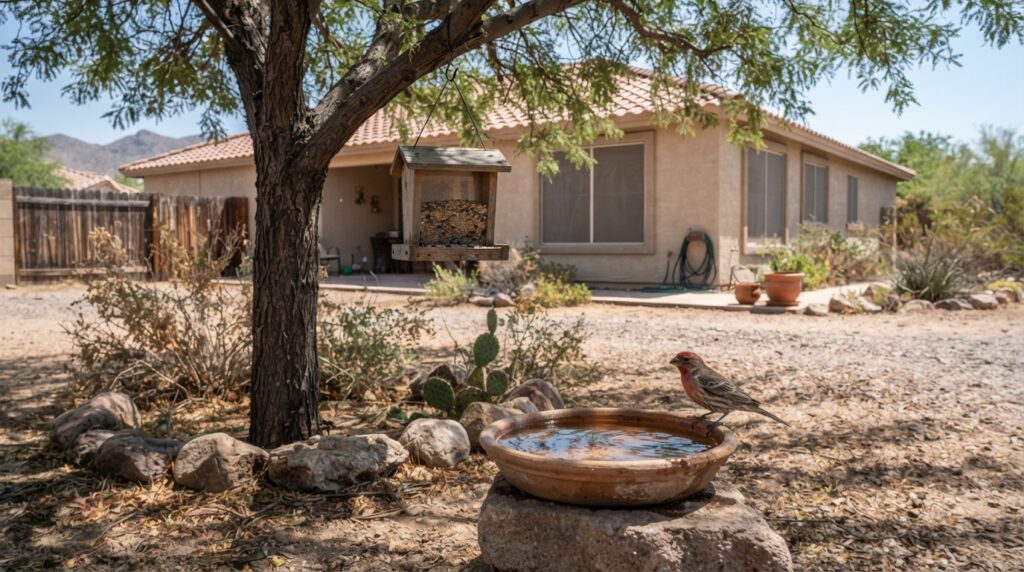
Water matters more than food here, and it is not close. A shallow ground-level basin refilled daily will bring in more species in a Sonoran Desert yard than any feeder. For seed, a ground or low platform feeder suits the birds that actually live here — quail, thrashers and towhees feed on the ground. Above 100°F, scale feeding back and put the effort into water and shade.
Bird feeding advice written for Ohio does not transfer well to Tucson. The species are different, the ground-feeding habit is far more pronounced, the heat imposes limits that do not exist elsewhere, and the single most valuable thing you can put out is a dish of water rather than a bag of sunflower.
This covers the low desert of southern Arizona, southern New Mexico and West Texas, with notes on where higher elevation changes things.
What is different here
- Water is the main event. In a landscape with almost no standing water, a basin is transformative
- Ground feeders dominate — quail, thrashers, towhees, doves
- Hummingbirds are a year-round proposition in much of the region, not a summer one
- Extreme heat changes the whole schedule from roughly May to September
- Native plants outperform feeders here more than almost anywhere
- Different unwanted visitors — javelina, rock squirrels, packrats
Who turns up
| Species | Where it feeds | Takes |
|---|---|---|
| Gambel’s Quail | Ground, in coveys | Cracked corn, millet, milo, sunflower |
| Curve-billed Thrasher | Ground and low platform | Seed, fruit, mealworms |
| Cactus Wren | Anywhere. Bold | Seed, suet, mealworms |
| Gila Woodpecker | Feeders, hummingbird feeders, fruit | Seed, suet, oranges, nectar |
| Gilded Flicker | Ground and trunks | Suet, ants, fruit |
| Verdin | Shrubs and hummingbird feeders | Insects, nectar |
| Abert’s Towhee | Ground, in cover | Millet, cracked corn |
| House Finch | Tube and hopper | Sunflower, nyjer |
| White-winged Dove | Ground and platform | Seed. Abundant in summer |
| Lesser Goldfinch | Nyjer feeders | Nyjer, sunflower chips |
| Phainopepla | Mistletoe berries, rarely feeders | Fruit. Water brings it in |
| Greater Roadrunner | Ground | Lizards and large insects, not seed |
Higher elevation changes the cast substantially. Above roughly 4,000 feet you start getting Acorn Woodpeckers, Mexican Jays, Bridled Titmice and Painted Redstarts, and in the sky islands of southeast Arizona the hummingbird list becomes one of the best in the country.
Water first
In most of the country a bird bath is a pleasant addition. Here it is the primary attraction.
- Ground level matters. Quail, thrashers and towhees will not use a pedestal bath. A shallow saucer or basin set on the ground gets far more use
- Very shallow. Under two inches at the edge, no more than three in the middle, with a rough base for grip. Add flat stones if it is glazed
- Deep shade if you can, under a mesquite or palo verde. Water in full desert sun is unusable by afternoon and evaporates fast
- Refill daily. Evaporation alone will empty a shallow basin in a day in June
- Scrub often. Warm water grows algae quickly
- A dripper or mister is the single best addition. Moving water carries much further in dry air, and hummingbirds fly through a mist rather than bathing in a basin
Check the fitting matches your outdoor tap thread before ordering. Honest drawbacks for this region in particular: a mister runs continuously unless you put it on a timer, which is a real consideration under drought restrictions, and hard water mineral deposits clog the fine nozzles — expect to soak them in vinegar periodically.
On water use. Much of this region is under long-term drought and municipal restrictions. A shallow basin refilled daily uses very little — far less than watering a lawn — but if you are on a strict schedule, a basin under a shaded drip line or positioned to catch condensate from an air conditioner is worth considering. Check your local rules rather than assuming.
Seed, and where to put it
The key difference is height. A large proportion of desert backyard birds are ground feeders, and a hanging tube feeder simply misses them.
| Feeder | Brings in |
|---|---|
| Ground or low platform | Quail, towhees, thrashers, doves. The most productive option here |
| Hopper or platform on a pole | Cactus Wren, Gila Woodpecker, House Finch, thrashers |
| Tube | House Finch, Lesser Goldfinch. Narrower audience than elsewhere |
| Nyjer feeder or sock | Lesser Goldfinch |
| Suet cage | Gila Woodpecker, Gilded Flicker, Cactus Wren — cool months only |
Milo is the exception here. Elsewhere on this site milo is filler that ends up on the lawn. In the Southwest, Gambel’s Quail and doves genuinely eat it, which is one of the few places a mix containing milo is defensible. White proso millet and cracked corn work for the same birds.
For everything else, black oil sunflower remains the best single seed. Full seed guide.
Summer: scale it back
From roughly May through September, low desert temperatures make several normal practices unwise.
- Plain suet comes down. It turns rancid above about 90°F and melted fat on feathers destroys their insulation. Detail here
- Hummingbird nectar every two days above 90°F, and above 100°F treat that as a maximum. Feeders in sun ferment faster still
- Seed in tiny amounts. Heat and the monsoon’s humidity spoil it fast, and moldy seed causes aspergillosis
- Ground feeding: only what gets eaten same day. Seed left overnight brings rodents and, in some areas, javelina
- Everything into shade. It matters more here than anywhere
Put the effort into water and shade instead. Feeding birds in extreme heat.
Hummingbirds are year-round
One of the best things about the region. Anna’s Hummingbirds are resident across much of it, Costa’s are present through the cooler months in the low desert, and Black-chinned breed widely. Rufous pass through on migration, and southeast Arizona gets species found almost nowhere else in the country.
That means a nectar feeder is a permanent fixture rather than a seasonal one, with the maintenance burden that implies — every two days in summer heat, every five or six in winter. Recipe and schedule.
Plant for them as well as feeding: chuparosa, ocotillo, penstemon, desert willow, agave and red yucca all work, use no water beyond what they would naturally get, and support the small insects hummingbirds need for protein.
Unwanted visitors
| Visitor | What to do |
|---|---|
| Javelina | Feed only what is eaten same day, never leave seed out overnight, store seed in sealed metal indoors. Never deliberately feed them — it is prohibited in parts of Arizona and creates dangerous animals |
| Rock squirrels and round-tailed ground squirrels | Baffled pole, safflower or hot pepper seed. Full approach |
| Packrats | Spillage is the draw. Catcher tray, daily sweeping, sealed metal storage. More here |
| Coyotes and bobcats | Drawn by the rodents and quail, not the seed. Keep pets in and do not leave pet food out |
| Africanized bees | A genuine consideration at water sources and hummingbird feeders. If a feeder is swarmed, take it down for several days rather than approaching it |
Common questions
What is the best way to attract birds in the desert?
Water, at ground level, in shade, refilled daily. In a landscape with almost no standing water it outperforms any feeder, and it brings in species that never touch seed.
How do I attract Gambel’s Quail?
Ground-level seed and ground-level water, with dense low cover nearby. They feed in coveys on the ground and will not use a hanging feeder. Cracked corn, millet and milo all work.
Is milo really acceptable here?
Yes, unusually. Quail and doves in the Southwest genuinely eat it, unlike feeder birds in the East and Midwest that discard it. It is one of the few regional exceptions to the usual advice.
Should I stop feeding in summer?
Scale it back sharply rather than stopping. Take plain suet down, offer tiny amounts of seed, change nectar every two days, and put the effort into water and shade.
Do I need to take hummingbird feeders down in winter?
No. Anna’s are resident across much of the low desert and Costa’s are present through the cooler months. Nectar feeders here are a year-round commitment.
Will feeding attract javelina?
Spilled seed can. Put out only what gets eaten the same day, never leave seed out overnight, and store it in sealed metal indoors. Deliberately feeding javelina is prohibited in parts of Arizona.
Related guides
- Feeding birds in extreme heat
- How to attract hummingbirds
- Best bird seed
- Mice and rats under the bird feeder
Sources: Cornell Lab of Ornithology, All About Birds species accounts and eBird regional abundance data; Project FeederWatch regional feeder bird data; Arizona Game and Fish Department guidance on feeding wildlife and javelina; Tucson Audubon Society and Audubon Southwest; University of Arizona Cooperative Extension; National Audubon Society Plants for Birds database.
Starting out?
One tube feeder with black oil sunflower brings in more species than any other single setup. Metal ports last; all-plastic ports get chewed open within a season or two.
This link goes to Amazon. If you buy through it we may earn a small commission, at no extra cost to you.