
Affiliate disclosure: some links on this page go to Amazon. If you buy through one we may earn a small commission, at no extra cost to you. Full disclosure.
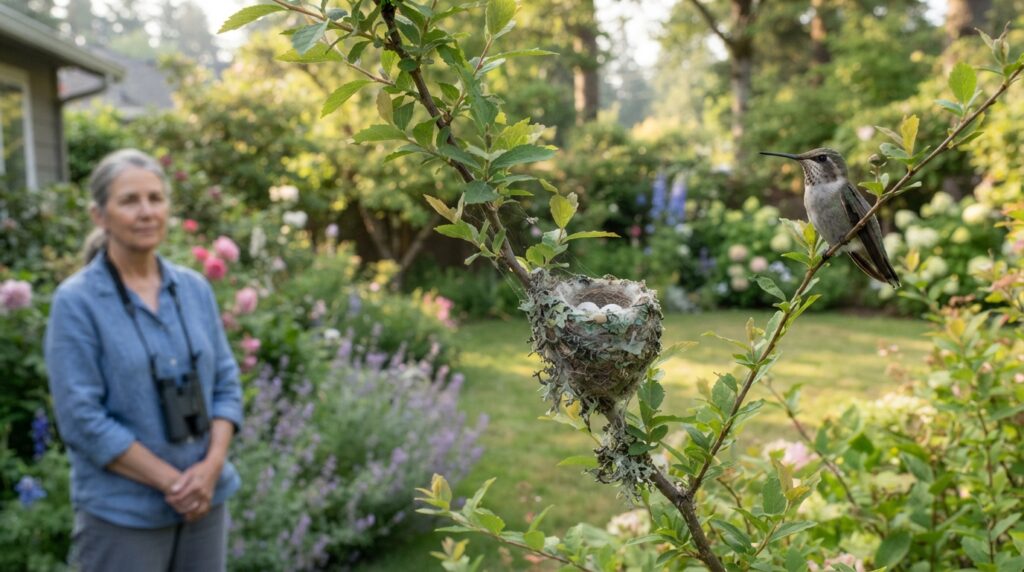
A hummingbird nest is a tiny cup about the size of half a walnut shell, usually saddled on a thin, downward-sloping branch and camouflaged with lichen so it looks like a knot. The female builds it alone, using spider silk that lets it stretch as the chicks grow. If you find one, watch from a distance and do not touch it: the whole cycle takes roughly five to six weeks, and nests, eggs and even empty nests are protected by federal law.
Most people who feed hummingbirds for years never see a nest. They are astonishingly small, extremely well hidden, and the female does everything she can to avoid leading anyone to them. Finding one is a genuine event — and the most useful thing to know when you do is how little you need to do about it.
The essentials
- About 1½ to 2 inches across — roughly half a walnut shell
- Built by the female alone, from plant down and spider silk
- Camouflaged with lichen to look like a knot on a branch
- Two eggs, each about the size of a navy bean
- Around 5 to 6 weeks from first egg to fledging
- Protected by federal law — including empty nests
What a hummingbird nest looks like
A neat, deep little cup, softer and more felt-like than any other backyard bird’s nest. It is usually saddled along the top of a thin branch that slopes slightly downward, often under a leaf canopy that sheds rain and shades the nest.
The outside is covered in flakes of lichen, bark or moss, which make it look like a small knot or bump on the branch. Many nests are found only because someone saw the female fly to what they thought was a knot.
| Feature | Typical |
|---|---|
| Size | About 1½–2 inches across, roughly an inch deep inside |
| Height | Often 10 to 40 feet up, but sometimes at eye level or lower |
| Site | Thin, downward-sloping branch, often under leaves. Occasionally wires, chains or strings of lights |
| Materials | Thistle and dandelion down, fern fuzz, spider silk, lichen |
| Eggs | Two, white, each about the size of a navy bean or small jelly bean |
The spider silk trick
The detail that makes hummingbird nests remarkable. The female binds the soft plant material together with spider silk, gathered from webs and wrapped around the structure.
Spider silk is sticky and elastic. It anchors the nest to the branch and holds the lichen on the outside, and because it stretches, the nest expands as the nestlings grow. By fledging time two young birds fill a cup that started out snug around two tiny eggs.
This is also one reason not to clear every spider web from your yard. Hummingbirds need them — and they eat small spiders and the insects caught in webs, which is where much of their protein comes from.
How to find one
Honestly, you mostly do not — you notice one by accident. But your chances improve if you:
- Watch where a female goes after feeding. Males take no part in nesting, so follow the plainer, green-backed birds without a colored throat
- Look for repeated flights to the same spot in a tree, especially with material in her bill in early spring
- Watch for a bird collecting spider silk or plant down — a strong sign building is underway
- Check thin branches near water, along woodland edges, and in trees with shelter overhead
- Use binoculars and keep your distance. A female that sees you watching may stay away from the nest
A nest is best watched from well back, which is exactly what binoculars are for. For watching a nest in your own yard, an 8x pair with good close focus is the useful choice. Honest drawbacks at budget prices: misaligned barrels cause eye strain within minutes, and many cheaper pairs cannot focus nearer than fifteen feet. What to look for.
The nesting timeline
These figures are typical of Ruby-throated Hummingbirds in the East; western species are broadly similar.
| Stage | Roughly how long |
|---|---|
| Building | About 6 to 10 days, sometimes less |
| Egg laying | Two eggs, laid a day or two apart |
| Incubation | About 12 to 14 days |
| Nestlings in the nest | About 18 to 22 days |
| After fledging | Fed by the female for about another week or so |
Start to finish, roughly five to six weeks. In the South and West, females often raise two broods in a season, sometimes building a new nest on top of or beside the old one.
What the nestlings look like
Newly hatched hummingbirds are dark, nearly naked and about the size of a bee, with short bills. For the first few days they are hard to see even in the nest. Over about three weeks they grow pin feathers, then real feathers, and their bills lengthen. Toward the end they sit side by side, peering over the rim, practicing wing-buzzing.
The female feeds them a slurry of nectar and small insects by pushing her bill down their throats. It looks alarming and is completely normal.
If you find one: what to do
- Leave it exactly where it is. Do not move it, even if the site seems poor
- Watch from a distance — a window or at least 15 to 20 feet away with binoculars
- Keep visits short and do not stand near it for long periods
- Do not trim the tree or shrub until the young have fledged
- Keep cats indoors. Fledglings on low branches are highly vulnerable
- Do not feed the nestlings or offer water. The female is almost always nearby, even if you do not see her
- Hold off on pesticides nearby — the female feeds her young insects
If a nest falls with young in it, a licensed wildlife rehabilitator is the right call. Hummingbird nestlings need specialized feeding that cannot be done at home, and sugar water alone will kill them. Your state wildlife agency lists licensed rehabilitators, and Animal Help Now at ahnow.org has a searchable directory.
Why you cannot keep an empty nest
Hummingbirds are protected under the Migratory Bird Treaty Act, and that protection covers the birds, their eggs, and their nests — including nests that are empty and clearly abandoned. Collecting or keeping one without a federal permit is illegal, however it was found.
Leave old nests where they are. Females sometimes reuse material from old nests, or build on top of them, and the lichen and silk are valuable to her.
Encouraging nesting in your yard
Hummingbirds do not use nest boxes, and there is nothing to build for them. What helps:
- Trees and shrubs with thin, sheltered branches — native deciduous trees especially
- Leave spider webs in quiet corners of the yard
- Plants that produce soft down — thistles, dandelions, cattails, native willows, ferns
- Native nectar plants so the female can feed close to the nest
- A clean, reliable feeder nearby — nesting females visit feeders briefly and often
- No pesticides — young hummingbirds are raised largely on insects
Skip the “nesting material” dispensers of cotton or synthetic fluff sold for hummingbirds. Cotton and dryer lint hold water, and synthetic fibers can tangle legs; natural plant down in the yard is what the birds actually use. How to attract hummingbirds.
Common questions
How big is a hummingbird nest?
About 1½ to 2 inches across — roughly half a walnut shell — and about an inch deep inside. The two eggs are each about the size of a navy bean.
How long do baby hummingbirds stay in the nest?
About 18 to 22 days after hatching, following around two weeks of incubation. The female keeps feeding them for about a week after they fledge.
Does the male help raise the young?
No. The female builds the nest, incubates the eggs and feeds the young entirely on her own.
Can I keep an empty hummingbird nest?
No. Nests are protected under the Migratory Bird Treaty Act even when empty and abandoned. Leave it in place — the female may reuse its materials.
I have not seen the mother. Is the nest abandoned?
Almost certainly not. She visits briefly and often, and she avoids the nest while people are watching. Watch from further away, or from inside, for an hour.
Do hummingbirds reuse nests?
Sometimes. A female may rebuild on an old nest or take materials from it for a new one, especially for a second brood.
Related guides
- How to attract hummingbirds
- One hummingbird is chasing all the others away
- Nestling or fledgling? Baby bird decision tree
- Binoculars for backyard birding
Sources: Cornell Lab of Ornithology, All About Birds, Birds of the World and NestWatch, Ruby-throated Hummingbird and western hummingbird species accounts including nest construction, clutch size and nesting periods; National Audubon Society; US Fish & Wildlife Service, Migratory Bird Treaty Act, on protection of nests; Animal Help Now rehabilitator directory.
Setting up for hummingbirds?
A saucer feeder that dismantles fully is easier to keep clean than a larger bottle feeder, and cleaning matters far more than capacity. Look for no yellow parts, which draw wasps.
This link goes to Amazon. If you buy through it we may earn a small commission, at no extra cost to you.