
Affiliate disclosure: some links on this page go to Amazon. If you buy through one we may earn a small commission, at no extra cost to you. Full disclosure.
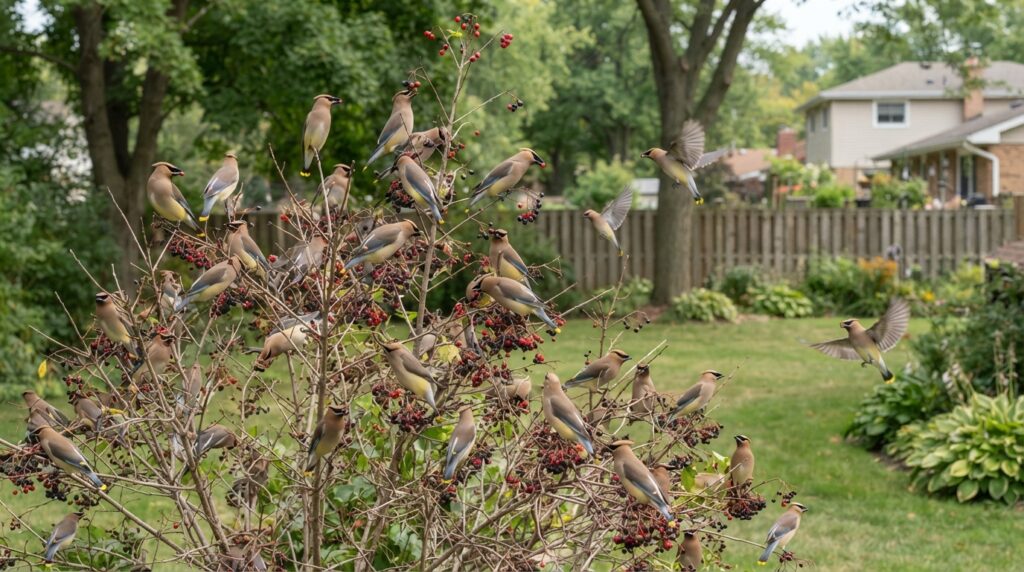
A flock of sleek, crested, tan birds with black masks and yellow-tipped tails that strips a holly, juniper or crabapple and then disappears is Cedar Waxwings. They’re one of the few North American birds that live mostly on fruit, so they wander in flocks from crop to crop. They don’t eat seed and won’t use your feeders. And yes, birds can get drunk: waxwings eating fermented berries have been documented flying into windows, sometimes fatally.
They arrive all at once, dozens of them, lined up along a branch. Within an hour your winterberry or serviceberry is bare, and they’re gone. Maybe you won’t see them again for weeks. Maybe they’re back tomorrow.
It’s one of the most beautiful sights a yard offers, and one of the most unpredictable, because Cedar Waxwings live by a completely different set of rules from the birds at your feeder.
The essentials
- Fruit specialists: can live on fruit alone for months
- Nomadic: flocks follow ripening fruit, not a fixed route
- Won’t eat seed. Attract them with berry-bearing plants and water
- Among the latest nesters in North America, timed to summer fruit
- Fermented fruit can intoxicate them
- Population: stable, about 64 million
How to recognize them
Cedar Waxwings are a little smaller than a robin, silky pale brown fading to gray on the wings, with a soft crest, a narrow black mask edged in white, a pale yellow belly and a tail tipped in bright yellow. Close up, many have small bright red tips on their wing feathers, like drops of sealing wax. That’s where the name comes from.
They’re easiest to find by ear: a thin, high-pitched whistle, almost a hiss, repeated constantly by the whole flock.
Cedar or Bohemian?
In the northern states in winter, check for the larger Bohemian Waxwing. According to Cornell Lab’s All About Birds, Bohemians have gray bellies and rich cinnamon under the tail, while Cedar Waxwings have yellowish bellies and white under the tail. Bohemians also have white patches in the wing. Audubon notes Bohemians breed in Alaska and western Canada and reach the northern US irregularly in winter, in some years as far as New England.
Why they strip a bush and vanish
Cornell calls the Cedar Waxwing one of the few North American birds that specializes in eating fruit, able to survive on it alone for several months. That diet drives everything else.
Fruit crops ripen in patches and don’t last, so waxwings can’t hold a territory the way a cardinal does. Instead, All About Birds describes big, unruly flocks that grow, shrink, split and rejoin, and Audubon notes their breeding and wintering areas can change from year to year depending on food supplies. A flock finds a loaded tree, eats it clean, and moves on.
The appetite is real. A USDA APHIS technical report on waxwings in agriculture cites early-season blueberry losses in Florida of 17% to 75%, mostly attributed to Cedar Waxwings.
What they eat through the year
| Season | Foods (per All About Birds) |
|---|---|
| Summer | Serviceberry, mulberry, dogwood, raspberries, strawberries, plus flying insects such as mayflies and dragonflies |
| Fall and winter | Eastern redcedar and juniper berries, mountain ash, honeysuckle, mistletoe, madrone |
USDA researchers note waxwings favor fruit with simple sugars such as glucose and fructose. In summer they also hawk insects over water, which is a lovely thing to watch at a pond or river at dusk.
The berry-passing trick
Audubon describes a line of waxwings on a branch passing a berry from bill to bill until one of them swallows it. Courting pairs do something similar, the male offering fruit, insects or flower petals to the female, according to All About Birds. If you see a flock lined up shoulder to shoulder, watch for it.
Can birds get drunk?
Yes, and waxwings are the best-documented case in North America.
All About Birds notes Cedar Waxwings occasionally become intoxicated, or even die, after eating overripe fruit that has started to ferment. The Missouri Department of Conservation says it usually happens in spring, when warming days ferment berries left over from winter, and that impaired birds fly into walls and windows.
The research. A 2012 study in the Journal of Ornithology by Kinde and colleagues examined several flocks of Cedar Waxwings in California that died after eating overripe Brazilian pepper tree berries. The birds had struck windows, plexiglass and fences. Ethanol was found in their intestinal contents and livers, and the authors concluded the birds died of trauma from flying while intoxicated.
Audubon has reported a similar event in Harris County, Texas, where about 50 Cedar Waxwings died along a road after a berry binge. In Canada, Bohemian Waxwings that ate fermented crabapples were found dead after hitting hospital windows.
You can’t stop fruit fermenting, but you can make windows safer, which protects every bird in the yard. The fix that works is marking the outside of the glass with dots or lines no more than 2 inches apart. How to stop window strikes.
Dot tape applied to the outside of large windows is the most reliable product fix for window strikes, if it’s spaced correctly. Honest drawbacks: it must cover the whole pane at 2-inch spacing, which takes time on a big picture window; it’s visible from inside, though less than you’d expect; and a few scattered hawk silhouettes, which many people buy instead, don’t work. Start with the windows nearest your berry shrubs.
Why some have orange tail tips
If you see a waxwing with an orange rather than yellow tail band, it’s not a different species. All About Birds says orange-tipped birds began appearing in the northeastern US and southeastern Canada in the 1960s.
Research by Mark Witmer, published in The Auk in 1996, traced the cause to non-native Morrow’s honeysuckle, whose berries contain a red pigment called rhodoxanthin. Birds eating the berries while their tail feathers are growing come out orange. Later work by Jocelyn Hudon and Robert Mulvihill links it to Tatarian honeysuckle and hybrids too, shrubs that were widely planted for wildlife in the 1960s and have since become invasive.
Why they nest so late
The USDA describes Cedar Waxwings as one of the latest-nesting species in North America, laying eggs from early June to early August, probably timed to the ripening of summer fruit. Their young are raised largely on fruit, which is rare among songbirds.
That diet has an odd side effect. All About Birds notes that Brown-headed Cowbird chicks raised in waxwing nests usually don’t survive, because they can’t develop on such a fruit-heavy diet. More on cowbirds.
How to attract waxwings
Feeders won’t bring them. Plants and water will.
- Plant native fruiting shrubs and trees. Cornell suggests dogwood, serviceberry, cedar, juniper, hawthorn and winterberry. A mix that ripens at different times gives flocks a reason to come back through the year
- Leave fruit on for winter. Winterberry, juniper and crabapple hold fruit into late winter, exactly when flocks are hungriest
- Add water. Cornell notes a bird bath brings in birds that never eat seed. Moving or dripping water is the strongest draw. Keeping a bird bath clean
- Choose natives over non-native honeysuckles, which are invasive across much of the East
Common questions
What birds eat all the berries at once?
Usually Cedar Waxwings, sometimes with American Robins. Waxwings travel in flocks and strip a fruiting tree or shrub quickly before moving on.
Do Cedar Waxwings come to bird feeders?
No. They eat fruit, and insects in summer, not seed. Berry-bearing plants and a bird bath are how to attract them.
Can birds really get drunk?
Yes. Waxwings eating fermented berries have been documented flying into windows while intoxicated, with ethanol found in their livers.
Why does this waxwing have an orange tail?
It ate berries of non-native honeysuckle while its tail feathers were growing. A pigment in the fruit turns the tail band orange.
What are the red tips on their wings?
Waxy red tips on some wing feathers. Their function isn’t fully known, but research suggests they signal age, since young birds have few or none.
Why do Cedar Waxwings disappear?
They’re nomadic, following fruit crops rather than keeping a territory. When a crop is gone, the flock moves on.
Related guides
- Why robins won’t eat from your feeder
- Why birds fly into windows and how to stop it
- Common backyard birds of North America
- How to keep a bird bath clean
Sources: Cornell Lab of Ornithology, All About Birds, Cedar Waxwing and Bohemian Waxwing accounts and species comparison, and “Attract birds with birdbaths”; National Audubon Society, Cedar Waxwing and Bohemian Waxwing field guides, and reporting on intoxicated birds (2011); Avery, M.L. and Duffiney, A., Cedar Waxwings, USDA APHIS Wildlife Damage Management Technical Series, 2016; Kinde, H. et al., Journal of Ornithology 153, 2012, on ethanol toxicosis in Cedar Waxwings; Witmer, M.C., The Auk 113(4), 1996; Hudon, J. and Mulvihill, R.S., North American Bird Bander; Mountjoy, D.J. and Robertson, R.J., The Auk 105, 1988; Missouri Department of Conservation.
Want a closer look?
A pair of 8x42 binoculars is the single thing that changes backyard birding most. Close focus matters more than magnification when the bird is fifteen feet away.
This link goes to Amazon. If you buy through it we may earn a small commission, at no extra cost to you.