
Affiliate disclosure: some links on this page go to Amazon. If you buy through one we may earn a small commission, at no extra cost to you. Full disclosure.
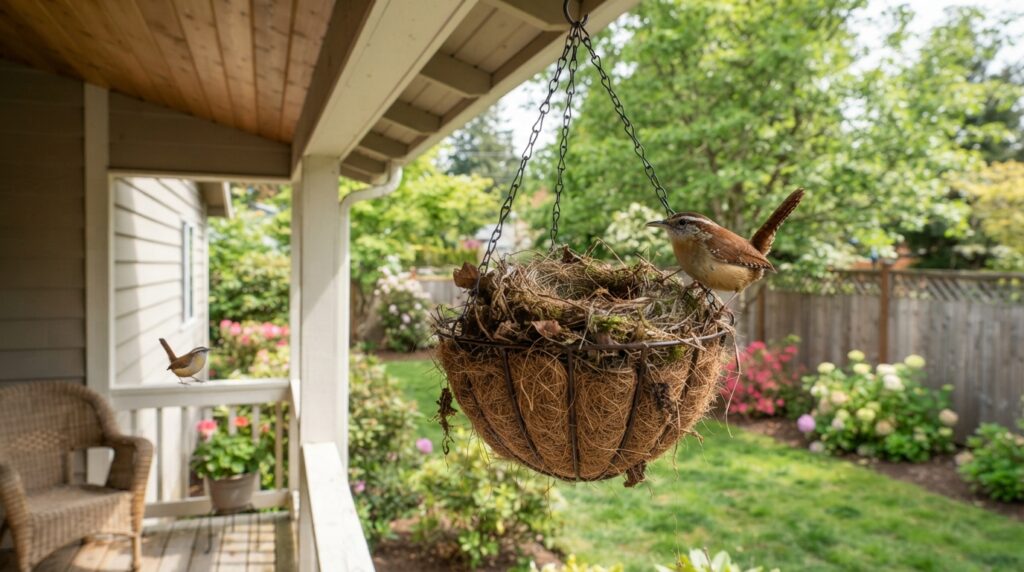
A bulky, domed nest with a side entrance tucked into a hanging fern, flower pot, mailbox or grill cover is very likely a Carolina Wren’s. Once there are eggs, leave it: the whole cycle is about four weeks, and the nest is protected by federal law. Don’t water over the nest. Water only at the soil edge, or at the roots, well away from it. After the young leave, you can clean up, though the pair may nest again nearby that same season.
Carolina Wrens are small, loud and unafraid of people, and they have a real talent for nesting in the one place you needed that week. The hanging basket by the front door. The mailbox. The pocket of a jacket left on the porch.
It’s rarely a problem for long, and with a couple of adjustments you can keep the plant alive and the nest going.
The essentials
- Nest: domed cup with a side entrance, often a little “porch”
- Eggs: usually 4 to 6
- Incubation: 12–16 days, by the female
- Nestlings: about 10–16 days in the nest
- Total: around 4 weeks from first egg to empty nest
- Up to 3 broods a year in the South
Is it a Carolina Wren?
The Carolina Wren is a round, cocked-tail little bird, rich reddish-brown above and warm buff-orange below, with a long white eyebrow stripe and a white throat. Cornell Lab’s All About Birds gives its length as 4.7 to 5.5 inches. The male’s song is a loud, ringing teakettle-teakettle-teakettle, surprisingly big for the size of the bird.
| Wren | Key differences |
|---|---|
| Carolina Wren | Bright reddish-brown, bold white eyebrow, buff-orange underneath. East and Southeast |
| House Wren | Duller gray-brown, faint eyebrow, barred wings and tail. Nationwide in summer; uses small-holed boxes |
| Bewick’s Wren | Gray-brown, bold white eyebrow, gray-white underneath, long tail with white spots. Mostly West; has virtually disappeared from the East |
The nest is a good clue too. All About Birds describes the Carolina Wren’s nest as a cup, usually domed, with a side entrance and often a woven extension like a porch or ramp, 3 to 9 inches long. Materials include bark strips, grass, leaves, pine needles and hair, and sometimes shed snakeskin, paper, plastic or string.
Why they pick such odd spots
Their natural sites are open, partly sheltered cavities 3 to 6 feet off the ground, in tree hollows, stumps and overhangs. Around houses, anything with a similar shape will do. Cornell and NestWatch list discarded flowerpots, mailboxes, propane-tank covers, a hanging fern, old coat pockets and boots. The Minnesota Breeding Bird Atlas adds outbuildings and abandoned nest boxes. Grill covers, garage shelves, bike helmets and watering cans all fit the pattern.
Building goes quickly. According to All About Birds, the male builds several nests, the female picks one, and the pair finishes it together. The first nest can take a week or more; later ones as few as four days. So if you see a wren carrying material into something you’re about to use, you have a short window to decide.
Before eggs: you can still say no
NestWatch says removing nest material by hand or with a hose is appropriate only in the early stages of building, before any eggs are laid. If you need that mailbox or grill in the next month, this is the moment: clear it out and close off the opening, or cover the item. The wren will simply build somewhere else.
Once there’s an egg, the nest is protected.
Once there are eggs: the law and the timeline
Carolina Wrens are protected under the Migratory Bird Treaty Act. The US Fish & Wildlife Service treats a nest as in use from the first egg until the young no longer depend on it, and destroying an in-use nest or relocating any nest requires federal authorization. NestWatch adds that active nests should never be moved, even a few feet, because the birds won’t recognize a moved nest.
| Stage | How long |
|---|---|
| Laying | Several days, usually 4 to 6 eggs in total |
| Incubation | 12–16 days, female only |
| Nestlings | 10–16 days, fed by both parents |
| Fledging | Young leave together, then stay near the parents for a while |
Clutch size varies by source: All About Birds gives 3 to 7 eggs, Audubon 5 to 6, and the Texas Breeding Bird Atlas generally 4. From the first egg to an empty nest, allow about four weeks.
How to water a hanging basket with a nest in it
This is the question everyone asks. NestWatch’s advice is clear: they generally recommend against watering planters with an active nest in them, because water can chill eggs quickly and wet nest material insulates poorly.
If the plant has to be watered:
- Use a watering can with a narrow spout, or a squeeze bottle, and deliver water directly to the soil on the side away from the nest, at the roots. NestWatch suggests tools that water the roots directly so water doesn’t pool near the nest
- Water in small amounts rather than a soak, so it doesn’t run through into the nest
- Water when the parent is off the nest, and move quickly
- Leave the basket hanging where it is. Don’t take it down to water it
You may lose some of the plant. Four weeks is short, and the basket can be replaced.
Other practical tips
- Mailbox: tape a note on it, or put up a temporary box beside it, and ask your carrier to leave mail there. Open the door gently and as little as possible
- Grill: don’t light it. Heat and smoke will kill eggs or chicks. Borrow one or plan on four weeks without
- Door wreath or porch planter: use another door for a few weeks if you can
- Pets: keep cats indoors; low nests in pots are within easy reach
- Don’t keep checking. A quick look now and then is fine, but frequent visits can lead predators to the nest
After the young leave
NestWatch recommends leaving the nest material in place during the breeding season, because the parents may raise another brood. All About Birds gives one to three broods a year, and Audubon notes up to three in the South. Once you’re sure the young have gone and no new eggs appear, you can clean out the basket or mailbox. An inactive nest can be removed without a permit, as long as you don’t keep it.
In Texas, the Breeding Bird Atlas records Carolina Wren egg dates from late February to mid-August, so in the South, “after the season” means late summer.
Give them a better option
If you’d rather they didn’t use your porch, put up a nest box nearby before spring. Standard nest box plans, including the one in our hole-size guide, use a 1½-inch entrance for Carolina Wrens, and Purdue Extension recommends mounting it 5 to 10 feet high. NestWatch’s own Carolina Wren design is roomier, with a 2½-inch opening, because these birds like partly open spaces. NestWatch notes the box can be attached to a building and can face any direction, and advises leaving it up in winter in colder areas, since the wrens roost in boxes.
A plain cedar box with a 1½-inch hole and a side or roof that opens for cleaning suits Carolina Wrens. Honest drawbacks: many boxes sold as “wren houses” have a 1-inch or 1⅛-inch hole sized for House Wrens, which is too small for a Carolina Wren, so check the listing; decorative boxes often lack drainage and ventilation; and a box is no guarantee. Wrens that like your hanging basket may still pick the basket.
Where Carolina Wrens live
They’re year-round residents across the eastern US and don’t migrate. All About Birds explains that mild winters in the mid-1900s let the range spread north, but northern populations drop sharply after severe winters, and Audubon describes the range edge advancing in mild years and being pushed back south by hard ones. Pairs can form any time of year and often stay together for life.
Common questions
Can I water my hanging basket with a wren nest in it?
NestWatch recommends against watering planters with active nests. If you must, water small amounts at the roots on the far side from the nest so none runs into it.
How long will the wrens be in my flower pot?
About four weeks from the first egg: 12 to 16 days of incubation and 10 to 16 days of nestlings.
Can I move the hanging basket?
Not once there are eggs. Moving a nest requires federal authorization, and the birds may not accept a nest that’s been moved.
Is it OK to remove the nest before eggs are laid?
Yes. NestWatch says removing material in the early building stages is appropriate. The wrens will build elsewhere.
Will they come back to the same basket?
They may nest again in the same season. Leave the nest in place until you’re sure breeding has finished for the year.
What size hole does a Carolina Wren box need?
Standard plans use 1½ inches. NestWatch’s design uses a larger 2½-inch opening to mimic the partly open sites they like.
Related guides
- Nest box hole sizes by species
- Birds nesting in your house, vents and chimney
- Nestling or fledgling? A decision tree
- Killdeer nesting in your driveway
Sources: Cornell Lab of Ornithology, All About Birds, Carolina Wren overview, identification and life history, and House Wren and Bewick’s Wren accounts; Cornell Lab, NestWatch Carolina Wren nest box page, FAQ, “Can I water my planter while a nest is in it?” and “To clean or not to clean”; National Audubon Society, Carolina Wren field guide; US Fish & Wildlife Service, “Bird nests” and Migratory Bird Permit Memorandum on nests (January 2025); Purdue Extension, FNR-246-W, nest boxes for wildlife; Texas Breeding Bird Atlas, Texas A&M University; Minnesota Breeding Bird Atlas.
Putting up a nest box?
The entrance hole diameter decides which species can use it and which cannot get in. Untreated wood, ventilation, drainage and a side that opens for cleaning are the four things to check.
This link goes to Amazon. If you buy through it we may earn a small commission, at no extra cost to you.