
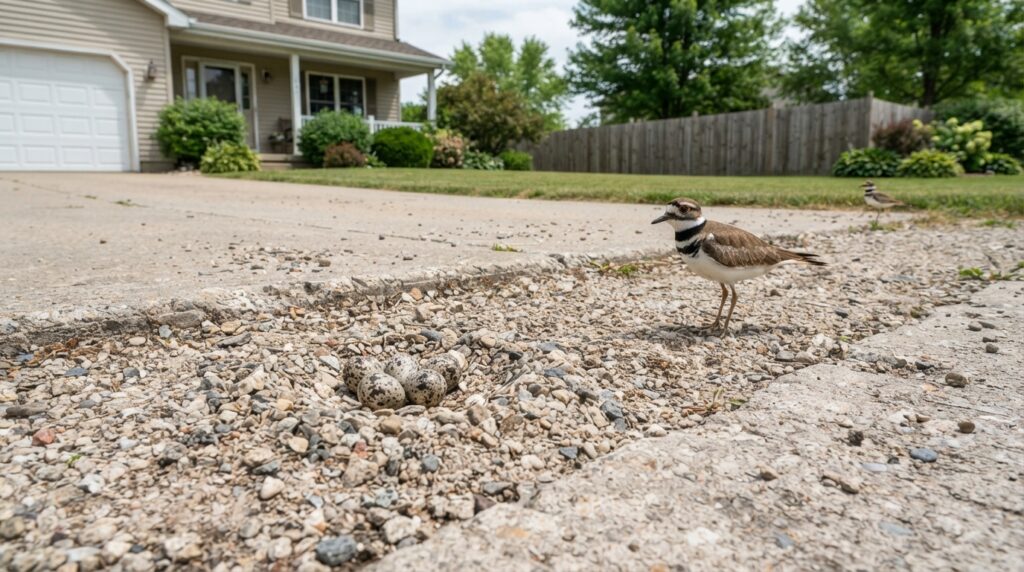
A brown-and-white bird with two black neck bands, screaming and dragging a “broken” wing across your gravel, is a Killdeer, and there are eggs nearby. Leave the nest where it is: moving it is illegal without federal authorization, and the parents won’t follow it. Mark the spot with cones, keep pets away, and park elsewhere for about four weeks. The chicks walk away from the nest within hours of hatching, and then the problem is over.
Of all the birds that nest near people, the Killdeer picks the most inconvenient spots. A gravel driveway, the edge of a parking lot, a baseball infield, a flat gravel roof. The nest is barely a nest, the eggs look exactly like the stones around them, and the first most people know of it is a bird running at them, crying, with one wing trailing on the ground.
The good news is that a Killdeer nest is temporary, and the timeline is short and predictable.
The essentials
- Eggs: usually 4, speckled buff, laid in a shallow scrape
- Incubation: about 22–28 days, shared by both parents
- Chicks leave the nest within hours of hatching, on foot
- First flight: about 25 days after hatching
- Protected under the Migratory Bird Treaty Act
- Don’t move it, not even a few feet
How to recognize a Killdeer and its nest
The Killdeer is a plover, a shorebird that has adapted to dry land. It’s about robin-sized but slimmer and longer-legged, brown above and white below, with two black bands across the chest and an orange rump that shows when it flies. Its call is a loud, shrill kill-deer, which is where the name comes from.
According to Cornell Lab’s All About Birds, the nest is a shallow depression scratched into bare ground, typically 3 to 3½ inches across, often on a slight rise. The birds may scrape several before choosing one, and after laying begins they often add pebbles, bits of shell, sticks or trash to it. On gravel, the result is nearly invisible.
Cornell lists lawns, driveways, athletic fields, parking lots, airports and golf courses among typical sites. The National Park Service adds gravel roads and stone-covered flat roofs. In short: open, flat, stony ground with a clear view all around.
The broken-wing act
When you get close to the nest, a parent runs ahead of you calling loudly, then drops to the ground with one wing held out and dragging, tail spread, as if injured. If you follow, it moves farther away and eventually “recovers” and flies off. It’s a lure, drawing predators away from eggs or chicks.
Cornell notes that Killdeer use a different tactic with cattle and horses, which are more likely to trample a nest than eat it: the bird puffs up, raises its tail over its head, and runs straight at the animal.
If you see the display, you’re close to the nest. The National Park Service advice is simple: leave the area. Look carefully where you step as you do, since the eggs are easy to crush.
The timeline
| Stage | How long | What you’ll see |
|---|---|---|
| Laying | Several days | One egg at a time, until the clutch is complete |
| Incubation | About 22–28 days | A parent sitting almost constantly; loud calling and wing-dragging if you approach |
| Hatching | Hours | Fluffy chicks with one black neck band, walking as soon as they’re dry |
| Leaving the nest | Same day | Parents lead the brood away, often toward damp ground |
| First flight | About 25 days after hatching | Young stay with parents nearby until then |
So from the day you find a full clutch, you’re looking at roughly three to four weeks of care around one spot. Once the eggs hatch, the nest itself is empty almost immediately. Killdeer chicks are precocial: Audubon notes they can run and feed themselves within hours, and the Texas Breeding Bird Atlas describes parents leading the brood off as soon as the last chick’s down dries.
In hot weather, the parents shade the eggs and soak their belly feathers to cool them, according to Audubon. A bird standing over the nest in midday sun is working, not abandoning it.
Why you can’t move the nest
Killdeer are protected under the Migratory Bird Treaty Act. The US Fish & Wildlife Service treats a nest as “in use” from the first egg until the young no longer depend on it, and says it’s illegal to destroy a nest with eggs or chicks in it. Its 2025 guidance memo goes further: relocating a nest also requires federal authorization, whether the nest is in use or not.
Beyond the law, it simply doesn’t work. NestWatch, the Cornell Lab’s nest-monitoring project, is explicit that active nests should never be moved, even a few feet, because the birds won’t recognize a nest that has been moved. You’d be trading a month of inconvenience for a failed nest.
Don’t pick up or relocate the eggs, however short the distance. There’s no authoritative guidance supporting it, and federal authorization is required for any nest relocation. If a nest is in a spot that creates a genuine safety problem, such as an active runway or a construction site, contact your state wildlife agency or the US Fish & Wildlife Service regional migratory bird permit office.
How to work around a nest in the driveway
- Mark it. Put traffic cones, stakes or flags in a wide circle around the nest so nobody drives or walks over it. At the University of Connecticut, facilities staff ringed a Killdeer nest with cones and netting, and all four chicks hatched
- Give it room. NestWatch advises giving nests plenty of space. The more often the parents are flushed, the more the eggs cool or overheat
- Park elsewhere or change your line. If the nest is in the middle of the drive, park on the street for a few weeks. If it’s at the edge, a marked detour may be enough
- Keep dogs and cats away. A dog on a leash, a cat indoors. Both will find a Killdeer nest faster than you did
- Pause the gravel work. Raking, grading, weed-killing and spreading new stone can all wait a month
- Tell the neighbors, delivery drivers and kids. A small sign on the cones helps
The parents will still scream at you every time you walk to the mailbox. That’s normal, and it doesn’t mean you’re causing harm, as long as you keep moving and don’t linger.
Killdeer on a flat gravel roof
Gravel roofs look like perfect nest sites to a Killdeer, but they can be a trap. All About Birds notes that chicks may be unable to leave a roof because of high parapets or screened drains, since they can’t fly for weeks after hatching. Chicks do sometimes jump: Cornell records a brood that survived a leap from a seven-story building.
If you manage a building with a nest on the roof, leave the nest alone, but plan ahead for hatching. When chicks appear and can’t get down, call a licensed wildlife rehabilitator or your state wildlife agency for advice before handling them. Animal Help Now, at ahnow.org, has a searchable directory of rehabilitators.
You found a chick on its own
A Killdeer chick is a ball of fluff on long legs with a single black neck band. Chicks scatter and freeze when a predator is near, so finding one alone usually means the parents are close by.
The Cornell Lab’s Celebrate Urban Birds project advises returning the chick to its family: chicks imprint on their parents and follow them closely, and a parent doing the broken-wing display nearby is a good sign of where they are. Hand-raised Killdeer chicks usually starve, so taking one indoors is almost never the answer.
If the chick is injured, bleeding, or the parents are clearly dead, the US Fish & Wildlife Service advises contacting a licensed rehabilitator. More on baby birds.
When and where it happens
Killdeer live year-round across much of the lower 48, according to the Missouri Department of Conservation. Northern birds migrate and, per Audubon, return as early as February or March.
- South and Texas: the Texas Breeding Bird Atlas records eggs by early March, with a peak in mid-April
- Southeast: the Alabama Department of Conservation gives April to July for egg-laying
- North: generally later spring into summer
Pairs often try more than once in a season. Cornell gives one to three broods, and the Texas atlas records as many as six nesting attempts in a season when nests fail. So if a nest is lost, don’t be surprised to find a new one nearby a week or two later.
Common questions
How long will the Killdeer nest be in my driveway?
Incubation takes about 22 to 28 days. The chicks leave the nest the same day they hatch, so expect three to four weeks from a full clutch.
Can I move a Killdeer nest a few feet?
No. Relocating a nest requires federal authorization under the Migratory Bird Treaty Act, and NestWatch advises that birds won’t recognize a nest that’s been moved, even a short distance.
Is the Killdeer really hurt?
Almost certainly not. The dragging wing is a distraction display to lead you away from the eggs or chicks.
Will the parents abandon the nest if I get close?
Brief disturbance is normal, and they’re used to it in the open places they nest. Repeated or prolonged disturbance lets eggs cool or overheat, so keep your distance and move on quickly.
Why do Killdeer nest on gravel?
They nest in open, flat, stony places with a clear view of approaching predators, and speckled eggs are camouflaged against the stones.
What do I do if the chicks are stuck on a roof?
Call a licensed wildlife rehabilitator or your state wildlife agency for advice. Chicks can’t fly for about 25 days and may be trapped by parapets.
Related guides
- I found a baby bird on the ground
- Nestling or fledgling? A decision tree
- Birds nesting in your house, vents and chimney
- Carolina Wren nesting in a hanging basket or mailbox
Sources: Cornell Lab of Ornithology, All About Birds, Killdeer overview and life history; Cornell Lab, NestWatch FAQ and Celebrate Urban Birds, on abandoned Killdeer chicks; National Audubon Society, Killdeer field guide and “10 Fun Facts About the Killdeer”; US Fish & Wildlife Service, “Bird nests,” “What to do if you find a baby bird,” and Migratory Bird Permit Memorandum on nests (January 2025); National Park Service, Mississippi National River and Recreation Area; Alabama Department of Conservation and Natural Resources; Missouri Department of Conservation; Texas Breeding Bird Atlas, Texas A&M University; UConn Today, University of Connecticut.