
Affiliate disclosure: some links on this page go to Amazon. If you buy through one we may earn a small commission, at no extra cost to you. Full disclosure.
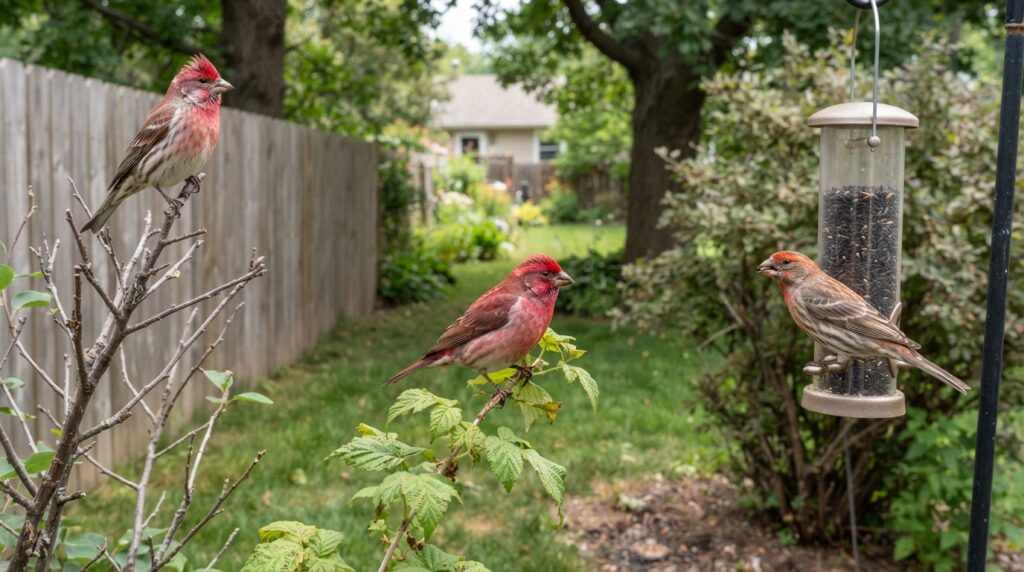
If you’re not sure, it’s probably a House Finch: they’re far more common at feeders. A male Purple Finch looks dipped in raspberry juice, with color across the head, back and wings and clean, unstreaked sides. A male House Finch is red mainly on the forehead, face and chest, with brown streaks down the flanks. Females are easier: a female Purple Finch has a bold white eyebrow and dark cheek, while a female House Finch has a plain, blurry face.
This is one of the most commonly misidentified pairs at American feeders, and in the West, Cassin’s Finch adds a third. All three are small, streaky, red-and-brown finches that eat the same seed from the same feeders.
The differences are consistent once you know where to look, and several of them work even at a quick glance through the window.
The fastest checks
- Female face: bold white eyebrow means Purple; a plain face means House
- Male color: red all over head and back means Purple; red mostly on face and chest means House
- Flanks: brown streaks on the sides point to House
- Bill: a short, curved, stubby bill means House
- Tail: deeply notched means Purple or Cassin’s
- Undertail: plain white is diagnostic of Purple
Which one are you likely to have?
Start with the odds, because they matter.
House Finch is one of the most common feeder birds in the country, present year-round in almost every lower-48 state. It’s originally a western bird. It was introduced to the East in the 1940s, when caged birds sold illegally as “Hollywood finches” were released on Long Island, and it spread across the entire eastern half of the continent.
Purple Finch breeds in coniferous and mixed forest across Canada, the Northeast, the upper Midwest and along the Pacific Coast, and moves south in winter. In much of the East and South, it’s a winter visitor that appears in some years and not others.
Cassin’s Finch is a bird of western mountains and conifer forests, from the Rockies to the Cascades and Sierra Nevada. Outside that range, it’s very unlikely.
| Where you are | Most likely |
|---|---|
| Southeast, Southwest, most cities | House Finch almost always |
| Northeast, Great Lakes, upper Midwest | House Finch; Purple Finch regularly, especially in winter |
| Pacific Coast | House Finch; Purple Finch in woodland yards |
| Western mountains | All three possible; Cassin’s at higher elevations |
Males
| House Finch | Purple Finch | Cassin’s Finch | |
|---|---|---|---|
| Red | Richest on the forehead, eyebrow and chest; varies from red to orange to yellow | Deep raspberry-purple over the head, back, wings and chest, like it’s been dipped in color | Bright red crown contrasting with paler pink face and throat |
| Flanks | Conspicuous brown streaks | Mostly clean, washed with pink | Fine, thin streaks |
| Back | Brown, streaked | Reddish, washed with color | Brownish with some pink |
| Head shape | Rounded, smooth crown | Fairly large; can look peaked | Large, often a peaked crest |
| Bill | Short and stubby, with a curved top edge | Short, conical | Longer, heavier, nearly straight on top |
| Tail | Longer, only slightly notched | Short, deeply notched | Short, deeply notched |
A yellow or orange male is a House Finch. Their color comes from pigments in their diet, and birds eating less of them turn out orange or yellow. Neither Purple nor Cassin’s Finches show this.
Females
Females are brown and streaky in all three species, and people often assume they’re sparrows. But the face pattern separates them quickly.
| House Finch | Purple Finch | Cassin’s Finch | |
|---|---|---|---|
| Face | Plain, blurry, no strong pattern | Bold: bright white eyebrow, dark cheek patch, white mustache stripe | Faint white eyebrow and mustache |
| Underparts | Dull white with thin, smudgy streaks | Bright white with thick, blurry streaks | Bright white with fine, sharp streaks |
| Undertail | Broad dark streaks | Usually plain white | Well-defined dark streaks |
The undertail tip. Project FeederWatch points out that a Purple Finch’s undertail coverts, the feathers under the base of the tail, are usually white and unstreaked. If you get a view from below, clean white under the tail is diagnostic of Purple Finch. It works on both sexes.
Voice
- House Finch: a long, rambling, warbling song that often ends with a buzzy, rising note
- Purple Finch: a rich, rapid, liquid warble; the call is a distinctive sharp “pik”
- Cassin’s Finch: a lively, varied warble that often mimics other birds
The free Merlin Bird ID app from the Cornell Lab can identify all three by sound and suggests species likely in your location on that date. It’s very helpful with this group.
Other birds that get mixed up with them
- Female House Finch vs House Sparrow: the sparrow has a plain gray-buff breast with no streaks; the finch is streaked all over. Small brown birds
- Red Crossbill: its crossed bill tips are unmistakable up close
- Pine Siskin: smaller, finer-billed, heavily streaked, with yellow in the wings
- Common Redpoll: a small red cap and black chin, a winter visitor in the North
What they eat at feeders
All three favor black oil sunflower, which is the best way to bring them in. House Finches also take nyjer and sunflower chips readily, and are one of the few species that will drink from hummingbird feeders.
A regional field guide, eastern or western, shows these three side by side with the key marks highlighted, which makes identification far easier than a national guide covering every species. Honest drawbacks: printed guides can’t show the variation of real birds as well as a series of photos, they don’t play songs, and the free Merlin app covers much of the same ground. A book is still easier to scan at a window.
A note on eye disease
House Finches are the main species affected by mycoplasmal conjunctivitis, a bacterial infection that causes swollen, crusty eyes and spreads at feeders. If you see a finch with swollen eyes, take feeders down and clean them. What to do.
Common questions
How do I tell a House Finch from a Purple Finch?
Males: Purple is raspberry-colored all over the head and back with clean flanks; House is red mainly on the face and chest with streaked brown flanks. Females: Purple has a bold white eyebrow; House has a plain face.
Why is my House Finch orange or yellow?
Its color comes from pigments in its diet. Males eating less of them come out orange or yellow. Purple and Cassin’s Finches don’t vary this way.
Are Purple Finches actually purple?
Not really. The color is a deep raspberry red. The name reflects an older use of “purple” for crimson.
Is the female finch at my feeder a sparrow?
If it’s streaked all over its breast and has a stubby finch bill, it’s a female finch. House Sparrows have plain, unstreaked breasts.
Where does Cassin’s Finch live?
In the mountains and conifer forests of the West, from the Rockies to the Cascades and Sierra Nevada. Outside that range it’s very unlikely.
Are House Finches native?
In the West, yes. Eastern birds descend from caged birds released on Long Island in the 1940s. They’re now protected under the Migratory Bird Treaty Act throughout the country.
Related guides
- Small brown birds: how to tell them apart
- Common backyard birds of North America
- House Finch with swollen, crusty eyes
- Best bird seed
Sources: Project FeederWatch, Tricky Bird IDs: Cassin’s Finch, House Finch and Purple Finch; Cornell Lab of Ornithology, All About Birds species accounts and species comparisons, and Bird Academy; National Audubon Society, House Finch or Purple Finch?; Cornell Lab of Ornithology, Birds of the World, on the introduction of House Finches to the eastern United States.
Feeding finches?
House and Purple Finches both favor black oil sunflower. A tube feeder with metal ports lasts far longer than an all-plastic one and is easier to disinfect.
This link goes to Amazon. If you buy through it we may earn a small commission, at no extra cost to you.