
Affiliate disclosure: some links on this page go to Amazon. If you buy through one we may earn a small commission, at no extra cost to you. Full disclosure.
Dump and refill the water every two or three days, and scrub the basin with a stiff brush once a week. For stains and buildup, scrub with one part white vinegar to nine parts water, or disinfect with one part bleach to nine parts water, then rinse very thoroughly and let it dry. Algae comes back fastest in full sun, so moving the bath into partial shade does more than any additive.
A bird bath is one of the most productive things you can put in a yard. It brings in species that never visit a feeder: warblers, robins, bluebirds, cedar waxwings. It’s also, if neglected, a green dish of algae, mosquito larvae and droppings that birds share beak to beak.
Keeping one clean takes five minutes a few times a week, and most of the effort is avoidable with better placement.
The routine
- Every 2–3 days: tip out the water and refill
- Weekly: scrub with a stiff brush
- As needed: vinegar for stains, dilute bleach for a full disinfect
- Rinse thoroughly after anything but plain water
- Partial shade slows algae more than any product
- Never add dish soap, antifreeze, salt or glycerine
Why bird baths get dirty so fast
Three things work against you.
Sunlight and nutrients feed algae. Droppings, feathers, pollen, leaves and seed hulls all add nutrients to the water. Put that in shallow water warmed by full sun and algae blooms within days.
Birds are dirty bathers. They drink from the same water they bathe and defecate in. Project FeederWatch points out that a bird bath can be as important a site for disease transmission as a feeder.
Standing water breeds mosquitoes. Mosquito larvae need roughly a week in still water to develop into adults. Change the water every few days and they never get the chance.
The routine, step by step
Every two or three days
- Tip out all the water. Don’t just top it up
- Give the basin a quick wipe or spray with the hose
- Refill with fresh water
This alone prevents mosquitoes breeding and keeps algae from getting a hold. A hose-end sprayer on a jet setting clears most loose debris in seconds.
Once a week
- Empty the bath
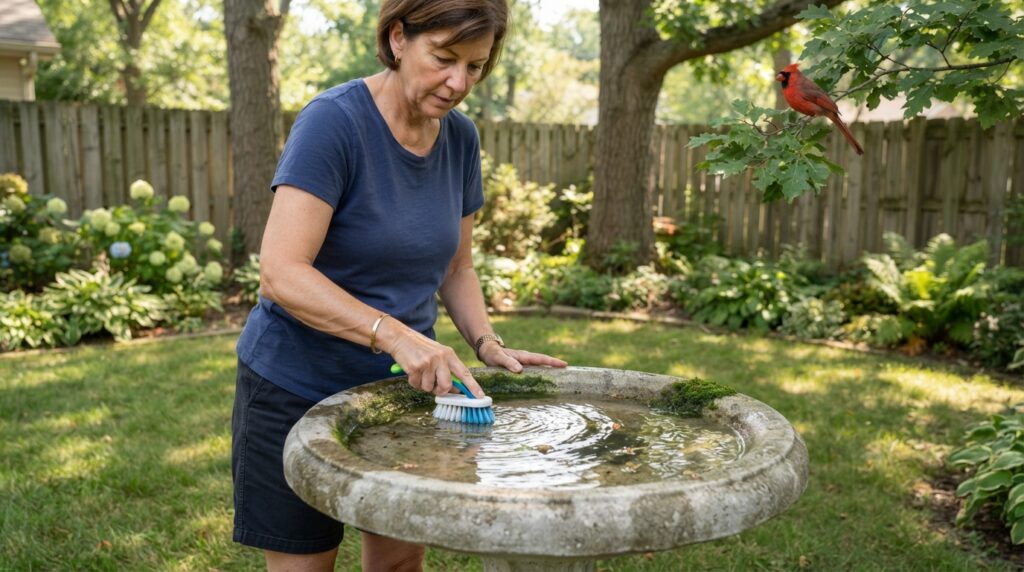
- Scrub the whole basin with a stiff-bristled brush, paying attention to the rim, where birds perch and droppings collect
- Rinse and refill
When stained or slimy
For mineral buildup or stubborn algae staining, scrub with a solution of one part white vinegar to nine parts water. Let it sit for a few minutes on heavy stains, scrub again, then rinse thoroughly.
For a full disinfection, such as after you’ve seen sick birds in the yard, Project FeederWatch recommends the same treatment as for feeders: one part household bleach to nine parts water. Scrub, let it stand about ten minutes, then rinse repeatedly until there is no smell of bleach, and let the basin dry before refilling.
Rinse properly after vinegar or bleach. Birds drink this water. Rinse until the smell is gone, then rinse again.
Never add anything to the water to keep it clean or ice-free. Dish soap strips the natural oils from feathers. Antifreeze is lethal. Salt is harmful to drink. Glycerine, sometimes suggested to stop freezing, coats and mats feathers. For winter, use heat instead.
A dedicated stiff brush with a long handle makes the weekly scrub quick. Keep it for the bird bath only, not the kitchen. Honest drawbacks: soft or nylon brushes don’t shift dried algae from textured concrete, wire brushes scratch glazed and resin basins (and scratches then hold algae), and a cheap brush with a short handle means kneeling on wet ground. A cleaning brush you already own will do.
Placement does most of the work
If your bath turns green within days of a scrub, the location is probably the problem.
| Change | Effect |
|---|---|
| Move into partial shade | The single biggest reduction in algae. Morning sun and afternoon shade is ideal |
| Away from feeders | Stops seed hulls and droppings falling in constantly |
| Away from overhanging trees in fall | Leaves add nutrients as they rot |
| About 10 feet from cover | Close enough for escape, not so close that cats can ambush |
| Add moving water | A dripper or small solar fountain slows algae and keeps mosquitoes away |
Moving water helps twice: algae grows more slowly in it, and mosquitoes won’t lay eggs in water that is disturbed. The sound of dripping water is also one of the strongest bird attractants there is. More on water for migrants.
What about the copper penny trick?
You’ll see it recommended widely: drop copper coins in the bath and the algae won’t grow. The idea has a basis, since copper ions are toxic to algae, but it doesn’t hold up well in practice.
- US pennies minted since 1982 are almost entirely zinc with a thin copper coating, so they release very little copper
- The amount of copper that dissolves from a few coins is small and inconsistent
- It does nothing about droppings, bacteria or mosquitoes, which are the real concerns
It’s unlikely to harm birds at that level, but it’s no substitute for changing the water. The same goes for most “bird bath protector” enzyme products: some may slow buildup, but none replace dumping the water every few days.
Materials and how they clean
| Basin | Cleaning notes |
|---|---|
| Concrete | Porous, so algae stains set in. Stiff brush and vinegar. Cracks if left full through a freeze |
| Glazed ceramic | Easy to wipe clean, but slippery for birds. Add a flat stone for grip. Cracks in freezes |
| Resin or plastic | Light, easy to empty, won’t crack. Scratches hold grime; avoid wire brushes |
| Metal | Easy to clean, but heats up fast in sun. Best in shade |
| Glass | Smooth and easy to clean, but slippery. Shows algae quickly |
A lightweight basin you can lift and tip out is far more likely to be cleaned regularly than a heavy pedestal bath. That practical point matters more than how it looks.
Common questions
How often should I clean a bird bath?
Change the water every two or three days and scrub the basin weekly. Clean more often in hot weather, and disinfect with dilute bleach if you see sick birds.
Is vinegar safe for cleaning a bird bath?
Yes, diluted one part vinegar to nine parts water, followed by a thorough rinse. It’s good for mineral stains and algae buildup.
Is bleach safe for bird baths?
Diluted one part bleach to nine parts water, it’s the disinfection method Project FeederWatch recommends, provided you rinse repeatedly until no smell remains and let the basin dry before refilling.
Do copper pennies stop algae?
Not reliably. Modern US pennies are mostly zinc, and the small amount of copper released has little effect. Changing the water does far more.
Will a bird bath breed mosquitoes?
Only if the water stands for about a week. Change it every two or three days, or add moving water, and larvae never develop.
Why does my bird bath turn green so fast?
Usually full sun plus nutrients from droppings and debris. Moving it into partial shade and away from feeders slows algae dramatically.
Related guides
- Heated bird baths and winter water
- How to clean bird feeders
- Feeding birds in extreme heat
- Sick birds at your feeder
Sources: Project FeederWatch (Cornell Lab of Ornithology), guidance on cleaning feeders and bird baths and disease transmission; Cornell Lab of Ornithology, All About Birds; National Audubon Society; US Centers for Disease Control and Prevention and university extension guidance on mosquito development in standing water; US Mint on the composition of the one-cent coin since 1982.
Cleaning day?
A brush set with a long flexible handle reaches the base of a tube feeder, which is the part that actually matters and the part a dishcloth never touches.
This link goes to Amazon. If you buy through it we may earn a small commission, at no extra cost to you.