
Affiliate disclosure: some links on this page go to Amazon. If you buy through one we may earn a small commission, at no extra cost to you. Full disclosure.
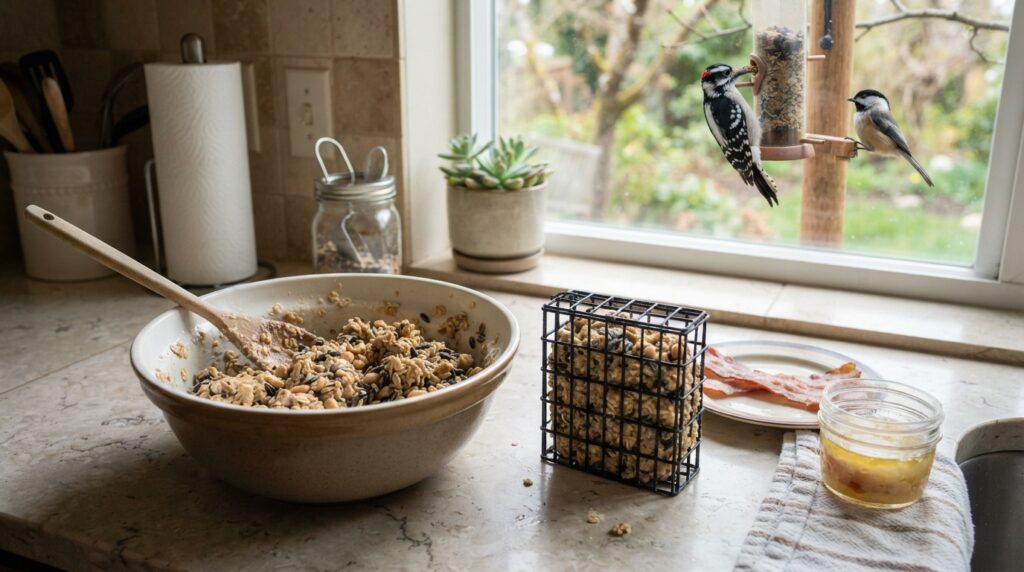
Melt 1 cup of lard with 1 cup of peanut butter, stir in 2 cups of quick oats, 2 cups of cornmeal and 1 cup of flour, press into molds and chill. The flour and cornmeal make it firmer and more heat-resistant than plain fat. Do not use bacon grease or other kitchen drippings: they carry salt and curing preservatives that concentrate when cooked. Serve it in cold weather, and keep it out of direct sun.
Making suet at home is one of the oldest bird-feeding traditions in the country, and it’s genuinely useful in winter, when fat is exactly what chickadees, nuthatches, woodpeckers and wrens need to get through a long night.
It’s also where a lot of well-meant mistakes happen, mostly involving whatever is left in the frying pan. Here is a recipe that works, and the reasons behind each ingredient.
The essentials
- Base fat: plain lard, or beef suet you render yourself
- Binders: cornmeal and flour make it firmer and less messy
- Never bacon grease or pan drippings
- No salt, no sugar, no bread, no meat scraps
- Cold-weather food. Take it down above about 70–80°F
- Size to fit your cage — standard cakes are about 4½ inches square
Why not bacon grease
It’s the most common question, and the answer is straightforward.
Bacon is cured with salt and preservatives, typically nitrites. Frying renders the fat out of the meat and leaves the salt and curing compounds behind in the drippings, more concentrated than they were in the bacon itself. The birding writers Kenn and Kimberly Kaufman advise against it for exactly this reason, as does much other guidance.
Small birds handle salt poorly. A food that makes up a large share of a chickadee’s winter calories is not the place for a salt load, however modest it looks to us.
The same reasoning rules out most kitchen fat:
- Bacon, sausage and ham drippings — salt and curing agents
- Roast drippings and gravy fat — salt, seasoning, and often onion and garlic
- Used cooking oil — stays liquid, soaks into feathers and destroys their waterproofing
- Butter and margarine — salted, soft, and they go rancid quickly
The recipe
Makes about 6 cakes, roughly 4½ inches square.
- 1 cup plain lard (check the label for no added salt)
- 1 cup peanut butter, crunchy or smooth — unsalted if you can find it
- 2 cups quick-cooking oats, uncooked
- 2 cups yellow cornmeal
- 1 cup plain flour
- Optional: ½ cup of hulled sunflower chips, chopped unsalted peanuts, or dried fruit such as raisins or cranberries
- Melt the lard and peanut butter together over low heat, stirring until smooth. Don’t let it smoke
- Take it off the heat and stir in the oats, cornmeal and flour until you have a thick, crumbly dough
- Fold in any optional extras
- Press firmly into molds. A square plastic food container, a silicone mold or a lined baking pan cut into squares all work
- Chill in the refrigerator until firm, about an hour, then store in the freezer
Many popular versions of this recipe add sugar. Leave it out: it adds nothing the birds need, and the Kaufmans list sugar among ingredients to avoid.
A square silicone mold makes cakes that slide straight into a standard suet cage, and the finished cakes pop out without breaking. Measure your cage before ordering; not every mold matches every cage. Honest drawbacks: cheaper silicone can hold a smell of fat after a few batches, and a food container you already own does the job almost as well.
Why the ingredients are there
| Ingredient | Job |
|---|---|
| Lard | Pure fat, the energy birds need in cold weather. Firm at cool temperatures |
| Peanut butter | Fat plus protein. Taken readily by woodpeckers, nuthatches and chickadees |
| Cornmeal and flour | Bind the fat so it crumbles rather than smears, and raise the temperature it softens at |
| Oats | Texture and carbohydrate. Must be uncooked — cooked oats go sticky |
The old warning that peanut butter makes birds choke has no good evidence behind it. Mixed into a firm cake with cornmeal, it’s a fine ingredient.
Rendering beef suet yourself
If you would rather use real suet than lard, ask a butcher for raw beef suet, the hard white fat from around the kidneys. It’s often cheap or free.
- Chop or grind it into small pieces
- Melt slowly over low heat until the fat runs clear and the solid bits shrink and brown
- Strain through cheesecloth or a fine sieve
- Let it cool and harden, then melt and strain it a second time
Rendering twice removes more of the impurities that make suet go rancid, so the cakes keep longer and stay firmer. Pure rendered suet softens at lower temperatures than a cornmeal-and-flour mix, so it’s strictly winter food.
When to serve it, and when not to
Homemade suet is a cold-weather food. In warm weather it softens and smears, and fat on feathers destroys their insulation and waterproofing, especially around the face, where birds can’t preen it out. Rancid fat is also a health problem in its own right.
As a working rule, serve it when daytime temperatures stay below about 70°F, keep it out of direct sun, and take it down in warm spells. Commercial no-melt dough is formulated for warmer weather; homemade versions generally aren’t. Suet in summer.
Offer it in a suet cage, smeared into the holes of a log feeder, or pressed into the scales of a large pinecone hung from a branch. The pinecone version is a good project with children.
Storage
- Freezer: wrapped individually, cakes keep for several months
- Refrigerator: a couple of weeks
- Outside in a cage: replace any cake that smells sour, looks darkened or greasy, or shows mold
Is homemade worth it?
Honestly, not always. Commercial suet cakes are inexpensive and consistent, and good ones are made from rendered fat with nothing harmful added. Making your own saves a little money if you get suet free from a butcher, and it lets you control exactly what goes in. But the main reason to do it is that it’s satisfying, not that it’s better for the birds.
If you buy, read the label: rendered beef fat or lard first, and no added salt. The cheapest cakes lean heavily on filler grains that birds pick out and drop. Suet and woodpeckers.
Common questions
Can I use bacon grease to make bird suet?
No. Frying leaves the salt and curing preservatives from bacon concentrated in the drippings. Use plain lard or rendered beef suet instead.
What is the easiest homemade suet recipe?
Melt 1 cup lard with 1 cup peanut butter, then stir in 2 cups quick oats, 2 cups cornmeal and 1 cup flour. Press into molds and chill.
Is peanut butter safe for birds?
Yes. The choking warning isn’t supported by evidence. Unsalted peanut butter mixed into a firm cake with cornmeal is a good ingredient.
Can I put homemade suet out in summer?
Not in warm weather. It softens, smears onto feathers and goes rancid. Serve it when daytime temperatures stay below about 70°F.
Which birds eat suet?
Woodpeckers, nuthatches, chickadees, titmice, wrens, and in some areas Bushtits and Yellow-rumped Warblers. Starlings love it too, which is what upside-down suet feeders are for.
How long does homemade suet last?
Several months in the freezer, a couple of weeks in the fridge. Outside, replace it as soon as it smells sour or looks greasy or moldy.
Related guides
- Suet in summer
- How to attract woodpeckers
- Can birds eat bread? Kitchen scraps that are safe
- Winter bird feeding in the Upper Midwest and Northeast
Sources: Kenn and Kimberly Kaufman, reader guidance on bacon fat and homemade suet published by Birds & Blooms; Cornell Lab of Ornithology, All About Birds and Project FeederWatch, on suet and feeding in cold weather; National Audubon Society; university extension guidance on rendering animal fat.
Putting out suet?
An upside-down suet feeder lets woodpeckers feed and largely defeats starlings, which will not hang inverted. It holds less than a standard cage.
This link goes to Amazon. If you buy through it we may earn a small commission, at no extra cost to you.