
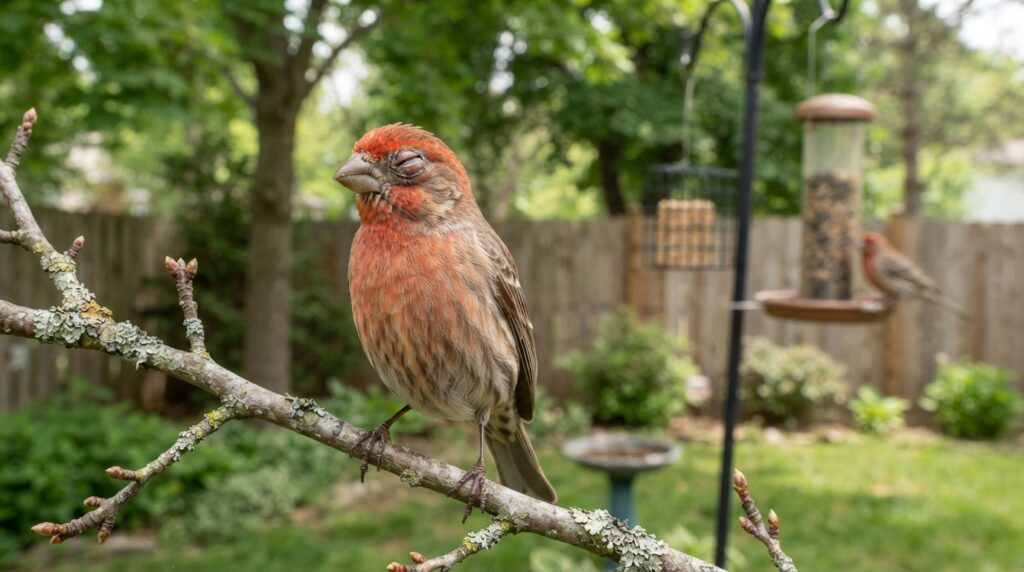
A finch with red, swollen, runny or crusted eyes almost certainly has House Finch eye disease, a bacterial infection called mycoplasmal conjunctivitis. It spreads at feeders. Take all feeders down for one to two weeks, disinfect them with a 1:9 bleach solution, rake up old seed beneath them, and report the sighting to Project FeederWatch. It poses no known risk to people.
It usually starts with one bird that looks wrong: a House Finch sitting still at the feeder, feathers fluffed, with one or both eyes swollen into pink lumps or glued shut with crust. Sometimes it barely reacts when you open the door.
This is one of the best-studied wildlife diseases in North America, largely because people who feed birds have been reporting it for over thirty years. That long record means there are clear answers about what it is and what helps.
The essentials
- Cause: the bacterium Mycoplasma gallisepticum
- Signs: red, swollen, runny or crusted eyes, sometimes swollen shut
- Mostly House Finches, also goldfinches, Purple Finches and grosbeaks
- Spreads at feeders, through contact with contaminated surfaces
- No known risk to people
- What helps: feeders down 1–2 weeks, disinfect, rake, report
What the disease is
Mycoplasmal conjunctivitis is caused by Mycoplasma gallisepticum, a bacterium long known as a respiratory pathogen of domestic poultry. In the winter of 1993–94, birders in Virginia and Maryland began reporting House Finches with swollen, crusted eyes. It was the first time the bacterium had been recorded causing disease in a wild songbird.
From there it spread rapidly through the eastern House Finch population, and over the following years reached as far as Quebec, Florida and California. Project FeederWatch participants documented its spread in near real time, which is one reason it became such a well-understood case of a wildlife epidemic.
The infection inflames the tissue around the eyes. In mild cases a bird has slightly red, watery eyes. In severe cases the eyes swell shut and crust over, and the bird is effectively blind.
Which birds get it
| Species | How often |
|---|---|
| House Finch | By far the most affected |
| American Goldfinch | Confirmed cases, less common |
| Purple Finch | Confirmed cases |
| Evening Grosbeak, Pine Grosbeak | Confirmed cases |
Project FeederWatch estimates that around 5 to 10 percent of the eastern House Finch population carries the disease at any time. That’s lower than during the epidemic years of the 1990s, and House Finch populations overall have stabilized.
Why it matters for the bird
The eye infection itself is rarely what kills a bird. A finch that cannot see well cannot find food efficiently, cannot spot a hawk or a cat, and struggles in cold weather. Death usually comes from starvation, predation or exposure.
Some birds do recover, particularly from milder infections. But according to Project FeederWatch, recovered birds do not gain lasting immunity and can be reinfected.
How feeders spread it
The bacterium passes between birds through contact with contaminated surfaces. A sick finch rubs its eyes on a feeder port or perch, and the next finch picks it up there.
Research by Virginia Tech scientists, who fitted wild House Finches with transmitter chips to record their feeder visits, found that the birds visiting feeders most often were the most likely to catch and spread the disease. Feeders do not cause the disease, but they concentrate birds and give it shared surfaces to travel on.
That’s why the useful responses all focus on the feeder.
What to do when you see a sick bird
- Take down every feeder and bird bath in the yard, not just the one where you saw the bird. Leave them down for one to two weeks. This gives sick birds a reason to spread out rather than keep meeting healthy ones at a single point
- Disinfect everything. Scrub off all debris, then soak for ten minutes in a solution of one part household bleach to nine parts water. Rinse thoroughly and let everything dry completely
- Rake and bag the ground beneath the feeders. Old seed, hulls and droppings hold contamination
- Wash your hands after handling feeders. The disease isn’t known to affect people, but droppings can carry other pathogens
- Report it (see below)
- When you put feeders back, clean them at least every two weeks from then on, and more often if you see another sick bird
Do not try to catch or treat the bird. Catching a wild bird causes serious stress, and House Finches are protected under the Migratory Bird Treaty Act. Home treatment with eye drops or antibiotics isn’t legal without a permit, and it doesn’t work in practice.
If a bird is so badly affected that you can pick it up, a licensed wildlife rehabilitator is the right call. Your state wildlife agency lists licensed rehabilitators, and Animal Help Now at ahnow.org has a searchable directory.
Feeder choices that reduce the risk
Some designs give the bacterium less to work with.
- Tube feeders with small ports limit how much of a bird’s face touches the feeder, compared with wide open trays
- Materials that can be disinfected — metal, glass and hard plastic. Wooden feeders are porous and cannot be properly sterilized
- Several spread-out feeders rather than one crowded one, so birds aren’t packed together
- Feeders that come fully apart, so you can reach every surface when cleaning
Full cleaning method in how to clean bird feeders.
Report what you see
Reports from people who feed birds are how this disease has been tracked since 1994, and they are still useful.
- Project FeederWatch collects disease observations as part of its regular counts, November to April. It asks participants to report whether they saw sick birds and when they didn’t, because the absences are data too. How to join
- eBird checklists can include a comment noting diseased birds
- Your state wildlife agency wants to hear about unusual numbers of sick or dead birds
How it differs from other feeder diseases
| Disease | Main signs | Most affected |
|---|---|---|
| House Finch eye disease | Swollen, crusty, runny eyes | House Finch, some goldfinches |
| Salmonellosis | Lethargy, fluffed feathers, sudden deaths, no eye symptoms | Pine Siskins, goldfinches, other finches |
| Avian pox | Wart-like growths on the bill, eyes, legs or feet | Many species |
| Aspergillosis | Labored breathing | Any, from moldy seed |
Growths around the eye are more likely pox than conjunctivitis. The response is the same for all of them: feeders down, disinfect, rake, report. Sick birds at your feeder covers the others in detail.
Common questions
Can humans catch House Finch eye disease?
There is no known health risk to people. It’s still sensible to wash your hands after handling feeders, because bird droppings can carry other pathogens.
Can my cat or dog catch it?
It isn’t known to infect cats or dogs. But a bird that cannot see is easy prey, so keep cats indoors, for the birds’ sake.
Can chickens catch it?
The same bacterium is a respiratory pathogen of poultry. If you keep backyard chickens, keep wild bird feeders well away from the coop and wash your hands between the two.
Will the sick bird recover?
Some do, especially from mild infections. Severe cases often die from starvation or predation because the bird cannot see. Recovered birds can be reinfected.
How long should feeders stay down?
One to two weeks. Clean everything before putting it back, then keep to a cleaning schedule of at least every two weeks.
Should I stop feeding birds altogether?
No. Take feeders down temporarily, clean them properly, and feed responsibly afterwards. Research indicates overall House Finch numbers remain stable.
Related guides
Sources: Project FeederWatch (Cornell Lab of Ornithology and Birds Canada), House Finch Eye Disease pages and FAQ; research by Virginia Tech scientists linking feeder visitation to disease transmission, reported by Project FeederWatch; Penn State Extension, House Finch Conjunctivitis; USGS National Wildlife Health Center; US Fish & Wildlife Service, Migratory Bird Treaty Act.