
Affiliate disclosure: some links on this page go to Amazon. If you buy through one we may earn a small commission, at no extra cost to you. Full disclosure.
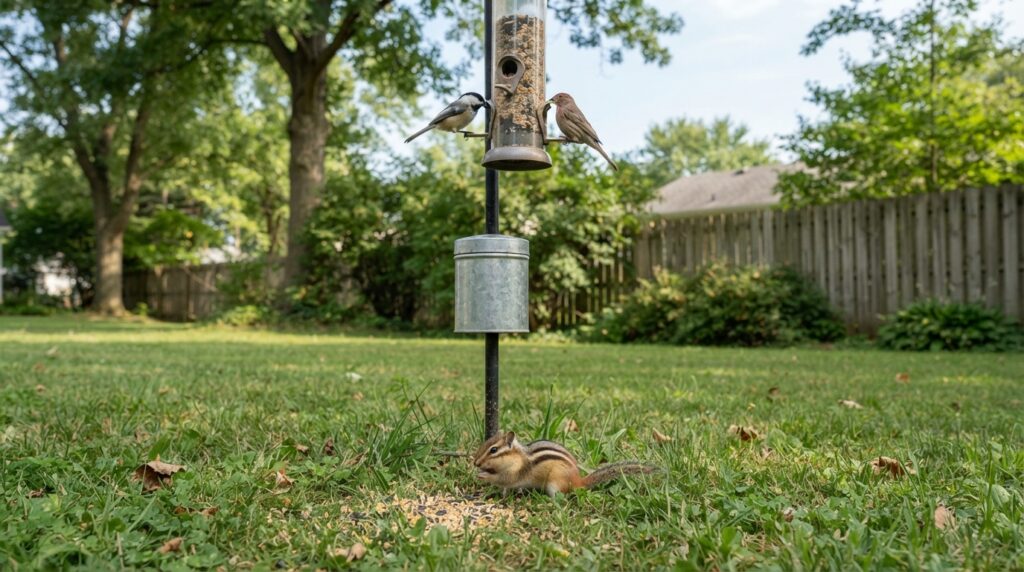
Chipmunks mostly work the ground, so the fix is mostly the ground. Stop seed falling with a catcher tray and hulled seed, sweep up daily, and mount feeders on a smooth pole with a baffle — chipmunks are smaller and weaker jumpers than squirrels, so a baffle stops them more reliably. Store seed in sealed metal. Do not poison them: it endangers the hawks, owls and pets that eat them.
Chipmunks are charming right up until you realize how much seed they are moving. Unlike squirrels, which eat as they go, chipmunks stuff their cheek pouches and carry food back to underground stores for winter, then come back for more. A single chipmunk working a busy feeder area can remove a surprising amount in a day.
The good news is that chipmunks are easier to defeat than squirrels, provided you deal with the right thing.
The essentials
- Chipmunks are hoarders, not just eaters — that is why seed vanishes fast
- They mostly feed on spilled seed on the ground
- Baffles work well — chipmunks jump and climb less than squirrels
- Hulled seed and catcher trays remove most of the draw
- Hot pepper seed deters mammals; birds cannot taste it
- Never poison. It kills the predators and pets that eat them
Why chipmunks empty feeders so fast
Eastern Chipmunks, the species in most eastern and midwestern yards, spend late summer and fall building a larder in an underground burrow system. They do not truly hibernate; they sleep through winter in bouts and wake periodically to eat from their stores. How well they survive depends on how much they have stashed.
A bird feeder is an extraordinary opportunity for an animal built for that. Each trip fills both cheek pouches, which stretch to several times the size of the head, and each trip ends underground. The pace picks up noticeably in September and October.
Out West, several related chipmunk species do the same, and golden-mantled ground squirrels — often mistaken for chipmunks — behave similarly.
Where they are getting the seed
Watch for ten minutes and you will usually find chipmunks working the ground under the feeder rather than the feeder itself. Birds drop and flick out a great deal of seed, and a reliable carpet of it on the ground is exactly what a chipmunk wants.
That tells you where to put the effort.
Stop the spillage
- A seed catcher tray under the feeder catches most dropped seed. Choose one wider than the feeder, with a mesh bottom for drainage
- Switch to hulled sunflower chips or a no-waste mix. Birds sort and flick far less when there are no shells to discard
- Avoid cheap mixes padded with milo, red millet and wheat — birds sweep them onto the ground and they become chipmunk food
- Sweep or rake daily while the problem lasts
- Fill small, so there is less to spill and less sitting out
These are the same changes that deal with mice and rats under a feeder, and for the same reason.
Baffles work better on chipmunks
Chipmunks can climb, but they are much smaller than tree squirrels and far weaker jumpers. A properly placed baffle stops them more reliably than it stops a determined gray squirrel.
- Smooth metal or PVC pole, not wood, not a textured shepherd’s hook
- A stovepipe or wide cone baffle below the feeder, at least four feet off the ground
- Away from launch points — fences, deck rails, low branches, planters, stone walls
- Nothing to climb beside the pole, including tall plants and ornaments
A stovepipe baffle — a wide metal cylinder around the pole — is the most dependable design for ground climbers. Check it fits your pole diameter. Honest drawbacks: it is bulky and not pretty, it does nothing about seed that has already fallen to the ground, and a pole placed within jumping distance of a fence or branch defeats it entirely. More on squirrel-resistant setups.
Hot pepper seed
Seed treated with capsaicin, the compound that makes chili peppers hot, deters chipmunks and squirrels strongly. Birds lack the receptors that register capsaicin as painful, so they eat it without noticing.
It works, and it is sold ready-treated. The real drawback is for you: capsaicin dust gets on hands and into eyes during refilling, and it is genuinely painful. Wear gloves, fill outdoors, and wash your hands afterward. It also costs more than untreated seed.
Storage
If you store seed in a garage or shed, a chipmunk may already have found it. Chipmunks chew through bags and plastic bins without difficulty. Use a metal container with a tight lid, raised off the floor, and check the building for gaps at ground level. More on seed storage.
What about burrows?
Chipmunk burrows are a common side complaint — small holes near patios, steps, walls and foundations. Burrows are generally modest, and serious structural damage is uncommon, but extensive tunneling under a patio or retaining wall can cause settling over time.
- Removing the food source reduces the population a yard supports over time
- An L-shaped footer of hardware cloth buried along a foundation or wall discourages burrowing there
- Reducing dense ground cover and stacked wood right against the house removes cover they like
What not to do
Do not use rodent poison. A poisoned chipmunk is eaten by hawks, owls, foxes, snakes and cats and dogs, and anticoagulant poisons pass up the food chain. Poisoning also puts the ground-feeding birds at your feeder at direct risk.
Do not use glue traps. They are inhumane and routinely catch birds, snakes and other animals.
Check your state’s rules before trapping or relocating. Chipmunks are not covered by the Migratory Bird Treaty Act, but state wildlife law on trapping and moving them varies widely. In many states relocation is illegal without a permit, and relocated animals usually die in unfamiliar territory while a new chipmunk moves into the vacancy.
Also skip mothballs, ultrasonic devices and predator urine. Mothballs are toxic and used outdoors in a way that is not legal under the product label; the other two have no good evidence behind them.
A note on perspective
Chipmunks do disperse seeds, aerate soil and feed a long list of predators, from Red-tailed Hawks to foxes. Most yards can live with a chipmunk or two once the ground is kept clean and the feeders are baffled — the goal is usually to stop them emptying the feeder, not to remove them entirely.
Common questions
How do I keep chipmunks out of my bird feeder?
Mount the feeder on a smooth pole with a stovepipe baffle, away from launch points, and stop seed reaching the ground with a catcher tray and hulled seed. Chipmunks mostly feed on spillage.
Can chipmunks climb bird feeder poles?
They can climb rough or textured poles and hooks. A smooth metal pole with a proper baffle stops them more reliably than it stops squirrels, since chipmunks are smaller and weaker jumpers.
Why are chipmunks taking so much seed?
They are hoarding. Chipmunks fill their cheek pouches and store food underground for winter, and the pace increases in late summer and fall.
Does hot pepper seed hurt birds?
No. Birds cannot sense capsaicin as painful. Mammals can, which is why it deters chipmunks and squirrels. Handle it with gloves — it is painful in your eyes.
Can I trap and move a chipmunk?
Check your state’s wildlife rules first; relocation is illegal in many states without a permit. It also rarely helps, because a new chipmunk moves in and the relocated one usually dies.
Are chipmunk holes a danger to my foundation?
Usually not seriously, though extensive burrowing under a patio or wall can cause settling over time. A buried hardware cloth footer discourages burrowing where it matters.
Related guides
- How to stop squirrels raiding your feeders
- Mice and rats under the bird feeder
- Weight-activated squirrel-proof feeders
- Best bird seed
Sources: Cornell Lab of Ornithology and Project FeederWatch on feeder placement, baffles and spillage; state wildlife agency and university extension guidance on Eastern Chipmunk biology, damage and control, including restrictions on trapping and relocation; US Environmental Protection Agency on rodenticide and mothball labeling; research on capsaicin and avian taste receptors.
Starting out?
One tube feeder with black oil sunflower brings in more species than any other single setup. Metal ports last; all-plastic ports get chewed open within a season or two.
This link goes to Amazon. If you buy through it we may earn a small commission, at no extra cost to you.