
Affiliate disclosure: some links on this page go to Amazon. If you buy through one we may earn a small commission, at no extra cost to you. Full disclosure.
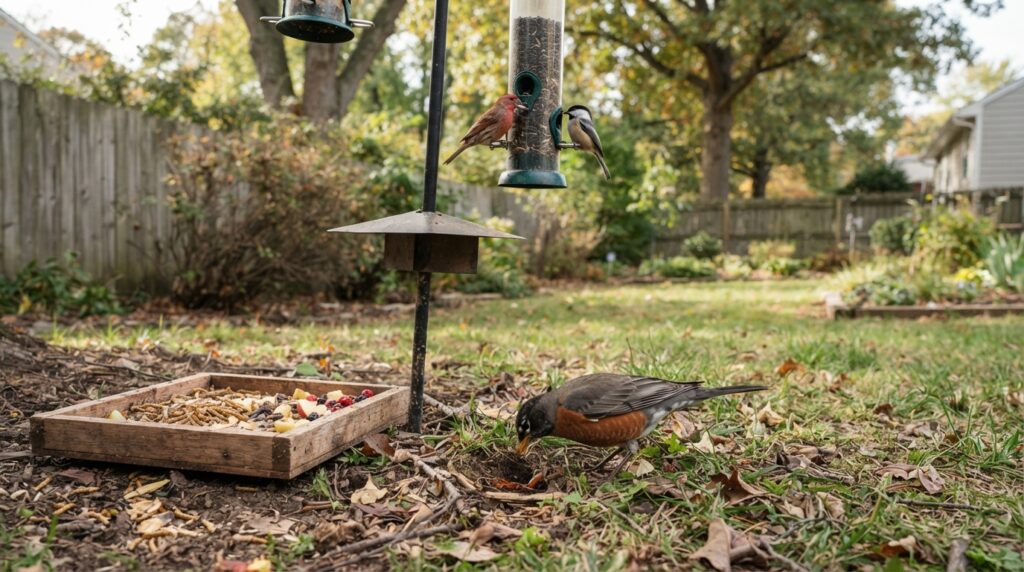
American Robins do not eat seed, so an ordinary feeder will never interest them. They eat earthworms and insects in spring and summer and switch to fruit and berries in fall and winter. To feed them, offer mealworms, chopped fruit or soaked raisins on a low platform, and water — a bird bath brings robins in more reliably than any food. And many robins never migrate at all: they stay through winter in flocks and simply stop hopping on lawns.
The American Robin is probably the most familiar bird in the country, and it produces two questions every year. In spring: why will robins not touch my feeder? In winter: where did the robins go, and why is there suddenly a flock of forty in the holly tree?
Both have the same answer. Robins live on a completely different menu from feeder birds, and that menu changes with the seasons.
The essentials
- Robins do not eat seed. Their bills are not built to crack it
- Spring and summer: earthworms, beetle larvae, caterpillars
- Fall and winter: fruit and berries
- Mealworms and fruit on a low tray work; seed never will
- Water is the most reliable draw of all
- Many never migrate — they flock and move to fruit
Why they ignore the feeder
Look at the bill. A cardinal or a finch has a thick, conical bill built to crack seed. A robin has a thin, straight bill built for probing soil and picking up soft food. Robins are members of the thrush family, and thrushes are not seed-eaters.
So it is not that robins have not found your feeder, or that they are shy of it. Sunflower, millet and nyjer simply are not food to them. No seed mix, however good, will change that.
What robins actually eat
| Season | Main diet |
|---|---|
| Spring | Earthworms, beetle grubs, caterpillars. The head-tilted lawn hunting everyone recognizes |
| Summer | Insects and worms, plus early fruit — serviceberry, mulberry, cherries |
| Fall | Increasingly fruit — dogwood, sumac, grapes, crabapple |
| Winter | Almost entirely fruit — holly, juniper berries, crabapple, hackberry, chokecherry |
That head tilt on the lawn, incidentally, is mostly about sight rather than hearing. Robins’ eyes sit on the sides of the head, so tilting brings one eye to bear on the ground. Research suggests they may also use hearing and touch, but sight appears to be the main tool.
How to feed them anyway
If you want robins at a feeding station, change the food and the feeder.
- Mealworms, live or dried and soaked, in a smooth-sided dish on a low platform. The most reliable food lure for robins. Detail on mealworms
- Chopped fruit — apple (seeds removed), pear, berries, halved grapes
- Raisins or currants, soaked in water first to soften. Keep them away from dogs, for which they are toxic
- Suet crumbles or no-melt dough in cold weather, on a tray rather than in a cage
- A low platform or ground tray, not a hanging feeder. Robins feed on the ground and rarely cling
Dried mealworms are the practical choice — they keep for months and need no refrigerating. Soak them in warm water for fifteen to thirty minutes before offering in nesting season, since young birds get most of their water from food. Honest drawbacks: starlings find mealworms fast and will clear a dish, rehydrated worms spoil within a day in warm weather, and robins are slower than bluebirds or wrens to learn to use a mealworm dish.
Water does more than food
A shallow bird bath brings robins in more reliably than anything you can put in a dish. Robins bathe often and enthusiastically, and in dry weather and hard freezes open water is scarce.
Keep it shallow — under two inches at the edge — with a rough base, refill daily and scrub it weekly. In winter, a heated bath is one of the few ways to reliably see robins up close in the cold months. Heated bird baths.
Where robins go in winter
Many of them go nowhere. The idea that the first robin on the lawn is the first sign of spring is a myth across much of the country. Robins are present year-round across most of the lower 48 states.
What changes is behavior. When the ground freezes and worms become unreachable, robins stop hunting on lawns and gather in flocks, sometimes large ones, in wooded areas with fruiting trees and shrubs. They are quieter, stay higher, and move around following fruit. People simply stop noticing them.
The robins that do migrate are mostly from the far north, and they move only as far as they need to find unfrozen ground and fruit. The “first robin of spring” is often a bird that spent the winter a few miles away, returning to its lawn once the ground thaws.
eBird maps make this vivid: robins are recorded across most of the country in January. A sudden flock stripping a holly or crabapple in February is a winter flock doing exactly this.
Planting for robins
Because robins live on fruit for half the year, planting does more for them than any feeder. Native fruiting trees and shrubs that hold fruit into winter are the most valuable:
- Winterberry and American holly — fruit persists deep into winter
- Eastern red cedar and other native junipers — berries and dense cover
- Serviceberry — early summer fruit, loved by robins
- Flowering and gray dogwood — fall fruit
- Native crabapples and hawthorns — fruit into winter
- Hackberry and chokecherry depending on region
Audubon’s free Plants for Birds database is searchable by zip code and gives a region-specific list.
Lawn chemicals matter more for robins than for most backyard birds, because robins eat the earthworms and grubs that live in treated soil. Pesticides and some lawn treatments can reach robins through their prey. Reducing chemical use on lawns is one of the most direct things a yard owner can do for them.
Robin nests
Robins build a sturdy cup of grass and mud, often on ledges — porch lights, gutters, window sills, the top of a downspout. The four pale blue eggs are the origin of “robin’s egg blue”.
If one is nesting somewhere awkward, it has to stay: robins are protected under the Migratory Bird Treaty Act and an active nest cannot legally be moved or removed. The cycle is short, roughly two weeks of incubation and two weeks in the nest. To steer future nests somewhere better, put up an open-fronted nest shelf under an eave in late winter — robins do not use enclosed boxes.
Young robins leave the nest before they can fly well and spend days on the ground being fed by their parents. That is normal. Nestling or fledgling?
Common questions
Do robins eat bird seed?
No. Robins are thrushes with thin bills built for soft food, not cracking seeds. They eat worms and insects in spring and summer and fruit in fall and winter.
What can I feed robins?
Mealworms, chopped fruit, soaked raisins, and suet crumbles in cold weather, on a low platform or ground tray. Water in a shallow bath is the most reliable draw of all.
Where do robins go in winter?
Many stay put. They stop hunting on frozen lawns and move into flocks around fruiting trees, where people stop noticing them. Robins are present across most of the lower 48 year-round.
Is the first robin a sign of spring?
Not really. It is usually a local bird returning to the lawn once the ground thaws, not a migrant arriving from far away.
Why is a robin attacking my window?
It is fighting its own reflection during breeding season. The fix has to go on the outside of the glass. Full detail.
Will robins use a birdhouse?
Not an enclosed one. They use open-fronted nest shelves mounted under an eave or on a sheltered wall. Put one up in late winter.
Related guides
- Mealworms for birds
- Heated bird baths and winter water
- Common backyard birds of North America
- Nestling or fledgling? Baby bird decision tree
Sources: Cornell Lab of Ornithology, All About Birds and Birds of the World, American Robin species account, including diet, winter behavior and foraging; eBird winter distribution data; Journey North robin migration studies; National Audubon Society and the Plants for Birds database; US Fish & Wildlife Service, Migratory Bird Treaty Act; university extension guidance on lawn pesticides and birds.
Starting out?
One tube feeder with black oil sunflower brings in more species than any other single setup. Metal ports last; all-plastic ports get chewed open within a season or two.
This link goes to Amazon. If you buy through it we may earn a small commission, at no extra cost to you.