
Affiliate disclosure: some links on this page go to Amazon. If you buy through one we may earn a small commission, at no extra cost to you. Full disclosure.
West of the Cascades, rain is the problem, not cold. Use roofed feeders with real drainage, fill small, and clean more often than the national two-week standard through the wet months. Keep a hummingbird feeder up all winter — Anna’s Hummingbirds are resident and depend on it in freezes. And when Pine Siskins arrive in numbers, watch closely for sick birds: the region has had serious salmonellosis outbreaks tied to feeders.
Western Washington, western Oregon and the coastal strip of northern California share a climate unlike anywhere else in the country: mild, gray and wet for most of the year, with short dry summers and occasional hard freezes that arrive with little warning. Advice written for the snowy Midwest or the humid Southeast misses almost everything that matters here.
This covers the lowlands west of the Cascades, with notes on where the dry east side differs.
What is different here
- Rain, not snow, is what ruins seed
- Anna’s Hummingbirds stay all year and need feeders kept thawed
- Pine Siskin outbreaks have forced feeder closures here before
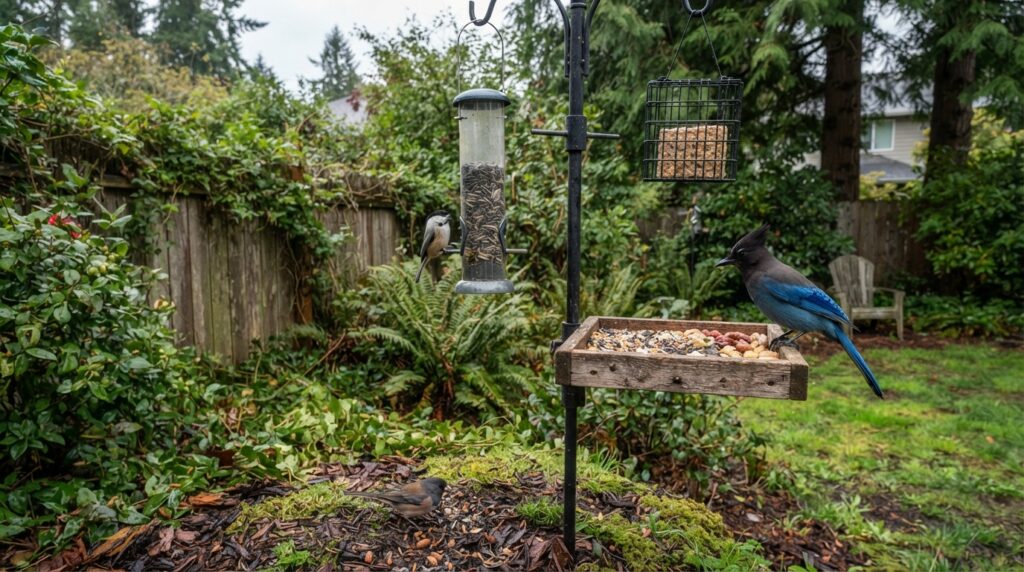
- A western species list — Steller’s Jay, Spotted Towhee, Varied Thrush
- Rats are a bigger feeder problem than in most regions
- Smoke season in late summer is now a regular event
Who turns up
| Species | Season | Takes |
|---|---|---|
| Anna’s Hummingbird | Year-round | Nectar, including through winter |
| Steller’s Jay | Year-round | Peanuts, sunflower, on platform |
| Dark-eyed Junco (Oregon form) | Year-round, busiest in winter | Millet and sunflower on the ground |
| Spotted Towhee | Year-round | Ground — millet, sunflower chips |
| Black-capped and Chestnut-backed Chickadee | Year-round | Sunflower, suet |
| Bushtit | Year-round | Suet, in chattering flocks of twenty or more |
| Red-breasted Nuthatch | Year-round | Sunflower, suet, peanuts |
| Northern Flicker (red-shafted) | Year-round | Suet, and ants on the lawn |
| Varied Thrush | Winter | Ground — fruit, millet, suet crumbs |
| Golden-crowned Sparrow | Winter | Millet on the ground |
| Pine Siskin | Irregular, sometimes abundant | Nyjer, sunflower chips |
| Rufous Hummingbird | Spring and summer | Nectar. Arrives as early as February |
Note how many of these feed on the ground. Juncos, towhees, Varied Thrushes and Golden-crowned Sparrows all want a low tray or a swept patch rather than a hanging feeder, which matters in a region where anything at ground level sits in the wet.
The rain problem
From October through May, seed in an open feeder does not stay dry. Wet seed clumps, sprouts and molds, and moldy seed causes aspergillosis, a fungal infection of the respiratory tract that is usually fatal to birds.
- Roofed feeders with a wide overhang, or a weather dome above a tube
- Mesh or screened bottoms on trays, never solid ones that pool water
- Fill small — a few days’ worth at most
- Empty the bottom inch of tube feeders at every cleaning, where wet seed collects
- Clean weekly through the wet season rather than every two weeks
- Raise ground trays an inch or two so they drain
- Store seed in sealed metal, indoors. A damp garage spoils a sack within weeks
A clear weather dome hung above an existing feeder is the cheapest single improvement for a wet climate, and it doubles as a squirrel baffle from above. Check the diameter is wide enough to actually shield the ports. Honest drawbacks: domes catch wind and set a hanging feeder swinging, they collect algae and need scrubbing, and they do nothing about rain blowing in sideways, which in a Pacific storm is most of it.
How to tell whether wet seed is still usable.
Anna’s Hummingbirds through winter
Anna’s Hummingbirds have expanded north over the last several decades and are now resident through the Puget Sound and Willamette Valley lowlands. Feeders are widely thought to have helped that expansion, which means many birds are genuinely relying on them in winter.
The hard part is the occasional freeze. Nectar freezes at roughly 27°F, and an Anna’s that finds a frozen feeder at dawn after a cold night is in real trouble.
- Rotate two feeders — one outside, one thawing indoors. Swap before dawn
- Wrap the reservoir with pipe insulation or a sock to buy an hour or two
- A clamp light with an outdoor-rated incandescent bulb near the feeder, on a GFCI outlet
- A purpose-made heated feeder if you get freezes every winter
- Keep to the 4:1 recipe. Do not make it stronger for the cold
A hummingbird hanging motionless from a feeder at dawn is almost certainly in torpor, an overnight energy-saving state, and will rouse as it warms. Do not handle it. More on winter hummingbirds.
Rufous Hummingbirds are the other species to plan for. They arrive remarkably early, often in February and March, and are aggressively territorial. Having a feeder up by mid-February catches the first arrivals.
Pine Siskins and salmonellosis
In the 2020–21 winter, a large Pine Siskin irruption brought a salmonellosis outbreak across the Pacific Northwest, and the Washington Department of Fish and Wildlife asked residents to take feeders down to slow it. Siskins crowding at feeders is exactly how the bacteria spread.
If siskins arrive in numbers: clean feeders at least weekly, spread birds across several feeders rather than one, and watch for birds sitting fluffed up, lethargic and easy to approach. At the first sign, take every feeder and bath down for one to two weeks and disinfect. Check your state agency for any current advisory. What to look for.
Rats and other visitors
Norway and roof rats are a common complaint in Seattle and Portland neighborhoods, and spilled seed on wet ground is ideal for them. The fixes are the usual ones applied more strictly: a seed catcher tray, hulled sunflower chips instead of whole seed, daily sweeping, feeders brought in at night, and sealed metal storage. Never rodent poison — it moves up the food chain into the Barred Owls and Cooper’s Hawks that hunt these yards. Full approach.
Raccoons are common and bold. In the foothills and on the east side, black bears are a real consideration, and both Washington and Oregon agencies advise removing feeders when bears are active. Detail.
East of the Cascades
The dry side is a different place: colder winters with real snow, hot dry summers, and a species list that leans toward the Mountain West — Black-billed Magpies, Cassin’s Finches, California Quail, Red Crossbills. Snow and ice guidance applies more than rain guidance there. Keeping feeders going in snow.
Wildfire smoke
Late-summer smoke from fires in the Cascades, British Columbia and California has become a regular feature of the region’s year. Birds go quiet and less active in heavy smoke. Keep feeders filled, keep clean water out and change it often — ash settles in it — and expect a quiet yard. What the research shows.
Common questions
Should I keep my hummingbird feeder up in winter in Seattle or Portland?
Yes. Anna’s Hummingbirds are resident and many rely on feeders through winter. Keep one up, and keep it thawed during freezes by rotating two feeders or using a heated one.
How do I keep bird seed dry in constant rain?
Roofed feeders or a weather dome, mesh-bottomed trays, small fills, and emptying the bottom inch at each cleaning. Clean weekly through the wet months rather than every two weeks.
What is the big orange-and-gray bird on the ground in winter?
Very likely a Varied Thrush, a winter visitor from the mountain forests. It looks like a robin with an orange eyebrow and a dark breast band. It feeds on the ground and is shy.
Are Pine Siskins a problem at feeders?
Not in themselves, but large siskin flocks are strongly associated with salmonellosis outbreaks. Clean weekly when they are around, and take everything down at the first sick bird.
What feeds the juncos and towhees?
Both are ground feeders. White proso millet and sunflower chips on a raised, mesh-bottomed ground tray, or scattered on a swept patch near cover.
When do Rufous Hummingbirds arrive?
Early — often February into March in the lowlands. Have a feeder up by mid-February to catch the first birds.
Related guides
- A hummingbird is still here in December
- Sick birds at your feeder
- Wet bird seed: can you still use it?
- Wildfire smoke and backyard birds
Sources: Cornell Lab of Ornithology, All About Birds species accounts and eBird regional abundance data; Washington Department of Fish and Wildlife guidance on the 2020–21 salmonellosis outbreak and on bears; Oregon Department of Fish and Wildlife; Project FeederWatch; Audubon Washington and Audubon Society of Portland (Bird Alliance of Oregon); USGS National Wildlife Health Center on salmonellosis and aspergillosis; published research on the northward range expansion of Anna’s Hummingbird.
Starting out?
One tube feeder with black oil sunflower brings in more species than any other single setup. Metal ports last; all-plastic ports get chewed open within a season or two.
This link goes to Amazon. If you buy through it we may earn a small commission, at no extra cost to you.