
Affiliate disclosure: some links on this page go to Amazon. If you buy through one we may earn a small commission, at no extra cost to you. Full disclosure.
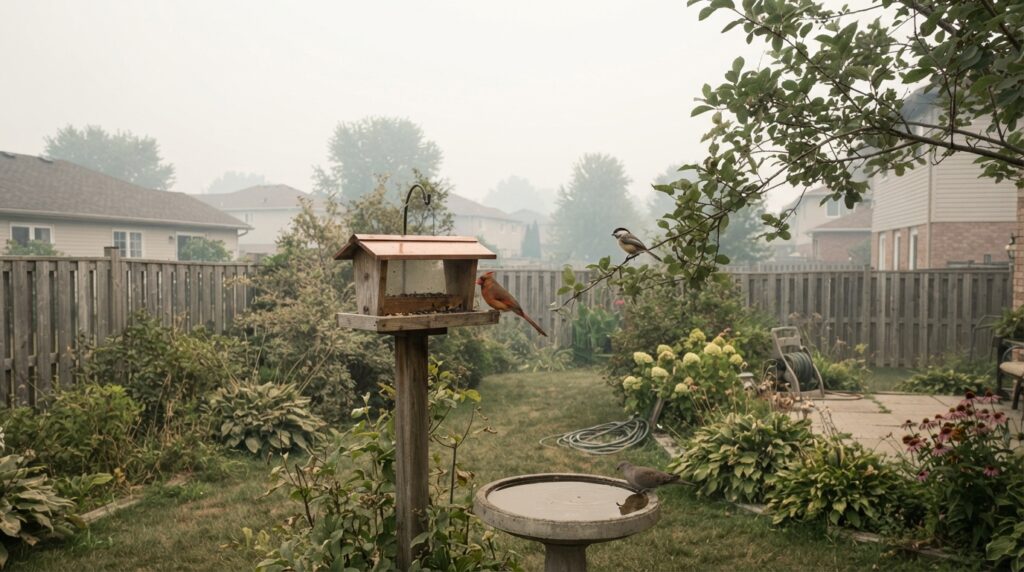
Birds are physiologically more exposed to smoke than we are, because their respiratory systems extract oxygen far more efficiently. In heavy smoke most songbirds become less active and stop singing, and your yard goes quiet. Keep feeders filled and provide clean fresh water — the leading hypotheses are that smoke tires birds out and fouls their feathers, which makes reliable food and clean water genuinely useful.
Smoke days have become a normal part of the year across much of the country — not only in the West, but in the Midwest, the Northeast and the Mid-Atlantic whenever Canadian smoke drifts south. And every time it happens, the same thing gets reported: the feeders go quiet.
This is one of the newer areas of ornithology, and the honest position is that research is still limited. But what exists is genuinely interesting, and considerably more useful than the guesswork that fills most pages on this subject.
What is known
- Birds are more exposed than people. Their respiratory systems are built for flight and extract more oxygen per breath
- Most songbirds go quiet in heavy smoke — less active, less vocal
- Not all species respond the same way. Some are seen more, not less
- Breeding is affected — new nest data shows delayed laying and reduced success
- Feeders and water may help, and that is an active research question rather than a settled one
- Research is limited. Anyone telling you this is fully understood is overstating it
Why smoke hits birds harder
Bird respiratory systems are built around the demands of flight. Air moves through in a one-way flow rather than in and out of dead-end sacs, which makes gas exchange dramatically more efficient than ours.
That efficiency cuts both ways. As researchers at the Cornell Lab have put it, a respiratory system that powers flight also means exposures capable of making a person ill will affect a bird. Smoke carries particulate matter and a range of gases and compounds, and birds take in proportionally more of it.
What smoke does to behavior
The clearest finding so far is that birds go quiet.
Cornell researchers studying grassland birds in New York during Canadian smoke outbreaks found reduced vocalizations, with the most pronounced effects in Bobolinks during an intense smoke event at the start of the breeding season. Savannah Sparrows and Common Yellowthroats were affected too. A separate study found similar reductions during an intense smoke outbreak in central and eastern Washington in 2020.
This matters more than it first sounds. Song is how territories are defended and mates attracted during breeding, so a bird that stops singing is not merely quieter — it is doing less of the work the season requires.
But not every species responds the same way. Olivia Sanderfoot, a research scientist at the Cornell Lab who studies this, has noted that while birds are generally less active and less likely to be observed in smoke, there are standouts — Tufted Titmice and Cedar Waxwings have been observed more frequently during smoke events.
One framework being explored for the variation is a “stay, shift, go” pattern: some species remain, some move locally, and some leave the area. Which strategy a species follows is not yet established.
Breeding and nesting
This is where the most substantial recent work sits. Analysis of a very large nest-monitoring dataset — on the order of 70,000 monitored nests of four widespread cavity-nesting songbirds across 2018 to 2025 — found that smoke strongly delays egg laying, and can extend both incubation and the nestling period.
More awkwardly, while smoke was associated with larger clutch sizes, in some species it was associated with markedly reduced hatching or fledging success. Laying more eggs and fledging fewer young is not a good trade.
The mechanism is not established, but the pattern points toward changes in adult behavior under smoky conditions — birds foraging less efficiently, provisioning young less, or spending less time on the nest.
There is a second-order problem too. Smoke appears to affect insect activity, and insects are what most songbirds feed their nestlings. A parent bird working harder to find fewer caterpillars, in worse air, is the situation that likely explains a good deal of this.
What to do in your yard
Guidance here is genuinely provisional. It is worth saying that plainly, because most pages on this subject present it as settled.
Two hypotheses under active investigation:
- Smoke fatigues birds and reduces foraging efficiency, which would make them more reliant on feeders
- Smoke particles foul feathers, which would send birds looking for clean water to bathe in
If either is right, the two useful things are food and water — and both are cheap, harmless and worth doing regardless.
During a smoke event
- Keep feeders filled. An easy meal is worth more than usual if foraging is harder
- Provide clean fresh water, and change it more often than usual — ash and particulates settle in it
- Clean feeders on schedule. Ash accumulates on trays and perches
- Keep cats indoors. Birds that are already stressed and less alert are easier caught
- Do not expect normal activity. A quiet yard is the documented response, not a sign you did something wrong
- Reduce other stressors — leave the leaf blower and the chainsaw for a clearer day
If you add one thing for fire season, make it water rather than another feeder. A shallow bath brings in species that never touch a feeder and covers both leading hypotheses at once. Depth is the specification that matters — under two inches at the edge, no more than three in the middle, with a textured base. Honest drawbacks: baths need scrubbing at least weekly in warm weather and more during a smoke event, concrete ones crack if left full through a freeze, and a bath in full sun evaporates fast in exactly the hot, dry conditions that come with fire season.
Longer term
Native planting is the more substantial answer, and it works on the underlying problem rather than the symptom. Native shrubs and trees support the insect populations birds actually feed their young on, and in fire-prone regions native species are generally better adapted to drought and fire than ornamentals are. Audubon maintains a free native plants database searchable by zip code.
If you want to contribute data
Project Phoenix exists specifically for this question. It is a community science program led by researchers at UCLA and the Natural History Museum of Los Angeles County, supported by Audubon Washington and other partners, and launched in 2023 to study how wildfire smoke and poor air quality affect bird behavior and distribution.
Participation is a ten-minute bird checklist once a week during fire season. It has grown quickly — from around 400 volunteers in its first year to nearly 2,000 — and it is built with beginners in mind, with workshops and bird walks for people new to identification.
Project FeederWatch data is being used on the same question, particularly for fires falling outside the normal fire season, such as the Southern California fires of January 2025.
A note on scale
Keeping a feeder filled through a smoke event is a reasonable thing to do and might help the birds in your yard. It is not a response to the underlying problem, which is a shifting fire regime driven by drought, heat and fuel loads.
Worth saying because the gap matters: the useful backyard actions here are native planting, water, and contributing observations to research. The rest of it is not a feeder question.
Common questions
Where did all my birds go during the smoke?
Most likely nowhere — they are less active and less vocal, which makes them much harder to detect. Research consistently finds reduced activity and reduced vocalization during heavy smoke.
Does wildfire smoke kill birds?
Smoke is known to cause health problems in birds, and their efficient respiratory systems make them more exposed than people. Direct mortality from smoke alone is hard to measure and remains an open research question.
Should I take my feeders down when it is smoky?
No. Keep them filled and clean. If smoke reduces foraging efficiency, a reliable food source is more useful than usual, not less.
Does smoke affect nesting?
Yes. Analysis of around 70,000 monitored nests found smoke delays egg laying and can extend incubation and the nestling period, with reduced hatching or fledging success in some species despite larger clutches.
Why do I see more birds at the feeder when it is smoky?
That happens too, and it is one of the things being investigated. Some species are observed more during smoke, and one hypothesis is that smoke tires birds and makes them more reliant on human-provided food and water.
How can I help with the research?
Project Phoenix collects ten-minute weekly checklists during fire season and is designed to be accessible to beginners. Project FeederWatch data is also being used on the same question.
Related guides
Sources: Cornell Lab of Ornithology, including research by Olivia Sanderfoot on smoke and bird behavior and studies of reduced vocalization in New York grassland birds and in Washington; Project Phoenix, led by researchers at UCLA and the Natural History Museum of Los Angeles County with Audubon Washington; National Audubon Society, including California wildfire and bird coverage and the Plants for Birds database; US Geological Survey; Project FeederWatch; published research on wildfire smoke and breeding outcomes in cavity-nesting songbirds.
Want a closer look?
A pair of 8x42 binoculars is the single thing that changes backyard birding most. Close focus matters more than magnification when the bird is fifteen feet away.
This link goes to Amazon. If you buy through it we may earn a small commission, at no extra cost to you.